Trying scuba diving in Sardinia for the first time
Can you scuba dive in Sardinia without a certification?
Yes. Nearly every dive centre on the island runs a 'try-dive' or 'discover scuba' programme for complete beginners, usually a short briefing in shallow water followed by a guided dive to 5-8m with an instructor holding onto you the whole time. No prior experience or swimming test is required, just a signed medical form.
Sardinia’s water is clear enough, most of the year, that a first dive here tends to stick in the memory longer than the certification card you get afterwards. You don’t need to be a swimmer of any particular ability, you don’t need previous experience, and you don’t need to commit to a multi-day course. What you need is a dive centre willing to take a complete beginner into shallow water for an hour, which on this island is most of them — the try-dive is a standard product, not a niche one, from Alghero and Capo Caccia in the northwest to Villasimius in the south.
| What it is | A supervised introductory dive to roughly 5-8m depth, no certification needed |
| Cost | €70-120 per person for a single try-dive, including full equipment |
| Time needed | Half a day: briefing, kit fitting, boat or shore entry, one dive of 25-40 minutes |
| Where | Alghero and Capo Caccia are the busiest beginner hubs; Cagliari and Villasimius also run them |
| Best time | June to September for warm water (22-26°C); a wetsuit is provided year-round |
What actually happens on a try-dive
A try-dive is not the same thing as an open-water certification course, and dive centres are careful to keep the two separate. You’ll fill in a short medical questionnaire, get fitted for a wetsuit, mask, fins and a buoyancy jacket, and then spend 15-20 minutes on land or in shallow water going through hand signals, how to clear your mask, and how to breathe through a regulator without panicking at the strange sensation of air on demand.
From there an instructor takes you down — usually one instructor per one or two guests — holding your arm or your buoyancy jacket for the entire dive, so there’s no expectation that you control your own depth or buoyancy. Alghero’s try-dive operators run exactly this format from the harbour, with the boat ride out to Capo Caccia itself part of the experience:
Try-dive for beginners in Alghero, no certification requiredMost first dives stay in the 5-8m range, deep enough to feel like real diving — fish, rock formations, the occasional octopus tucked into a crevice — but shallow enough that ears equalise easily and a rushed ascent carries no real risk. Expect the underwater portion to last 25-40 minutes, less if you’re using air quickly through nerves, which is completely normal and nothing instructors haven’t seen a hundred times before.
Where beginners dive on the island
Alghero and the Capo Caccia headland form the busiest hub for first-timers, for a simple reason: the marine protected area here has calm, current-free bays with a sandy or low-rock bottom, good visibility most of the season, and a concentration of dive centres used to running two or three try-dives a day in summer. The Neptune’s Grotto cliffs above the water get most of the tourist attention, but the coastline below is where the diving actually happens, and a full introductory experience with a proper dive centre covers both the briefing and the boat transfer:
Introductory diving experience in Alghero for first-time diversFurther round the same headland, dive professionals run small-group sessions specifically built around Capo Caccia’s calmer inlets, useful if you’re nervous about being one of a large boat party:
Guided diving with local professionals at Capo CacciaCagliari and Villasimius in the south offer the same style of programme around the Sella del Diavolo headland and the Capo Carbonara marine reserve, with the advantage of warmer water slightly earlier in the season thanks to the more sheltered gulf. If you’re based in the south rather than the northwest, there’s no real disadvantage to trying there instead — the fish life and rock topography are comparable, just with a different backdrop.
Do you need to be a strong swimmer
No, and this is the single most common misconception that stops people booking. Try-dives don’t require you to swim any distance unassisted; you’re guided the whole time and can hold the instructor’s arm if you want to. What actually matters more is comfort with your face being underwater and breathing through your mouth rather than your nose — if snorkelling has ever made you anxious, it’s worth mentioning that at the briefing so the instructor can go extra slowly. Anyone with ear, sinus or heart conditions should check with a doctor first, since the medical questionnaire every centre uses will flag exactly this before you’re allowed in the water.
What it costs and what’s included
Expect to pay roughly €70-120 for a single try-dive, which almost always includes full equipment rental (wetsuit, mask, fins, tank, regulator, buoyancy jacket), the instructor’s time, and often a boat transfer to the dive site. That’s broadly comparable to a half-day boat and snorkelling trip, and noticeably cheaper than a first day of an actual certification course, which typically starts around €300-450 for the full multi-day Open Water qualification. If you’re unsure whether you’ll enjoy diving enough to commit to a course, the try-dive is the sensible, low-cost way to find out before spending real money.
If you’d rather stay on the surface first
Snorkelling is the obvious lower-commitment alternative, and Sardinia’s water clarity means it delivers a surprising amount of what diving does, minus the equipment and the depth. A guided snorkelling tour around the Capo Caccia cliffs covers many of the same underwater features a try-dive would, from a boat rather than with tanks:
Guided snorkelling tour of the Capo Caccia cliffs from AlgheroFor a broader look at where snorkelling works best across the island without any diving equipment at all, the best snorkelling spots in Sardinia covers the shore-accessible coves as well as the boat-only ones.
How it compares to going straight for certification
If you already know you love the water — you’ve snorkelled plenty and want to go deeper properly — it may make more sense to skip the try-dive and book an Open Water course directly, since the skills taught overlap and you’d effectively pay for the same introductory pool session twice. The try-dive earns its place for genuine first-timers who aren’t sure diving is for them, or who only have a single free day rather than the three or four a full course needs. For the destinations with the best year-round diving once you are certified, diving in Villasimius and Capo Carbonara and diving at La Maddalena are the two most rewarding next steps.
When to go
June through September gives the most reliable combination of warm water (22-26°C) and calm conditions, with July and August the busiest and priciest months for dive centre bookings. May and October are workable with a thicker wetsuit and slightly cooler water, and worth considering if you want a quieter boat and more one-on-one attention from the instructor. Outside that window most beginner-focused centres scale back to weekends only or close for the season, so Sardinia in winter is not the time to plan a first dive.
What you’ll actually see on your first dive
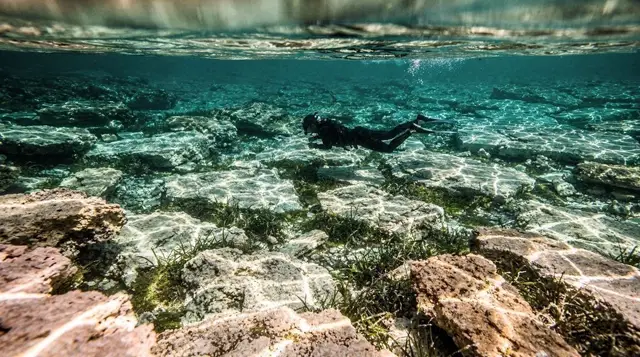
Managing expectations helps here: a beginner dive in 5-8m of water isn’t going to look like a nature documentary, but Sardinia’s marine protected areas do deliver a genuine variety of life even at shallow depth. Expect schools of damselfish and sea bream weaving around rock formations, the occasional wrasse in bright breeding colours, sea urchins and starfish tucked into crevices, and, with a bit of luck, an octopus changing colour as it retreats into a hole.
Groupers, the Mediterranean’s largest reef fish and a protected species around most of the island’s marine parks, are a highlight when they appear, often curious rather than skittish around divers in areas where spearfishing is banned. Don’t expect coral reefs — the Mediterranean simply doesn’t have them — but the rock formations, sea grass meadows and clarity of the water more than make up for it on a good day.
Choosing a dive centre
Not all try-dive operators are equal, and a few checks before booking are worth the five minutes they take. Look for a centre affiliated with a recognised training agency (PADI, SSI or CMAS are the most common in Italy), ask how many guests share one instructor on the try-dive itself — one-to-one or one-to-two is standard and anything larger is worth questioning — and check whether the price quoted includes the boat transfer or only the dive itself, since some centres charge these separately.
Reviews mentioning specific instructor names are usually a good sign of a personal, unrushed operation rather than a volume-focused one. It’s also worth asking directly whether the centre’s insurance covers first-time divers specifically, since a few budget operators cut corners here that are worth avoiding regardless of the modest saving.
Physical preparation and what to expect in your body
Nerves are normal, and instructors are used to guests breathing faster than necessary or gripping the instructor’s arm harder than needed on a first descent. Equalising your ears — gently pinching your nose and blowing to release pressure as you descend — is the one genuinely learnable skill that matters most for comfort, and it’s covered thoroughly in the pre-dive briefing.
A mild head cold or blocked sinuses is one of the few conditions that can turn a try-dive uncomfortable rather than dangerous, since you won’t be able to equalise properly; if you’re congested on the day, it’s worth rescheduling rather than pushing through. Alcohol the night before is generally fine in moderation, but centres will decline to take anyone who is visibly still under the influence on the morning of a dive, for obvious safety reasons.
After the dive: certification pathways
If a try-dive convinces you that diving is for you, most centres running beginner sessions in Alghero and around Capo Caccia also offer the full Open Water certification, typically structured over three to four days combining classroom theory, confined-water pool sessions and four open-water dives.
Because the try-dive uses the same shallow sites and often the same instructors, some centres will credit the introductory session’s pool time toward the course if you sign up within a short window, which is worth asking about directly rather than assuming it applies automatically. Certification prices in Sardinia run roughly in line with the rest of southern Europe, typically €350-450 including all equipment, materials and the certification card itself, and the qualification is valid worldwide with no expiry.
What a typical booking day looks like
Most try-dive operators run on a fairly fixed daily schedule through the summer season: a morning session and, on busy days, an afternoon one, each taking a small group of beginners plus any certified divers booked onto the same boat for a proper dive. Arrival is usually 20-30 minutes before the stated start time to complete paperwork and get fitted for a wetsuit, and the whole outing, from arrival to returning to the harbour, typically runs two to three hours including the boat transfer, briefing and the dive itself.
Cancellations for weather are more common than first-time visitors expect, particularly around Capo Caccia’s exposed side; a good operator will offer a rebooking for another day rather than simply refunding and leaving you to sort out the rest of your itinerary, so ask about their weather policy when you book.
Combining a try-dive with the rest of your trip
A try-dive is a half-day commitment at most, which leaves plenty of room to combine it with other activities on the same trip. Visitors based in Alghero often pair a morning try-dive with an afternoon exploring Alghero’s old town or a visit to Neptune’s Grotto, while those in the south can easily fit a try-dive around a day otherwise spent at Poetto beach or exploring Cagliari itself.
For a longer stay built specifically around trying several water activities, the seven-day north Sardinia itinerary has enough flexibility to fit a try-dive alongside boat trips, hiking and beach time without feeling rushed.
Frequently asked questions about trying diving in Sardinia
Is a try-dive safe for someone who has never dived before?
Yes, when run by a licensed dive centre with a certified instructor holding you throughout. The shallow depth (5-8m) and constant supervision are specifically designed to minimise risk for complete beginners.
How deep do you go on a first dive?
Typically 5-8 metres, occasionally up to 10-12m if conditions and the group’s comfort allow, but always well within recreational no-decompression limits and far shallower than certified dives.
Can children try diving in Sardinia?
Most centres set a minimum age of 8-10 for supervised try-dives in a pool or very shallow water, and 10-12 for an open-water try-dive, but ages and rules vary by operator, so check when booking if you’re travelling with children.
What should I bring?
A swimsuit worn under the wetsuit, a towel, and sun protection for the boat ride. Equipment, including the wetsuit itself, is provided by the dive centre as part of the price.
Will I get seasick on the boat out to the dive site?
It’s possible on a choppy day, particularly around exposed headlands like Capo Caccia. If you’re prone to motion sickness, take medication in advance and mention it when booking so the centre can advise on conditions.
Does a try-dive count towards a real certification?
Not automatically, though some centres will credit the pool and briefing time if you sign up for a full course within a short window. Ask before you book if this matters to you.
Is it worth doing more than once in the same trip?
If your first try-dive goes well, a second at a different site (say, Villasimius after Alghero) is a reasonable way to see more of the coastline before committing to certification, and most centres offer a discount for repeat guests.
What happens if I panic underwater?
Instructors are trained specifically to recognise early signs of anxiety and will slow down, stop, or return to the surface with you immediately if needed; there’s no shame in signalling that you want to pause, and a good instructor treats it as routine rather than a failed dive.
Can I wear glasses or contact lenses while diving?
Contact lenses work fine under a standard dive mask. Glasses don’t fit under a mask, but many dive centres can supply a prescription mask for an additional fee if you book ahead and specify your prescription.
Diving & snorkelling tours on GetYourGuide
Verified deep-linked GetYourGuide tours. Book through these links and we earn a small commission at no cost to you.
These are our own photographs of Sardinia, not the operator's pictures of this tour — open the tour page to see those.