Alghero is the one Sardinian city where the walled old town is genuinely worth wandering for its own sake, not just as an evening add-on to a beach holiday. Catalan forces took the city in 1354 and resettled it with colonists from Barcelona; six and a half centuries later, l’Alguerès — a dialect of Catalan — is still spoken, taught in local schools, and printed on street signs alongside Italian. Walk the ramparts at sunset and the mix of honey-coloured stone, wrought-iron balconies and watchtowers looking out over the Mediterranean feels closer to the Balearics than to the rest of Sardinia.
Beyond the old town, Alghero works as a full holiday base in a way few other Sardinian towns do: it has its own airport, a long sandy beach a walk from the centre, a proper choice of restaurants and hotels across every budget, and it sits directly at the gateway to Capo Caccia and the Porto Conte marine park, arguably the best diving and boat-touring coastline in north-west Sardinia.
That combination — real history, a working airport, a genuine beach and some of the island’s best diving on the doorstep — makes Alghero one of only a handful of Sardinian towns that functions equally well as a one-week standalone holiday or as the anchor point for a wider northwest loop taking in Sassari, Stintino and Bosa further down the coast. It doesn’t have the exclusivity of the Costa Smeralda or the capital-city weight of Cagliari, but for most travellers that’s an advantage: prices are reasonable, the pace is unhurried, and nothing about it feels manufactured for tourism the way parts of Gallura’s coast can.
The old town and the ramparts
Alghero’s centro storico is compact enough to cover in half a day but rewards slower exploration — narrow lanes open unexpectedly onto small squares, coral jewellery workshops sit beside bakeries selling Catalan-influenced pastries, and the sea ramparts (the Bastioni) circle the old town’s seaward edge with uninterrupted horizon views.
a guided city centre tour combined with a visit to the Palmavera nuraghe pairs Alghero’s Catalan heritage with the older Nuragic site just outside town, a useful pairing if you only have one morning for history. For food specifically, a food and wine walking tour of the city centre covers the local specialities — bottarga, lobster alla Catalana, and coral-adjacent trivia most visitors never hear otherwise.
See our full Alghero old town guide for a self-guided walking route, and filigree and coral jewellery in Sardinia if you’re shopping — Alghero has been a coral-working centre since medieval times and the genuine workshops are worth distinguishing from the imported tourist stock.
The city’s Catalan character goes beyond the language and street signs. Look up while walking the lanes and you’ll spot Gothic-Catalan window frames and doorways dating to the 14th and 15th centuries, largely intact because Alghero avoided the heavier post-war redevelopment that reshaped parts of Cagliari and Olbia. The cathedral, Santa Maria, mixes Catalan-Gothic origins with a later neoclassical facade — worth stepping inside for the bell tower views alone, climbable for a small fee and one of the better vantage points over the old town’s rooftops and the bay beyond.
Getting around the old town
The centro storico is entirely pedestrianised in its core, and the four main gates into the walls — Porta a Mare, Porta Terra among them — make orientation straightforward even without a map. Evening is the best time to walk the Bastioni ramparts: the sea-facing walls catch the sunset directly, and by early evening the aperitivo crowd spills out from bars built directly into the old fortifications, a genuinely pleasant way to watch the light change over the water.
Beaches, boats and Capo Caccia
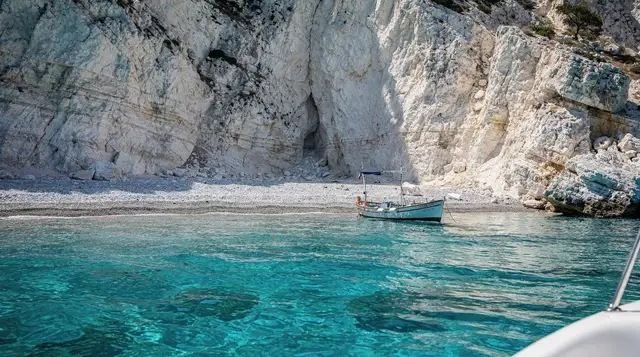
Alghero’s own beach, Lido di Alghero, runs for over a kilometre north of the old town and is genuinely good — fine sand, shallow entry, and close enough to walk from most central hotels. But the real draw is what’s reachable by boat: the Capo Caccia headland and the Porto Conte marine protected area, 10 to 15km up the coast, hold some of the clearest water and most dramatic cliff scenery in Sardinia.
a boat tour to Capo Caccia is the standard way to see the headland’s sea caves and cliffs from the water, and it’s the better option for most visitors over driving to the cape and hiking down (and, more painfully, back up) the 654 Escala del Cabirol steps to Neptune’s Grotto. For a longer day, a six-hour catamaran tour of Porto Conte natural park covers more coastline with proper swimming stops, and a catamaran sunset tour is the pick for an evening out on the water without committing a full day.
Divers have some of Sardinia’s best conditions right on Alghero’s doorstep — see diving Alghero and Capo Caccia for site details, and diving in Sardinia for a wider comparison. For the full detail on Neptune’s Grotto itself, including whether it’s worth the boat trip versus the steps, read Neptune’s Grotto, Alghero.
For certified divers specifically, a diving trip from Alghero covers a range of sites along the coast depending on conditions and group experience, from beginner-friendly reefs close to the harbour to the more demanding wall dives out toward Capo Caccia. Visibility here regularly tops 20 metres in summer, and the coastline’s mix of caves, walls and reef makes it one of the more varied stretches for diving anywhere in Sardinia — a genuine draw independent of the city’s history and food.
Boat rental is also worth knowing about for anyone who’d rather explore independently than join a fixed-route tour: inflatable boat rental in Alghero allows a self-guided day along the coast for those with some boating experience, no skipper required for the smaller craft. It’s a genuinely different way to see this coastline compared to a guided catamaran tour, though it does require checking the weather and your own competence honestly before setting out — the coast beyond the marked swimming areas can turn choppier than it looks from the harbour.
| What | Where | How long | Notes |
|---|---|---|---|
| Old town walking tour | Alghero centro storico | 1–2 hours | Combine with Palmavera nuraghe |
| Boat tour to Capo Caccia | Alghero port | 3–4 hours | Sea caves, no steps |
| Catamaran tour, Porto Conte | Alghero port | 6 hours | Swimming stops included |
| Diving trip | Alghero/Capo Caccia | Half day | All levels, gear included |
Getting to and around Alghero
Alghero-Fertilia airport (AHO) sits just 10 minutes north of the city, making Alghero the easiest of Sardinia’s three airport towns to reach without a long transfer — a taxi or the local bus into the centre takes under 20 minutes. See our Alghero-Fertilia airport guide for details. That said, renting a car is still worth it if you’re planning to reach Capo Caccia, Porto Conte or Sassari independently, since bus coverage beyond the town centre thins out fast — see visiting Sardinia without a car for what’s realistically possible on public transport alone.
Within the old town, everything is walkable; a car is only useful for reaching the coast or countryside beyond it.
Where to eat and stay
Alghero has arguably the best restaurant density of any Sardinian coastal town outside Cagliari, with a strong Catalan-Sardinian seafood tradition — lobster alla Catalana (aragosta alla catalana) is the dish to order, ideally paired with a local Vermentino or the region’s other whites. See Sardinian food and wine for a wider primer. Accommodation ranges from budget guesthouses just outside the walls to genuinely smart hotels inside the old town itself — book well ahead for a room within the ramparts in July and August.
Prices for both restaurants and rooms sit noticeably below the Costa Smeralda for comparable quality, which is part of why Alghero has become a popular base for longer stays rather than a quick stopover. Outside the old town, the Lido beachfront has a more relaxed, family-oriented strip of hotels and gelaterie, generally cheaper again than a central address within the walls, and still a walkable distance from the historic core. For a broader look at where to base a Sardinia trip overall, our where to stay in Sardinia guide compares Alghero against the island’s other main hubs.
Frequently asked questions about visiting Alghero
Is Alghero worth visiting if I’m not interested in beaches?
Yes — the old town’s Catalan heritage, architecture and food scene stand on their own, and day trips to Capo Caccia and Neptune’s Grotto work regardless of whether you swim.
How do I get to Neptune’s Grotto from Alghero — boat or the steps?
Both work: the boat trip is easier and includes views of the Capo Caccia cliffs from the water, while the 654-step staircase (Escala del Cabirol) is free but genuinely strenuous, especially the climb back up in summer heat.
Is Alghero-Fertilia airport well connected internationally?
It has a reasonable spread of European budget airline routes, particularly from Italy, Germany, France and the UK in summer, though fewer year-round connections than Cagliari or Olbia.
How many days should I spend in Alghero?
Three to four days covers the old town, a boat trip to Capo Caccia, a beach day and one further excursion; two days is workable if you’re combining it with a wider northwest Sardinia loop.
Is Alghero’s old town crowded in summer?
Yes, particularly the central lanes and ramparts in the evening during July and August; visit the historic core in the morning for a quieter experience.
Do people really speak Catalan in Alghero?
Yes, l’Alguerès is still actively spoken by part of the older population and taught in local schools, though everyone also speaks standard Italian.
Is diving in Alghero suitable for beginners?
Yes, several sites close to the harbour suit newer divers, while the more demanding wall dives and caves toward Capo Caccia are better reserved for experienced or certified divers.
Can I rent a boat in Alghero without a skipper’s licence?
Smaller inflatable boats are available for self-guided rental without a licence in Italy, though it’s worth being realistic about your own boating experience and checking conditions before heading beyond the sheltered bay.