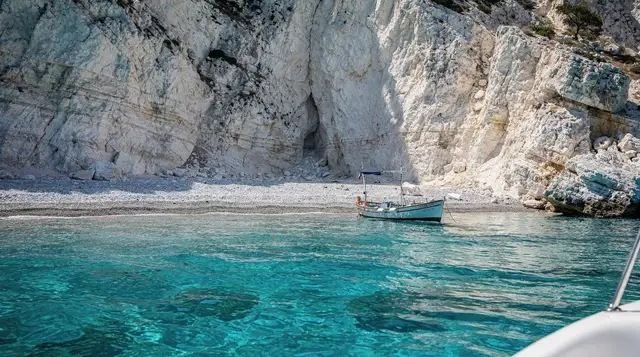
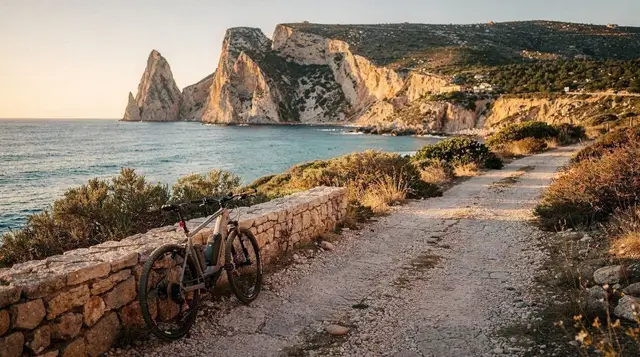
Capo Caccia is the limestone headland that closes off the western end of Porto Conte bay, 15 minutes’ drive from Alghero, and it’s the single most dramatic stretch of coastline in north-west Sardinia. The cliffs drop close to 300 metres straight into the sea in places, riddled with sea caves carved by millennia of wave action, and the whole promontory is protected as part of the Porto Conte regional park — no development, just cliff, scrub and a working 19th-century lighthouse at the tip.
Unlike most of Sardinia’s coastline, which alternates sand and granite in relatively gentle formations, Capo Caccia is limestone — the same rock type that produces the dramatic karst scenery found in parts of Croatia and southern Italy, riddled with sinkholes, caves and underground water systems both above and below sea level. That geology is precisely what makes the headland’s cave system so extensive, and it’s also why the cliffs here are sheerer and more vertiginous than almost anywhere else on the island.
The headland’s centrepiece is Neptune’s Grotto (Grotte di Nettuno), a limestone cave system that runs over a kilometre into the cliff, with stalactite formations, an underground saltwater lake, and passages that have been open to visitors since the 19th century. It’s genuinely spectacular, and genuinely awkward to reach, which is the whole story of Capo Caccia in one sentence.
The name “Capo Caccia” — Cape Hunting — dates to when the headland’s cliffs and caves were used for falconry, and the promontory remains one of the more important nesting sites in the Mediterranean for the peregrine falcon and other cliff-nesting birds of prey, along with colonies of shearwaters. Birdwatchers occasionally visit specifically for this reason, independent of the cave and diving crowds, particularly in spring and early summer nesting season — see birdwatching in Sardinia for other sites worth combining with a Capo Caccia visit.
Neptune’s Grotto: boat or steps
There are exactly two ways in. The Escala del Cabirol — “the roe deer’s staircase” — is 654 steps cut into the cliff face, built in the 1950s, descending from a car park at the top of the headland to the cave entrance at sea level. It’s free, dramatic, and completely exhausting on the way back up in summer heat; bring water and take it slowly. It’s also the only option when the sea is too rough for boats, which happens more often than the brochures suggest, particularly outside peak summer.
The alternative is a boat tour to Capo Caccia from Alghero’s harbour, which docks directly at the grotto entrance when conditions allow, skipping the steps entirely and adding views of the cliffs from the water on the way. It’s the better choice for most people, and essential if the steps aren’t realistic for your group — but check the forecast, since sea conditions can cancel the boat option with little notice. Full detail on both routes, current opening hours and what to expect inside is in our dedicated Neptune’s Grotto, Alghero guide.
Inside, the cave is developed with walkways and lighting rather than left as raw wilderness, which makes it accessible to most visitors regardless of caving experience — this isn’t a scramble through mud, it’s a guided walk along a fixed route. The highlight for most visitors is the Sala della Reggia, a chamber with a still saltwater lake reflecting the stalactite formations above, and the whole visit typically runs 45 minutes to an hour, timed to entry groups that depart every 20 to 30 minutes in high season. Photography is allowed but tripods generally aren’t, given the narrow walkways and volume of visitors moving through in summer.
Diving and snorkelling at Capo Caccia
The same cliffs that make Capo Caccia dramatic above water make it one of the best dive sites in Sardinia below it: sheer walls, caves and swim-throughs, and visibility that regularly exceeds 20 metres in summer. a diving trip for certified divers at Capo Caccia covers the headland’s wall dives and cave systems, and it’s worth booking with an operator who knows the specific sites rather than a generic Alghero dive centre — conditions here can be more demanding than the sheltered bays further along the coast.
Snorkellers aren’t left out: a combined boat tour with snorkelling and paddleboarding reaches shallower coves around the headland without requiring certification. See diving Alghero and Capo Caccia for a full site breakdown and diving in Sardinia for the wider island picture.
For a longer day on the water that isn’t diving-focused, a full day trip on a sailing boat along the Capo Caccia coastline covers more distance at a gentler pace, with several swimming stops built into the route.
It suits travellers who want the scenery and the swimming without committing to a dive centre’s schedule, and it’s a reasonable middle ground between the fast catamaran day trips and a slower, more traditional sailing day. For a wider look at how this coastline compares to Sardinia’s other diving regions, see diving La Maddalena and try diving in Sardinia for beginners if you’re not yet certified but curious to give it a go.
A note on timing that applies to almost everything at Capo Caccia: this is a headland that rewards an early or late visit over a midday one. Morning light suits photography of the cliffs from a boat, midday brings the worst of the crowds at the grotto entrance, and late afternoon into sunset gives the best conditions for the lighthouse walk. If you can only do one thing here, weigh the grotto against a simple sunset visit to the headland — both are worthwhile, but they suit different kinds of travellers and different amounts of available time.
| What | Access | How long | Notes |
|---|---|---|---|
| Neptune’s Grotto by boat | Alghero port | 3–4 hours round trip | Weather-dependent |
| Neptune’s Grotto by steps | Capo Caccia car park | 1–2 hours | 654 steps, free, strenuous |
| Diving at Capo Caccia | Alghero, certified divers | Half day | Wall dives, caves |
| Lighthouse and cliff walk | Headland car park | 1 hour | Free, no booking |
The lighthouse and cliff walks
Beyond the grotto, the headland itself is worth the drive for the views alone. The lighthouse at the tip, still operational, marks one of the most exposed points on Sardinia’s north-west coast, and the short walking paths around it give uninterrupted views back along the cliffs toward Porto Conte and out to sea toward the Balearic direction on a clear day. It’s a free stop and pairs well with a visit to Porto Conte, the sheltered bay immediately behind the headland, or a wider natural park day taking in both.
The wind at the lighthouse can be genuinely strong even on an otherwise calm day at sea level — the exposed position catches gusts that don’t reach the sheltered coves below, so bring a layer even in summer, and keep a firm grip on anything loose near the cliff edge. Sunset from this vantage point is one of the better free experiences in north-west Sardinia, with the light catching the limestone cliffs in warm tones as it drops toward the sea; arrive 30 to 45 minutes before sunset to find a good spot before the small car park fills.
Getting to Capo Caccia
Capo Caccia is roughly 25 minutes by car from central Alghero and about 15 minutes from Alghero-Fertilia airport, along a scenic but winding coastal road — see our Alghero-Fertilia airport guide for arrival logistics. There’s no public transport to the headland itself, so renting a car or booking a boat tour that handles the transport for you are the only realistic options.
Parking at the top of the headland, near the Escala del Cabirol car park, is limited and fills quickly from mid-morning in July and August — arrive before 9.30am if you’re driving up independently and want a space close to the steps, or plan to walk a little further from an overflow area on the busiest days. If you’re booking the boat option instead, this is one less thing to worry about, since the tour departs from Alghero’s harbour directly.
Combining Capo Caccia with a wider northwest itinerary is straightforward: Porto Conte is a five-minute drive back along the same road, Alghero itself is 25 minutes, and Sassari is under an hour if you want to add a very different kind of stop to the same day. See the Alghero and Capo Caccia boat trips guide for how to sequence a full day covering both the headland and the bay behind it.
Frequently asked questions about visiting Capo Caccia
Can the boat to Neptune’s Grotto get cancelled?
Yes, if the sea is too rough to dock safely at the grotto entrance, which happens periodically even in summer; check with the operator on the day if conditions look marginal, and have the steps as a backup plan.
How difficult is the Escala del Cabirol staircase?
It’s 654 steps with no shade for most of the descent and the same climb back up; manageable for a reasonably fit adult but genuinely tough in midday summer heat, and not suitable for anyone with mobility issues.
Is there a beach at Capo Caccia?
No, the headland is entirely cliff — the nearest proper beaches are in Porto Conte bay just behind it, or back toward Alghero.
Do I need diving certification to see the underwater scenery at Capo Caccia?
For the wall dives and caves, yes, certification is required; snorkelling tours reach shallower coves around the headland without it.
Is Capo Caccia crowded in summer?
The grotto and its car park get busy from mid-morning in July and August; the wider headland and lighthouse walks stay quieter, since most visitors don’t venture beyond the cave entrance.
Are there birds to see at Capo Caccia beyond the cave?
Yes, the cliffs are an important nesting site for peregrine falcons and shearwaters, particularly worth a look in spring and early summer if birdwatching interests you.
How windy does it get at the lighthouse compared to sea level?
Noticeably windier — the exposed clifftop position catches gusts that don’t reach the sheltered coves below, so bring a light layer even on a warm day.