Diving in Sardinia
Where's the best place to dive in Sardinia?
Capo Caccia near Alghero for dramatic underwater cliffs and caves, the La Maddalena archipelago for granite walls and clear water, and Villasimius's Capo Carbonara marine protected area for the richest marine life. All three suit both beginners and certified divers, with dive centres offering everything from try-dives to advanced wreck routes.
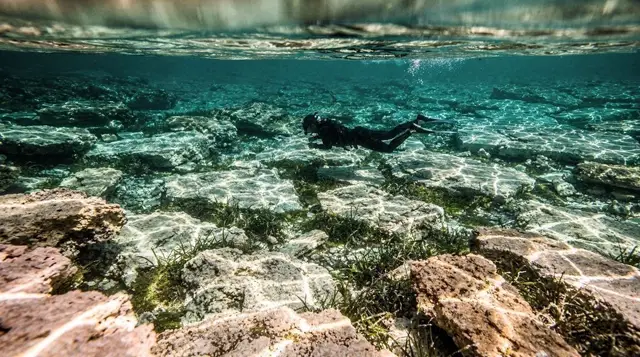
Sardinia’s water clarity is the reason divers rate it above most of the rest of Italy — visibility regularly runs 20-30m in the north and west, helped by the lack of major rivers silting up the coast and strict marine protection around several of the best sites. This isn’t a wreck-diving destination first (though wrecks exist), it’s a destination for granite walls, limestone caves, Posidonia meadows and genuinely healthy fish populations inside the island’s marine protected areas.
This guide covers the three main diving regions — Capo Caccia, the La Maddalena archipelago and Villasimius’s Capo Carbonara — plus costs, certification options, and what to expect if you’ve never dived before and want to try it as a one-off rather than commit to a course.
| Best regions | Capo Caccia (Alghero), La Maddalena archipelago, Villasimius/Capo Carbonara |
| Visibility | 15-30m typically, best May-October |
| Water temperature | 14-16°C in winter, up to 26-27°C in August |
| Try-dive cost | €70-110 for beginners with no certification |
| Certified dive cost | €45-75 per dive, less for multi-dive packages |
| Season | April to November for most centres; year-round for cold-water certified divers |
Capo Caccia: caves, walls and the island’s best-known dive sites
The limestone cliffs at Capo Caccia, near Alghero, drop into some of the clearest water on the island’s west coast, and the underwater landscape matches the drama above the surface — vertical walls, swim-throughs and the entrance to Neptune’s Grotto system extending below the waterline as well as above it. This is the region most Sardinia dive guides lead with, and for good reason: it combines easy access from a proper town with genuinely advanced-level terrain for anyone who wants it.
The Alghero diving experience covers the main Capo Caccia sites for certified divers, while the Capo Caccia diving trip with professional guides goes deeper into the more technical parts of the coastline for experienced divers. For anyone who’s never dived before, the try-dive for beginners in Alghero is a proper introduction with an instructor, no certification required. See our diving at Alghero and Capo Caccia guide for the full site-by-site breakdown of this coast.
La Maddalena archipelago: granite and clarity
The La Maddalena archipelago’s granite seabed and lack of river run-off give it some of the clearest water anywhere around Sardinia, particularly around the outer islands and the channels near Caprera. Dives here tend toward drift routes along granite boulders rather than the wall-and-cave terrain of Capo Caccia, with a different but equally rich fish population thanks to the marine park’s protections.
The scuba diving for beginners in La Maddalena is a solid first-timer option, and the full-day scuba diving trip to the Lavezzi Islands from La Maddalena extends the range across the Bonifacio Strait toward Corsican waters for certified divers wanting a longer day. Full detail on this archipelago’s dive sites is in our diving at La Maddalena guide.
Villasimius and Capo Carbonara: the richest marine life
South of Cagliari, the Villasimius coast and the Capo Carbonara marine protected area consistently show the healthiest fish populations of the three main regions, a direct result of decades of protection restricting fishing inside the reserve. Groupers, barracuda and large schools of bream are a realistic sighting here in a way they’re less reliably seen elsewhere on the island.
The scuba diving excursion inside the marine protected area from Villasimius is the standard route into this reserve, and the discover scuba diving experience at Capo Carbonara works well for first-timers wanting a gentler introduction than the more current-exposed Capo Caccia sites. See our diving at Villasimius and Capo Carbonara guide for the site list.
For a more advanced route, the advanced diving trip in the Gulf of Angels from Cagliari reaches deeper sites along the capital’s own stretch of coast, a less-touristed alternative to the three headline regions.
| Region | Terrain | Best for | Nearest base |
|---|---|---|---|
| Capo Caccia | Walls, caves, swim-throughs | Advanced and adventurous divers | Alghero |
| La Maddalena archipelago | Granite drift dives | Clarity, beginner-friendly options | Palau, La Maddalena, Cannigione |
| Villasimius / Capo Carbonara | Marine reserve, healthy fish life | Marine life, gentler beginner sites | Villasimius, Cagliari |
Costs and certification levels for 2026
A single dive for an already-certified diver runs €45-75 depending on the region and whether equipment rental is included, dropping with multi-dive packages of five or ten dives bought upfront. A try-dive for complete beginners — a supervised, shallow introductory dive with an instructor, no course required — typically costs €70-110 and includes all equipment. Full open-water certification courses run over three to four days and cost €350-500, a bigger commitment but worth it if you’re planning to dive regularly afterward rather than just once on holiday.
| Experience level | What it involves | Typical cost |
|---|---|---|
| Try-dive (no certification) | Shallow, supervised, single dive | €70-110 |
| Certified single dive | Standard dive with equipment | €45-75 |
| Multi-dive package (5-10 dives) | Discounted per-dive rate | €200-450 |
| Full certification course | 3-4 days, open-water qualification | €350-500 |
Choosing a dive centre and what to check before booking
Sardinia’s dive centres range from small, family-run operations with a single boat to larger PADI or SSI-affiliated centres running multiple daily departures. Certification is worth confirming regardless of size — ask specifically which agency (PADI, SSI, CMAS) a centre is affiliated with, since this determines which qualification you’ll hold afterward and whether it’s recognised internationally for future diving elsewhere. Group size per instructor matters more at the more technical Capo Caccia sites than at gentler reef dives; a ratio of no more than four divers per instructor is reasonable to ask for on anything beyond a shallow, sheltered dive.
Equipment quality varies between centres more than price alone suggests. Regulators, BCDs and wetsuits that are well maintained make a genuine difference to comfort, particularly on longer or cooler dives, and it’s a fair question to ask how often a centre services its rental equipment. Reviews mentioning equipment condition specifically are more useful than generic star ratings when comparing options.
What to pack for a diving trip to Sardinia
Bring your own mask if you have one you trust — a well-fitted mask makes more difference to comfort than almost any other piece of gear, and rental masks, while functional, rarely fit as well as one you’ve broken in yourself. A 5mm wetsuit covers most of the April-to-October season comfortably; a shorty (3mm or less) suffices only in the warmest weeks of July and August for shallower dives.
Reef-safe sunscreen is worth packing specifically for the marine-protected areas around Villasimius and the Lavezzi Islands, where several dive centres now actively discourage standard sunscreen formulations. A dive log book, if you keep one, is useful for tracking depth and site history across a multi-day trip, though most centres can also provide digital logging if you don’t bring your own.
Season and water temperature
Most dive centres operate April to November, with the best visibility and warmest water from June to September, when the sea reaches 24-27°C at the surface and stays comfortable at depth in a good wetsuit. May and October offer noticeably fewer other divers at the same sites, at the cost of a slightly cooler dive — a 5mm wetsuit is worth having rather than relying on a shorty.
Serious cold-water divers do dive through winter, when visibility can actually improve at some sites due to less boat traffic and algae growth, but this is a minority pursuit requiring a drysuit and local knowledge of conditions. See our best time to visit Sardinia guide for how the diving season fits into the island’s wider weather patterns.
Shoulder season — May and October specifically — offers a reasonable middle ground for divers who want to avoid peak-season crowds without committing to a drysuit. Water temperature in these months sits around 18-20°C, cool enough to want a full 5mm wetsuit but well within range for most reasonably experienced divers, and dive boats run noticeably less full than during the July-August peak, meaning more individual attention from instructors and less waiting around between dives.
Marine protection and diving etiquette
Much of Sardinia’s best diving sits inside formally protected marine areas — Capo Carbonara near Villasimius, sections of the La Maddalena archipelago, and the Bonifacio Strait’s Lavezzi reserve reachable from the north coast. These protections are the direct reason the diving here is as good as it is, and diving etiquette inside them matters more than it might elsewhere: no touching or standing on coral or rock formations, no removing shells or marine life as souvenirs, and strict adherence to any anchoring restrictions communicated during the pre-dive briefing.
Dive centres operating inside these reserves are generally well versed in the specific rules and will brief divers accordingly, but it’s worth understanding the reasoning rather than treating the rules as arbitrary red tape — the fish populations and visibility divers come for exist precisely because these restrictions have been enforced for years.
Buoyancy control is worth practising before a Sardinia trip if you’re not a frequent diver, particularly for the cave and swim-through sections at Capo Caccia, where poor buoyancy risks contact with fragile rock formations that have taken centuries to form. Most centres will assess buoyancy during the first dive of a multi-dive booking and adjust the route accordingly if needed, prioritising safety and site preservation over covering the most dramatic terrain on day one.
Combining diving with the rest of a Sardinia trip
Diving rarely fills an entire holiday on its own, and Sardinia’s diving bases double well as places to explore beyond the water. Alghero’s old town, Villasimius’s beaches, and the La Maddalena archipelago’s boat-tour scene all give non-diving days plenty to do, whether that’s a rest day between dives or time for a non-diving travel companion. Many visitors structure a week around two or three dive days interspersed with beach time, archaeological sites or simply exploring a nearby town — see our how many days do you need in Sardinia guide for how to balance diving against the island’s other main draws in a single trip.
Frequently asked questions about diving in Sardinia
Do I need to be certified to dive in Sardinia?
No — every major dive centre offers try-dives for complete beginners, supervised one-on-one or in small groups with an instructor, no prior experience or certification required.
What’s the water visibility like compared to other Mediterranean destinations?
Consistently among the best in the western Mediterranean, typically 15-30m depending on region and season, helped by the lack of major rivers and strict protection in the marine parks.
Is Sardinia good for snorkelling as well as diving?
Yes — many of the same regions, particularly Capo Caccia and Villasimius, have excellent shallow snorkelling that doesn’t require any equipment beyond a mask and fins. See our best snorkelling spots in Sardinia guide for the shallow-water alternatives.
When is the water warmest for diving?
July and August, reaching 26-27°C at the surface, though depth still cools noticeably — a 5mm wetsuit is standard even in peak summer for anything beyond a shallow dive.
Are there wrecks to dive in Sardinia?
Yes, though fewer headline wrecks than Malta or parts of Sicily; some centres around Cagliari and the north coast run wreck-focused trips for experienced divers. See our wreck diving in Sardinia guide for the specific sites.
Which region is best for a first-time diver?
Villasimius and Capo Carbonara generally, thanks to calmer, more sheltered conditions and strong marine life without the current exposure of some Capo Caccia sites.
Do I need my own equipment?
No — every dive centre listed here rents full equipment, included in try-dive and most single-dive prices; bringing your own mask and fins is common among regular divers but not required.
How do I know if a dive centre is properly certified and safe?
Check its diving agency affiliation (PADI, SSI or CMAS are the main ones operating in Sardinia), read recent reviews specifically mentioning equipment condition and instructor ratios, and don’t hesitate to ask directly about group size per instructor before booking anything beyond a shallow, sheltered dive.
Can I dive at multiple regions during one Sardinia trip?
Yes, though it requires more driving than staying in one base — Alghero to Villasimius is roughly three hours by road, and to the La Maddalena area closer to two and a half. Most divers pick one or two regions rather than trying to cover all three in a single trip; see our itineraries section for how to structure a longer stay around more than one diving base.
Is night diving available in Sardinia?
Yes, at some centres around Capo Caccia and Villasimius specifically, for certified divers with the relevant experience — a genuinely different way to see the same sites, with nocturnal marine life on display that’s largely hidden during daytime dives.
Diving & snorkelling tours on GetYourGuide
Verified deep-linked GetYourGuide tours. Book through these links and we earn a small commission at no cost to you.
These are our own photographs of Sardinia, not the operator's pictures of this tour — open the tour page to see those.