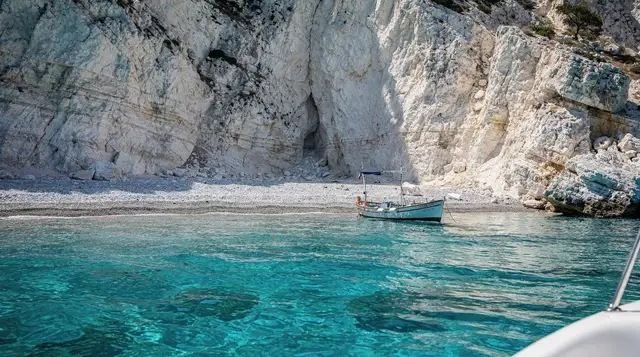
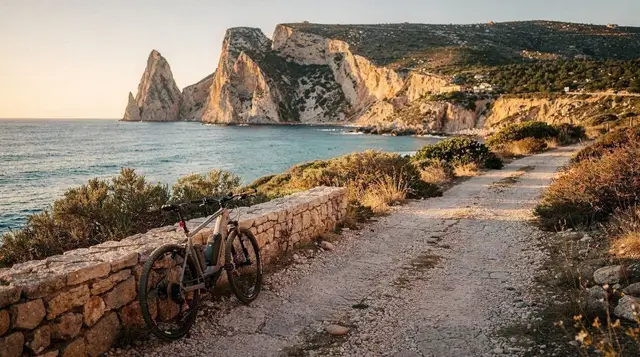
Masua is a hamlet of the comune of Iglesias, strung along a short stretch of cliff on Sardinia’s south-western coast. It has no hotel strip, no promenade and barely a handful of buildings, but it has one thing that makes it a fixture on almost every Iglesiente itinerary: the Pan di Zucchero, a limestone sea stack rising straight out of the water just off the beach, and Porto Flavia, a mining tunnel engineered directly into the cliff face a few hundred metres north.
| Where | Iglesiente coast, comune of Iglesias, about 55km west of Cagliari |
| Known for | The Pan di Zucchero sea stack and the Porto Flavia mine tunnel |
| Time needed | Half a day for the beach and Porto Flavia; more with canyoning |
| Getting there | Car via the SP83 coastal road; no useful bus service |
| Best time | Before 9am for the beach in summer; any season for Porto Flavia |
The Pan di Zucchero: Sardinia’s tallest sea stack
The Pan di Zucchero — literally “sugarloaf” — is a freestanding limestone pinnacle rising around 130 metres out of the sea a short swim from Masua’s beach. It’s the tallest sea stack in the Mediterranean by most reckonings, a chunk of the same dolomitic limestone that forms the cliffs behind it, left standing after millennia of erosion cut it away from the coastline. It’s visible from several points along the SP83 well before you reach the village, but the view from Masua’s own beach — stack, cliff and old mining structures in one frame — is the one worth the trip.
Boat trips around the base of the stack run from Masua and nearby Buggerru in summer, and it’s a regular stop on wider Iglesiente coastal itineraries. Divers rate the area too: the water around the stack drops quickly to a genuine wall dive, though it’s a specialist outing rather than a snorkel-and-look spot. Our best snorkelling spots in Sardinia guide covers where the Iglesiente coast fits against the island’s better-known snorkelling.
Getting down to the beach
Masua’s beach sits directly below the car park and the old mine buildings, reached by a stairway and path cut into the cliff — steep enough that it counts as the main physical effort of the visit, and not the kind of descent to attempt in flip-flops with a cooler bag. It levels out onto a narrow strip of grey sand and pebbles, small by Sardinian standards, with the Pan di Zucchero filling the view straight ahead and the rusted loading gantries of the old mine visible up on the cliff to one side.
There’s no meaningful shade on the beach and only a modest stretch of usable sand, so it fills up fast in July and August — by mid-morning in peak season it can feel genuinely crowded for a beach this size. The one piece of advice that actually works here is arriving early: before 9am the car park has space, the stairs are quiet, and the light on the Pan di Zucchero is better for photos anyway.
Parking itself is limited and informal, mostly a gravel area above the stairs that fills before the beach does. Unlike La Pelosa or Cala Goloritzé further east, Masua has no access quota or booking system — it’s first-come, first-served, which in practice means first-come wins and everyone after 10am queues for a parking spot instead.
Porto Flavia: a mine you can walk into
A short walk (or a very short drive) north of the beach car park is Porto Flavia, the reason engineers still study this stretch of coast. Built in 1924 by the Belgian-owned Vieille Montagne mining company, Porto Flavia solved a specific, expensive problem: how to load zinc and lead ore from the Iglesiente mines onto cargo ships without ferrying it out on small boats, the slow and dangerous method used before. The solution was to blast two parallel tunnels straight into the cliff, one for the ore conveyor and one for the workers, connecting the inland mine galleries to the open sea.
Ore travelled down through the tunnel system and out through nine loading bays cut into the cliff face, each with an opening onto the sea, from which it dropped directly into the holds of ships moored below. What took a full day of small-boat ferrying before Porto Flavia took around thirty minutes once it opened — a genuine leap in industrial logistics for the time, and one that kept the site in commercial use until the mines finally closed in the 1990s.
Guided visits (tickets typically €10-14, best booked ahead in summer) take you through the tunnels to the loading bays themselves, where the openings frame a sheer drop to the water and a close-up view of the Pan di Zucchero from an angle almost nobody else gets. It’s one of the more genuinely impressive pieces of industrial heritage anywhere on the island, and it pairs naturally with the wider mining landscape covered in our museums worth visiting in Sardinia guide.
For a single organised visit that covers Porto Flavia alongside the rest of the Iglesiente mining coast, a private tour of the Iglesiente mines, Nebida and Masua is the most efficient way to see the sites without working out access and opening times yourself.
Canyoning through the old mine galleries
Masua is also the starting point for one of the more unusual adventure activities on this coast: dry canyoning through the disused mine canal linked to Porto Flavia. Rather than the waterfalls and pools of a typical Sardinian canyon, this route works through tunnels, shafts and rock-cut passages that once carried ore and workers, descending and scrambling through spaces built by miners rather than shaped by a river. It’s a half-day outing, roughly five hours including equipment and instruction, and it needs no prior canyoning experience — a dry canyoning tour through the Porto Flavia mine canal covers harnesses, helmets and a qualified guide.
It’s a genuinely different way to experience the same industrial history that Porto Flavia’s guided walking tour covers from the surface, and it tends to appeal to visitors who’ve already done a conventional canyon elsewhere on the island. Our canyoning in Sardinia guide sets this route against the wetter, more classic canyons of the Supramonte and Gennargentu, and best caves in Sardinia covers where underground Sardinia is worth a visit beyond the mines.
Walking the coast from Nebida to Masua
The Iglesiente mining coast runs north from Masua toward Nebida, where the Laveria Lamarmora ore-washing plant clings to the cliffs in one of the most photographed industrial ruins in Sardinia — that hamlet’s own history is worth its own visit rather than a detour here.
Between the two, a marked coastal path traces the clifftop past abandoned mine structures, with the Pan di Zucchero staying in view for most of the walk and repeated vantage points over the sea below. A guided panoramic hiking route from Nebida to Masua covers the full stretch with a local guide who can explain what’s being looked at, since most of the structures along the way have no on-site signage.
South of Masua, the coast road continues toward Buggerru, another former mining town with its own beach and museum, and inland the route leads back to Iglesias itself, whose old town and cathedral make a natural pairing with a coastal half-day at Masua. For the industrial history that predates all three, Carbonia and its coal museum sit about 25 minutes further south. Anyone building a longer route around this corner of the island should look at our west coast Sardinia in seven days itinerary, which strings the Iglesiente mines together with the Sinis peninsula and the Costa Verde further north.
Getting to Masua and driving the SP83
There’s no train or useful bus route to Masua — a hire car is the only realistic way in, and it’s worth budgeting the time the road itself demands. The approach from Iglesias follows the SP83, known locally as the Strada Costiera delle Miniere (the mining coast road), a narrow, winding route that climbs and drops along the clifftops with several pull-offs giving the first views of the Pan di Zucchero well before Masua itself comes into sight. It’s one of the more spectacular short drives in Sardinia, but it’s slow: allow 25-30 minutes from Iglesias for what looks like a short distance on the map, and expect to want to stop more than once for photos.
Cagliari-Elmas airport (CAG) is roughly an hour and fifteen minutes away via the SS130 and SP83; there’s no faster route regardless of what a map application suggests, since none of this coast has motorway-standard roads. For general guidance on renting and driving here, see our renting a car in Sardinia and driving in Sardinia guides — both are worth reading before you land, since fuel stations and passing places thin out fast once you leave Iglesias.
If Masua is one stop on a longer day out from the capital, day trips from Cagliari covers how it compares with the island’s other half-day options, and how to avoid the crowds in Sardinia has more on the early-arrival strategy that works here as well as anywhere else on the coast.
When to go
Masua works at any time of year for Porto Flavia and the clifftop views, since neither depends on swimmable water. For the beach itself, May through October is the realistic swimming window, with July and August bringing the crowding and parking pressure described above. September is the strongest compromise: warm sea, thinner crowds, and cooler conditions for the walk down the stairs and back up again.
Outside the main season, check opening times for Porto Flavia’s guided visits directly, since winter access can be reduced. Our quiet beaches in Sardinia guide is a useful cross-check if the crowding here puts you off — though it’s fair to say nowhere on this particular stretch of coast is genuinely empty in August. For the photography angle specifically, the hidden coves of Sardinia post covers a few less-visited alternatives nearby.
Frequently asked questions about Masua
How do you get down to Masua beach?
By a stairway and path cut into the cliff, starting from the car park above. It’s steep and takes several minutes each way, with no shade and no facilities on the beach itself, so bring water and proper shoes rather than sandals.
Can you swim near the Pan di Zucchero?
Yes, from Masua’s beach it’s a manageable swim out toward the base of the stack in calm conditions, and it’s a popular spot for snorkelling around the rocks at its foot. Check conditions before swimming out any distance, since the open exposure means the sea can pick up quickly.
How long does a Porto Flavia visit take?
A standard guided visit runs around 45 minutes to an hour, covering the tunnels and the loading bays with the sea views through the cliff openings. Tickets are typically €10-14 and are worth booking ahead in July and August, when visitor numbers are highest.
Is the canyoning tour at Masua suitable for beginners?
Yes. The dry canyoning route through the Porto Flavia mine canal needs no prior experience — guides provide harnesses, helmets and instruction, and the route runs through tunnels and rock passages rather than water, so it’s more accessible than a typical wet canyon.
Is Masua worth visiting if I’ve already seen Nebida?
They’re different sites worth seeing separately rather than one substituting for the other. Nebida has the Laveria Lamarmora washing plant and its own clifftop views; Masua has the Pan di Zucchero, the beach and Porto Flavia. Most visitors do both on the same half-day, connected by the coastal path or a short drive.
Does Masua have a parking quota like La Pelosa?
No formal booking system exists for Masua, unlike La Pelosa or Cala Goloritzé. The limit in practice is physical: a small, informal car park above the stairs that fills by mid-morning in summer. Arriving before 9am is the only reliable way to get a space in July and August.
Is there anywhere to eat in Masua?
Options are limited — a bar or small café near the car park in season is generally all there is. Most visitors eat in Iglesias or Buggerru, both a short drive away and better equipped with restaurants.