Nebida sits just north of Masua on the Iglesiente mining coast, and most visitors drive straight through it on their way to Masua’s famous sea stack without stopping. That’s a mistake, or at least an incomplete plan — Nebida has its own landmark, arguably more photogenic precisely because almost nobody stops for it, and a stretch of coastal road that’s worth slowing down for regardless of where you’re headed next.
| Where | Sulcis-Iglesiente coast, between Iglesias and Masua |
| Cost | Free to walk the viewpoints and beach |
| Time needed | 1-2 hours, or a half day combined with Masua |
| Getting there | Car via the SP83 coastal road from Iglesias (about 15 minutes) |
| Best time | Late afternoon into sunset for the Laveria Lamarmora; morning for a quieter beach |
The Laveria Lamarmora: a mine building left on the edge of a cliff
The reason to come to Nebida is the Laveria Lamarmora, the ruined shell of a 19th-century ore-washing plant that processed lead and zinc extracted from the surrounding hillside before being shipped out by sea. What makes it striking isn’t the building itself so much as where it sits: a multi-storey stone and metal structure perched right at the edge of a sheer drop to the water, with almost nothing between the walls and open air on the seaward side.
It’s one of the most photographed pieces of industrial ruin in Sardinia, and for good reason — from certain angles along the SP83, the Laveria appears to be floating above the sea with no visible ground beneath it. It’s floodlit after dark, which makes an evening drive-by worth doing even if you’ve already seen it in daylight. There’s no ticket, no gate and no set visiting hours; it’s viewed from the road and from a couple of informal pullouts rather than entered.
The SP83: Sardinia’s mining coast road
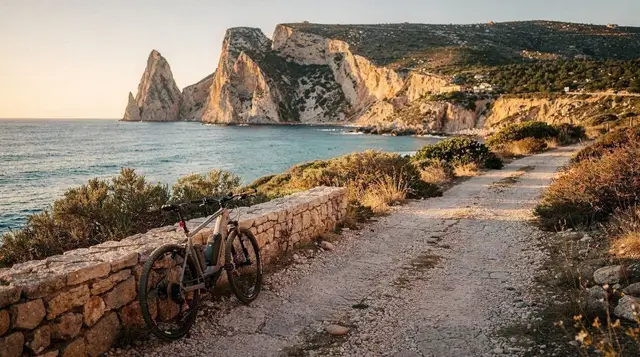
The SP83, sometimes signposted as the Strada Costiera delle Miniere (the miners’ coastal road), links Nebida to Masua and on to Buggerru further south, and it’s one of the more rewarding short drives in this part of Sardinia. The road hugs the clifftop for long stretches, with the Laveria Lamarmora, the sea stack at Masua and repeated glimpses of the Pan di Zucchero appearing and disappearing as the road curves. Informal gravel pullouts along the route let you stop safely for photos without blocking traffic — there’s no shortage of them, so there’s rarely a need to stop somewhere marginal.
Driving this stretch slowly, with stops, takes under half an hour end to end, but budget closer to an hour if you want to actually get out at each viewpoint. See driving in Sardinia for general road conditions — this particular road is narrow with limited passing room in places, so it rewards a relaxed pace rather than a rush.
A quieter beach below the cliffs
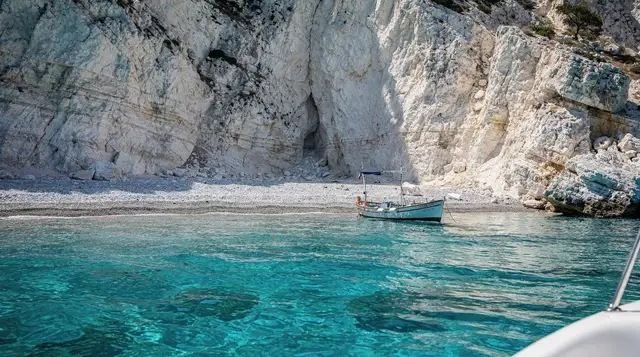
Nebida has its own small pebble beach, reached by a path down from the village that’s steep but shorter than the descent at Masua. Because most day-trippers bypass Nebida entirely for the more famous stop down the coast, this beach stays noticeably quieter even in August. It’s not a wide sweep of sand — expect pebbles, clear water and limited space — but for anyone who’d rather skip a crowd than see the single most photographed sea stack in Sardinia, it’s the better trade.
The mining heritage behind the ruins
Nebida, like Masua and Iglesias, belonged to the Iglesiente mining district that made this stretch of Sardinia one of Europe’s major sources of lead, zinc and silver from the 19th century through the 1960s and 70s. The Laveria Lamarmora processed ore hauled down from inland mines before it was loaded onto ships — the same basic function as Masua’s Porto Flavia tunnel, just above ground rather than carved into the cliff face.
The whole coastline, from Nebida down through Masua and Buggerru, now falls within the Parco Geominerario Storico e Ambientale della Sardegna, recognised by UNESCO in 1998 as the world’s first geopark — a formal acknowledgment that this landscape’s industrial scars are as much a heritage site as the nuraghi elsewhere on the island. For a broader look at the archaeology and geology that give this coast its shape, see the best caves in Sardinia guide, since several of the district’s old mine tunnels and natural caves sit within a short drive.
A guided hike along this stretch, covering both Nebida and Masua’s landmarks with proper context on the mining history, is the most efficient way to see it without missing the details a passing photo stop skips over:
Panoramic hiking tour from Nebida to MasuaFor a deeper, private look at the district’s mining sites specifically, including areas not obvious from the road:
Private tour of the Iglesiente mines, Nebida and MasuaGetting there and combining it with the rest of the coast
Nebida is about 15 minutes by car from Iglesias on the SP83, and 5-10 minutes north of Masua on the same road. There’s no meaningful public transport option covering this coast — a hire car is the only practical way to see it, and the same applies to the rest of the Sulcis-Iglesiente coastline covered in driving in Sardinia and renting a car in Sardinia. Average driving speeds on roads like the SP83 run well under what a map’s distance suggests — narrow curves and photo stops both slow things down — so build in more time than a GPS estimate implies.
Most visitors treat Nebida as a 20-30 minute stop bolted onto a half day covering Masua and possibly Buggerru or Iglesias itself. It fits naturally into a broader loop of the west coast; see the west coast Sardinia 7-day itinerary for how this stretch slots into a longer trip.
What isn’t worth the detour
There’s genuinely very little to see in Nebida beyond the Laveria Lamarmora, the coastal viewpoints and the beach — the village itself is a scattering of houses with no real centre, restaurants or shops to speak of. Anyone expecting a town in the conventional sense, with a piazza and a choice of places to eat, should plan to base themselves in Iglesias instead and treat Nebida purely as a scenic stop.
A realistic half day
Late morning: drive the SP83 from Iglesias, stopping at Nebida’s viewpoints over the Laveria Lamarmora (20-30 minutes). Early afternoon: continue to Masua for the beach, Pan di Zucchero viewpoint and, if timed right, a Porto Flavia tour. Late afternoon: loop back through Nebida for a second, better-lit look at the Laveria before heading back to Iglesias for dinner. This whole route, done unhurried with stops, comfortably fills a half day without needing an overnight stay on this stretch of coast — where to stay in Sardinia has broader guidance if a longer base nearby appeals.
Frequently asked questions about Nebida
Is the Laveria Lamarmora safe to walk right up to?
The ruin itself is fenced off from public access in the most exposed sections, and it’s viewed from the road and a couple of marked pullouts rather than walked into. There’s no official visitor path inside the structure, and the drop beyond it is real — stick to the designated viewpoints.
Can I swim at Nebida’s beach?
Yes — it’s a small pebble beach with clear water, reached by a steep but short path down from the village. It has no lifeguard and minimal facilities, so it suits confident swimmers who don’t need services rather than families looking for a full day at the beach.
Is Nebida worth visiting if I only have time for one stop on this coast?
If a single stop is all you have, Masua’s Pan di Zucchero is the more famous sight and probably the better single choice for most first-time visitors. But if the goal is fewer crowds and a genuinely distinctive photo, Nebida’s Laveria Lamarmora holds its own and takes far less time to see.
What’s the best time of day to photograph the Laveria Lamarmora?
The last two hours before sunset, when low light rakes across the stonework and the sea beyond turns a deeper blue. The ruin is also floodlit after dark for a different, moodier shot.
Do I need a guide to see Nebida properly?
No — the viewpoints are accessible by anyone driving the SP83, and there’s no ticketed site to navigate. A guided hike adds historical context on the mining operations that isn’t obvious just from looking at the ruin, which is the main reason to book one.
How does Nebida compare to Buggerru further south?
Buggerru is a small working town with a harbour, a museum and services; Nebida is a scenic stop with almost no infrastructure. They’re complementary rather than substitutes — Buggerru for a coffee and a wander, Nebida for the view.