National parks of Sardinia
How many national parks does Sardinia have?
Two formal national parks — Asinara and the La Maddalena archipelago — plus several regional parks and marine protected areas that function similarly, including Molentargius-Saline, Porto Conte, Tavolara-Punta Coda Cavallo and the Sinis-Mal di Ventre marine reserve. A long-proposed Gennargentu National Park in the mountainous interior was never formally established due to local opposition.
Two national parks, and a longer list of protected areas that matter just as much
Strictly speaking, Sardinia has two national parks: Asinara, the former prison island off the north-west coast, and the** La Maddalena archipelago**, seven granite islands scattered off the north-east near Palau. Both carry full national park status, the highest level of protection Italy grants.
What surprises most visitors is that a proposed third — Gennargentu National Park, covering the wild interior around the island’s highest peaks — was drafted in the 1990s and never formally established, blocked largely by local communities wary of restrictions on grazing and land use that never got resolved to everyone’s satisfaction. The area is still protected in pieces, through smaller regional reserves, but it never got the unified national park status that was once planned.
Beneath that top tier sits a wider network that, in practice, protects just as much of the island’s wildlife: regional parks like Molentargius-Saline and Porto Conte, WWF-managed oases like Monte Arcosu, and marine protected areas covering some of the clearest water on the island — Tavolara-Punta Coda Cavallo, Capo Carbonara, and the Sinis-Isola di Mal di Ventre reserve. For a visitor planning where to actually go, this wider list matters more than the formal national park designation, since several of the regional and marine reserves are easier to reach and just as rewarding.
| Protected area | Type | Where | Known for |
|---|---|---|---|
| Asinara | National park | Off Stintino, north-west | White donkeys, former prison, marine reserve |
| La Maddalena archipelago | National park | Off Palau, north-east | Granite islands, Napoleonic history, clear water |
| Molentargius-Saline | Regional park | Inside Cagliari | Wild flamingo colony, former saltworks |
| Tavolara-Punta Coda Cavallo | Marine protected area | Off Olbia/Golfo Aranci | Bottlenose dolphins, Tavolara island |
| Capo Carbonara | Marine protected area | Villasimius, south-east | Snorkelling, Isola dei Cavoli |
| Sinis-Isola di Mal di Ventre | Marine protected area | Cabras, west coast | Quartz beaches, wrecks, clear water |
| Monte Arcosu | WWF oasis | Inland from Cagliari | Sardinian deer, reintroduced |
| Giara di Gesturi | Protected natural area | Near Barumini, interior | Wild Giara horses |
Asinara: the island a century kept closed
Asinara only became a national park in 1997, the same year its prison — which once held mafia bosses under Italy’s strictest detention regime — finally closed. That closed history is why the island’s white donkeys, wild goats and mouflon range so freely today: nearly no development, no agriculture, and almost no permanent population for over a century. The full-day catamaran trip to Asinara island from Stintino is the standard way in — boat access only, no private cars once you’re there. Full detail on getting around the island, the donkeys and the marine reserve is in our dedicated Asinara National Park guide.
La Maddalena: Napoleon, Garibaldi, and some of Sardinia’s clearest water
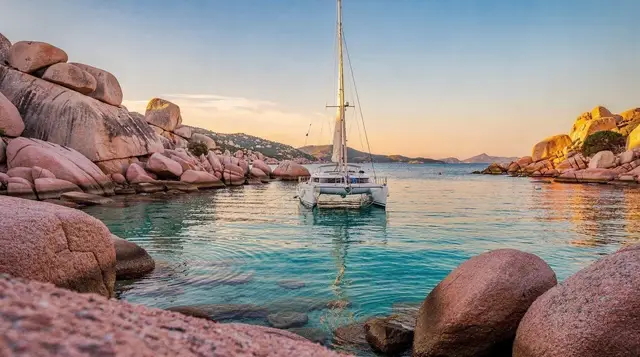
The La Maddalena archipelago’s seven main islands sit in the strait between Sardinia and Corsica, close enough that a young Napoleon Bonaparte tried and failed to take the fort here in 1793, and Giuseppe Garibaldi later chose Caprera, one of the group’s islands, as his final home. The archipelago’s water rivals Asinara’s for clarity, and boat trips from Palau or La Maddalena town reach beaches like Spiaggia Rosa (now off-limits to landing to protect its coral-pink sand) and Cala Coticcio, sometimes nicknamed “Tahiti” for its colour. See our La Maddalena archipelago boat tour guide for operators and routes.
Molentargius-Saline: a wetland inside the capital
Unlike Asinara and La Maddalena, Molentargius needs no boat and no permit — it’s a former saltworks turned regional park sitting inside Cagliari itself, home to a wild greater flamingo colony that’s bred here since 1993. Walking the park is free; the EcoSafari flamingos tour in Molentargius Park and the Conti Vecchi salt flats train and tour both add guided context and the site’s industrial saltworks history, which the flamingos now share the landscape with.
Tavolara-Punta Coda Cavallo: dolphins off the north-east coast
This marine protected area, stretching from Olbia’s gulf past Golfo Aranci to Tavolara island, is Sardinia’s most reliable spot for wild bottlenose dolphin sightings, with a resident population and operators reporting sighting rates around 80% in season.
The Olbia dolphin watching and snorkelling boat tour and the Golfo Aranci dolphin watching and snorkelling boat tour both work this reserve; our dolphin watching in Sardinia guide covers every operator and what a trip actually involves.
The rest of the network: marine reserves, oases and the Giara
South of Cagliari, Capo Carbonara protects the water off Villasimius, including Isola dei Cavoli, and ranks among the island’s best snorkelling without a boat trip needed to reach it from shore in several spots. On the west coast, the Sinis-Isola di Mal di Ventre marine reserve off Cabras protects both the quartz sands of Is Arutas and a scatter of ancient shipwrecks in clear, current-swept water — see our Sinis peninsula coverage for access details.
Inland, the WWF’s Monte Arcosu oasis, in the hills behind Cagliari, holds Sardinia’s main population of Sardinian deer — a subspecies reintroduced here after coming close to extinction on the island in the mid-20th century — while the Giara di Gesturi plateau near Barumini protects the wild Giara horses, a small native breed found nowhere else. Neither carries national park status, but both function as genuine wildlife reserves; see the wild horses of the Giara for the horses specifically.
Why Gennargentu never became a national park
The Gennargentu massif, home to Punta La Marmora — Sardinia’s highest peak at 1,834m — and the wild Supramonte limestone plateau around it, was drafted as a national park in the early 1990s under Italian conservation law. Local opposition, largely over restrictions the designation would have placed on traditional grazing and hunting rights across a region where those practices run deep, meant the plan was never finalised.
The area retains real protection today through a patchwork of smaller reserves and its role within the wider Gennargentu-Supramonte hiking network, but it lacks the single unified national park status that Asinara and La Maddalena have. For visitors this mostly changes paperwork rather than access — the hiking, from Punta La Marmora to the Supramonte gorges, remains some of the best on the island regardless of the formal designation. See our hiking in Sardinia and Supramonte hiking guide for routes.
Planning a wildlife-focused trip around Sardinia’s protected areas
Because the parks and reserves are spread across the whole island, most visitors pick two or three rather than attempting all of them. A north-east base near Olbia covers La Maddalena and Tavolara-Punta Coda Cavallo easily; a north-west base near Alghero or Stintino puts Asinara and Porto Conte within reach; and Cagliari covers Molentargius and Capo Carbonara without much driving.
See Sardinian wildlife: what you can see for a species-by-species overview and birdwatching in Sardinia for the island’s bird-focused sites specifically. Our renting a car in Sardinia and driving in Sardinia guides cover getting between them, since public transport rarely reaches these areas directly.
What each park actually costs, and how long to allow
Costs vary sharply between the two national parks and the wider network of regional and marine reserves. Asinara’s boat crossing runs from roughly €35-55pp for an organised full or half-day tour including a guide and swim stops, with bike hire on the island itself adding a further €10-15 if you don’t book a tour that already includes cycling. La Maddalena boat trips sit in a similar range, typically €40-60pp for a half-day covering several of the archipelago’s beaches, more if lunch is included.
Molentargius costs nothing to walk independently; a guided EcoSafari or bike tour runs roughly €20-40pp for 1.5 to 3 hours. Entry to the marine protected areas at Tavolara-Punta Coda Cavallo, Capo Carbonara and Sinis-Isola di Mal di Ventre is free from shore, though snorkelling or diving trips into the reserve itself carry the operator’s own pricing on top.
Allow a full day for Asinara or La Maddalena once travel time to the departure port is factored in — neither is a realistic half-day add-on unless you’re already staying in Stintino, Porto Torres or Palau. Molentargius needs as little as an hour for a focused walk to the nearest viewing point, or half a day if you’re combining a guided tour with time at Poetto beach next door. Monte Arcosu and the Giara di Gesturi are best treated as a half-day each, since both sit some distance inland from the coastal bases most visitors use.
Camping and overnight stays: what’s realistic
None of the protected areas covered here allow camping on-site, which catches out a small number of visitors expecting a wilder, more permissive setup than mainland Italy’s national parks sometimes offer. Asinara has no public accommodation of any kind — every visit is a day trip departing from and returning to Stintino or Porto Torres, and overnighting on the island isn’t an option for tourists. La Maddalena is less restrictive: the town of La Maddalena itself has hotels and B&Bs, and campsites operate on the Sardinian mainland near Palau for travellers touring by camper van, but wild camping on the archipelago’s islands is not permitted and is enforced.
Molentargius, being an urban park inside Cagliari, is a day-use site by nature — nobody expects to camp there, but it’s worth noting for anyone assuming a dawn stakeout inside the park boundary outside organised, permitted activity is allowed; it generally isn’t. For overnight stays near any of these parks, our where to stay in Sardinia guide covers basing yourself in Stintino, Palau or Cagliari specifically for a parks-focused itinerary.
Photographing the parks: light, access and what’s realistic
Asinara’s donkeys are most active — and most approachable for a photograph — in the two hours after sunrise and before sunset, when they graze in open ground near Cala Reale rather than resting in shade through the heat of the day; a minibus tour timed for an early departure gives a real advantage over a midday booking. La Maddalena’s granite coastline photographs best from the water, since the pink-tinted quartz sand and turquoise shallows that make the archipelago famous are largely inaccessible on foot — a boat tour with an early or late departure avoids both the crowds and the flat, harsh light of midday.
Molentargius rewards patience over travel: arrive at Bellarosa Minore in the first hour after sunrise, when the flamingos feed most actively and the low light picks out their colour against the still water, and bring a telephoto lens or binoculars, since the birds keep a genuine distance from the paths. None of the parks allow drone photography without separate authorisation, which in practice means very few visitors bother pursuing it — check current rules directly with the park authority if aerial shots matter to your trip.
Frequently asked questions about Sardinia’s national parks
How many true national parks does Sardinia have?
Two: Asinara and the La Maddalena archipelago. A third, Gennargentu, was proposed in the 1990s but never formally established.
Do you need to pay to enter Sardinia’s national parks?
Access itself is generally free, but reaching Asinara and La Maddalena requires a paid boat crossing, and organised tours on both islands carry their own cost. Molentargius, by contrast, is free to enter and walk on foot from the mainland.
Which park is best for a day trip without a boat?
Molentargius-Saline, inside Cagliari, needs no boat and no advance booking, making it the most accessible of the protected areas covered here.
What happened to the plan for a Gennargentu National Park?
It was drafted in the early 1990s but never finalised, largely due to local opposition over restrictions on grazing and traditional land use. The area remains protected through smaller regional reserves instead.
Which marine protected area has the best chance of dolphin sightings?
Tavolara-Punta Coda Cavallo, off Olbia and Golfo Aranci, has the island’s most established dolphin-watching operators and a resident bottlenose dolphin population.
Can you see wildlife in Sardinia’s parks without joining an organised tour?
Yes for Molentargius and several marine reserves accessible from shore, but Asinara, La Maddalena and most dolphin-watching require a boat, which in practice means booking a tour or a scheduled ferry.
Can you camp inside any of Sardinia’s national parks?
No. Asinara has no public accommodation at all, and wild camping isn’t permitted on the La Maddalena archipelago’s islands either — an overnight stay means basing yourself in Stintino, Porto Torres or Palau instead.
How much does a typical park visit cost?
Molentargius is free to walk independently. Asinara and La Maddalena boat trips typically run €35-60pp for a half or full day, with guided tours and bike hire adding to that. The marine reserves are free to view from shore.
Nature & wildlife tours on GetYourGuide
Verified deep-linked GetYourGuide tours. Book through these links and we earn a small commission at no cost to you.
These are our own photographs of Sardinia, not the operator's pictures of this tour — open the tour page to see those.