Asinara National Park guide
Can you visit Asinara island and how do you get there?
Yes. Asinara has no permanent residents and no bridge — access is by boat only, almost always from Stintino or Porto Torres. There are no private cars on the island itself; visitors get around by park minibus, rented bike, on foot, or by boat tour along the coastline.
An island that spent a century keeping people out
Asinara sits off the north-western tip of Sardinia, a 20km-long sliver of granite and scrub visible from Stintino’s La Pelosa beach on a clear day.
For most of the 20th century it was closed to the public for reasons that had nothing to do with conservation: from 1885 it held a quarantine station and leper colony, and from 1885 to 1997 it operated as a high-security prison, eventually housing mafia bosses under Italy’s strictest detention regime after the 1992 assassinations of judges Falcone and Borsellino. The prison closed in 1997 and the island became a national park the same year — one of only two true national parks in Sardinia, alongside the La Maddalena archipelago.
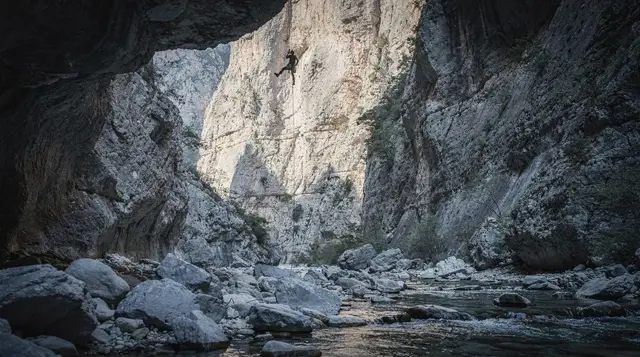
That closed history is exactly why Asinara today feels unlike anywhere else on the island. A century with no agriculture, no roads built for cars, and almost no permanent population left the interior close to wild, and the coastline — now a fully protected marine reserve — has some of the clearest water in Sardinia. The old prison blocks at Cala d’Oliva and Fornelli still stand, roofless in places, walked past rather than restored, which makes the visit as much a piece of recent history as a nature outing.
| Where | Off Stintino, north-west Sardinia; boat access only |
| Access points | Stintino (most frequent) or Porto Torres |
| Getting around on the island | Park minibus, rented bike or e-bike, on foot; no private cars |
| Marine reserve | Yes — full protection zones around Cala Reale and Cala d’Oliva |
| Best season | May to September for swimming; spring for wildflowers and cooler walking |
| Signature sighting | The white Asinara donkey, found nowhere else in the wild |
The white donkeys, and why they’re white
Asinara’s best-known residents are its donkeys — small, stocky, and genuinely white or very pale grey rather than the usual grey-brown, a result of a genetic condition (leucism, not albinism, since their eyes are dark rather than pink) that’s unusually common in this isolated population. They roam freely across the island with no fencing, alongside wild goats descended from farm stock abandoned when the prison closed, and mouflon that were introduced decades ago and now breed wild in the scrubland. None of them are dangerous, all keep a natural distance, and none should be fed — despite what it might look like on a busy August day, this is a protected population, not a petting zoo.
Sightings are close to guaranteed rather than certain: the donkeys favour open ground near Cala Reale and along the tracks between the old prison sites, and most organised tours build in at least one stop where they’re reliably grazing.
Boat access: catamaran, sailboat or speedboat from Stintino
Almost every visit to Asinara starts with a short crossing from Stintino, which sits closer to the island than Porto Torres and runs more frequent departures. Full-day trips are the standard format and typically combine a landing on Asinara with swim stops along the marine reserve’s coastline on the way there or back.
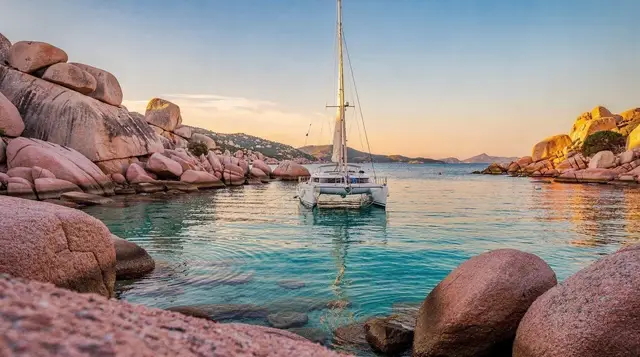
The full-day catamaran trip to Asinara island is the most complete single option — a full day, a proper landing on the island, and swim stops in the reserve’s clearest coves. For a shorter outing, the half-day speedboat tour to Asinara covers the crossing and a landing in roughly half the time, useful if you’re also trying to fit in La Pelosa beach the same day.
The catamaran tour with lunch and swim stops adds a meal aboard, which suits a full day without needing to plan food on the island itself, where facilities are limited to a couple of seasonal kiosks.
Travellers who’d rather sail than motor have options too. The vintage sailing boat tour to Asinara with lunch covers the same water at a slower pace under sail, and the 15-metre sailboat trip combining La Pelosa and Asinara pairs the island with a pass along Sardinia’s most photographed beach in a single outing — a sensible choice if you want both without a second day.
Getting around once you’re on the island
Private cars have never been allowed on Asinara and still aren’t — the roads are narrow, unsealed in stretches, and the whole point of the park’s management is to keep motor traffic minimal. Visitors move around by the park’s own minibus service, by rented bike or e-bike, or on foot.
The Asinara minivan tour from Stintino is the easiest way to cover real distance across the island in a single day, taking in the former prison buildings at Fornelli and Cala d’Oliva plus the best donkey-spotting stretches, without needing to cycle in summer heat.
If you’d rather cover the ground under your own power, renting a mountain bike in Porto Torres lets you bring your own pace to the island’s gravel tracks — worth it for the coastal stretches a minibus tour won’t stop at for long, though it demands a reasonable fitness level given the island’s modest but real hills and the lack of shade for most of the route.
Water beyond the boat trip: kayaking and diving-grade clarity
Asinara’s marine protected area extends well beyond the coves that day-trip boats stop at, and the water quality here is a genuine step up from most of the Sardinian coastline — a byproduct of a century with essentially no coastal development. The guided kayaking excursion from Porto Torres gets you closer to the shoreline than any motorised tour can, paddling into inlets that catamarans skip because of their draught, with a guide who knows which stretches of the reserve allow closer approach.
A rest day around the crossing: Stintino itself
Because most Asinara trips depart from Stintino, it’s worth treating the town as more than a boarding point. The sunset hike at Capo Falcone with a tasting covers the headland directly opposite Asinara, with views back across the strait that most day-trippers never see since their boat has already left by sunset. For an evening after a long day on the water, the Italian cuisine dinner in a villa is a low-key alternative to Stintino’s busier seafront restaurants in peak season.
What a day on Asinara actually looks like
A typical full-day boat trip leaves Stintino’s harbour by mid-morning, crosses the strait in 30 to 45 minutes depending on the operator and boat type, and spends the middle of the day on the island — either touring by minibus with fixed photo stops, or with free time to walk from the landing point at Cala Reale or Cala d’Oliva. Most operators build in one or two swim stops in the marine reserve, either on the crossing or on the return leg. Expect to be back in Stintino by early evening. Facilities on the island are minimal by design: a couple of seasonal snack points, no shops of note, and no accommodation open to the public, so this is a day trip rather than an overnight, whatever the season.
Combining Asinara with the rest of the north-west
Asinara pairs naturally with the rest of a north-west Sardinia stay. Stintino itself and our dedicated La Pelosa beach guide cover the mainland side of the strait, while Alghero, 45 minutes south, has its own coastline covered in Alghero and Capo Caccia boat trips.
If Asinara is one stop on a longer wildlife-focused trip, see national parks of Sardinia for how it compares with the wild horses of the Giara further south, and Sardinian wildlife: what you can see for the island’s other notable species. Anyone arriving by ferry through Porto Torres can fold Asinara into the first or last day of a trip without much detour, and our renting a car in Sardinia and driving in Sardinia guides cover getting to Stintino from either of the island’s main airports.
What a day trip to Asinara costs, in full
Prices vary by boat type and what’s included, but a realistic full-day budget runs €50-80pp for an organised catamaran or speedboat tour with a guide, a landing and at least one swim stop; sailing options run similar or slightly more given the slower, more scenic pace. Bike rental on the island itself, if not already bundled into a tour, adds roughly €15-25 for the day; the park’s own minibus service, where available independently of a tour, charges separately per stop rather than as a single day pass.
Lunch aboard, when included in catamaran packages, typically adds €10-20pp over a self-catered version, worth it for anyone who’d rather not carry food across a strait and back. Factor in Stintino parking if driving in for the day — free spaces exist but fill early in August — and a taxi or short walk from wherever you’re staying, since Stintino’s harbour sits at the edge of town rather than centrally.
The prison blocks up close: what you actually see
The former high-security prison at Fornelli and the settlement at Cala d’Oliva are the two most visited former-prison sites on the island, and both are viewed from outside rather than entered freely — cell blocks stand roofless and weather-worn in places, walked past on a minibus tour or a longer bike route rather than toured room by room. Fornelli held some of Italy’s most notorious mafia bosses under the strict “41-bis” isolation regime introduced after the 1992 killings of judges Falcone and Borsellino, and the isolation of the site — no bridge, no regular public ferry until the prison closed — was very much the point.
Cala d’Oliva, the island’s former administrative settlement, has a more lived-in feel, with the old warders’ housing and a small church still standing near the harbour where boats now land day-trippers rather than prison staff. Neither site has extensive signage in English, so a guided tour adds real context that a self-directed walk past the buildings won’t provide on its own.
Weather and sea conditions that can cancel a crossing
The strait between Stintino and Asinara is short but exposed, and a strong mistral from the north-west can make the crossing rough enough that operators cancel or delay sailings, most commonly in spring and autumn rather than the calmer peak summer months.
Cancellations are usually announced the morning of departure rather than days ahead, since forecasts this local change quickly; booking directly with an operator that offers a refund or rebooking policy for weather cancellations is worth checking before paying, particularly if Asinara is the single fixed point in a tightly planned itinerary. If a crossing looks marginal, the earlier morning departures generally have calmer water than early-afternoon sailings, since local thermal winds tend to build through the day in summer.
Frequently asked questions about visiting Asinara
Can you stay overnight on Asinara?
No public accommodation operates on the island; all visits are day trips departing from and returning to Stintino or Porto Torres the same day.
Is Asinara safe to visit given its prison history?
Yes — the prison closed in 1997 and the site now operates purely as a national park. The former cell blocks are viewed from the outside on organised tours rather than entered freely.
Do you need to book a tour, or can you just take a ferry over?
Scheduled public ferry services exist in season, but most visitors book an organised boat tour because it bundles the crossing with transport around the island — without a minibus, bike or long walk arranged in advance, options for actually seeing the island once you land are limited.
Are the white donkeys guaranteed to be visible?
Not contractually, since this is a wild population, but sightings are highly likely — most tours stop specifically where the donkeys are known to graze, and the island’s small size makes an encounter more likely than not on any given visit.
What should I bring for a day on Asinara?
Water, sun protection, comfortable walking or cycling shoes, and swimwear if your tour includes a stop in the marine reserve. Food options on the island are limited to a few seasonal kiosks, so pack lunch if your tour doesn’t include one.
Is Asinara suitable for a half-day trip, or does it need a full day?
Half-day speedboat options exist and are worth it if time is tight, but they cover a fraction of the island. A full-day catamaran or minivan tour is the better choice if Asinara is the priority for the day rather than a quick add-on.
What does a full day on Asinara typically cost?
Budget €50-80pp for an organised boat tour with a guide and at least one swim stop; bike rental and lunch, where not already included, add a further €15-40 depending on what you book.
Can bad weather cancel an Asinara boat trip?
Yes — the strait can get rough in a strong mistral, most often in spring and autumn. Cancellations are usually decided the morning of departure; check an operator’s weather policy before booking if your dates are tight.
Is mobile phone signal available on Asinara?
Patchy at best — coverage exists near Cala Reale and Cala d’Oliva but drops out across much of the interior and along parts of the coast, so don’t rely on it for navigation once away from the main landing points.
Nature & wildlife tours on GetYourGuide
Verified deep-linked GetYourGuide tours. Book through these links and we earn a small commission at no cost to you.
These are our own photographs of Sardinia, not the operator's pictures of this tour — open the tour page to see those.