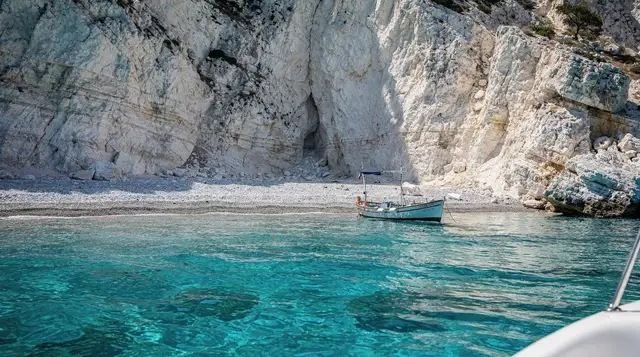
Palau is the working harbour town that everyone travelling to the La Maddalena archipelago passes through, and it has quietly become one of the best value bases in Gallura as a result. It sits on a granite headland facing the islands directly — on a clear day you can see Caprera, Spargi and the outline of Corsica from the seafront — and every boat company running trips into the archipelago’s protected waters operates out of its harbour, which means genuine competition on price rather than the near-monopoly pricing you find in Porto Cervo or Baja Sardinia.
The town itself is modest: a main street, a scattering of decent seafood restaurants, and a granite outcrop above the harbour carved by wind into the shape of a bear — Roccia dell’Orso, the Bear Rock — that gives sweeping views over the strait for a small entrance fee. What draws people here isn’t the town, though, it’s the water: the channel between Palau and the archipelago is some of the clearest in the western Mediterranean, and the beaches on Budelli, Spargi and Santa Maria are frequently ranked among the best in Italy.
Boat trips into the archipelago
This is Palau’s reason for existing on a Sardinia itinerary. The La Maddalena archipelago is a national park covering seven main islands and dozens of granite islets, almost all of it accessible only by boat, and Palau has the widest range of operators and boat types of any port in Gallura — bigger than Santa Teresa Gallura to the north and far more choice than Porto Pollo just south.
For a first visit, a full-day boat tour with four stops around the archipelago is the sensible option — it covers Budelli’s famous pink-sand coastline (viewed from the water; landing is banned), Santa Maria’s shallow turquoise bay, and usually a stop at Spargi or Razzoli, with swimming time at each. Groups run 20 to 40 people on these boats, which keeps the price down but means you’re not choosing your own pace.
If you’d rather set your own itinerary, a speedboat tour capped at ten people costs more per head but covers ground faster and lets the skipper adjust the route around wind and crowds — worth it in July and August when the bigger boats’ usual anchorages get busy by mid-morning. For a slower day with lunch included, a small-group sailing trip with lunch on board trades speed for comfort and works well for couples or older travellers who’d rather not scramble in and out of a RIB.
Divers should look separately at diving La Maddalena, since the archipelago’s clear water and wrecks (including a WWII-era shipwreck near Caprera) are a genuine draw independent of the sightseeing boats. Compare all the formats in our La Maddalena archipelago boat tour guide before booking — price differences of €30 to €40 between near-identical routes are common, and they usually come down to boat size and how many stops are actually included rather than promised.
Private speedboat charters are the other option worth knowing about. a private speedboat tour taking in Caprera and the archipelago works well for a family or group of friends who’d rather not share a boat with strangers, and it opens up the option of requesting specific stops — Cala Coticcio on Caprera, sometimes called Tahiti Beach for its colour, is a common request that the bigger group tours rarely include because the approach is tight for a large hull.
A shorter alternative, a four-hour RIB tour of the archipelago, suits anyone short on time who still wants the open-water speed and spray of a rigid inflatable without a full-day commitment.
| What | Where from | How long | Typical price |
|---|---|---|---|
| Full-day archipelago tour, 4 stops | Palau harbour | 7–8 hours | €55–€75 |
| Small-group speedboat tour | Palau harbour | 4–5 hours | €90–€130 |
| Roccia dell’Orso (Bear Rock) | Above Palau town | 1 hour | €8 entry |
| Ferry to La Maddalena town | Palau port | 15 minutes | €4 one-way, cars extra |
Palau versus staying on La Maddalena itself
A question worth answering directly: should you base yourself in Palau or cross over and sleep on La Maddalena island instead? Both work, and the choice mostly comes down to what else is on your itinerary. Palau has better road links to the rest of Gallura — Arzachena, the Costa Smeralda towns and Santa Teresa Gallura are all a short drive away, which matters if boat trips aren’t the only thing on your list. La Maddalena town, by contrast, is entirely car-optional: everything is walkable, the pace is slower, and you wake up already inside the national park rather than needing a morning ferry crossing.
For a trip built entirely around the archipelago, La Maddalena town is arguably the better sleep; for anyone combining boat days with beach towns, vineyards or a wider Gallura loop, Palau’s mainland position and wider transport links make more sense. The ferry between the two runs constantly and costs little, so it’s also entirely possible to stay in one and spend an evening in the other.
Getting to Palau
Olbia Costa Smeralda airport is around 45 minutes by car via the SS125, and there’s no direct bus — a taxi runs roughly €70 to €80, so most visitors rent a car at the airport. If you’re arriving from Corsica, the car ferry from Bonifacio to Santa Teresa Gallura lands 25 minutes up the coast; see the Bonifacio-Santa Teresa ferry guide for schedules. There’s also a passenger and car ferry running constantly between Palau and La Maddalena town, a 15-minute crossing that runs year-round and doesn’t need booking outside peak weekends.
The Bear Rock and around town
Roccia dell’Orso sits on the headland above town and is worth the short drive or 25-minute walk up: the granite has been sculpted by wind into a genuine bear shape, and the platform beside it gives one of the best panoramic views in Gallura, taking in the whole archipelago and, on a clear day, Corsica’s mountains. It gets busy at sunset in July and August; go mid-morning instead for the same light with a fraction of the crowd. Below town, Porto Rafael is a small, deliberately pastel-painted hamlet worth a wander if you’re staying nearby, and the coast road towards Santa Teresa Gallura passes several small coves worth a stop if you have a car.
Palau’s own beaches are modest compared to the archipelago’s, but two are worth knowing about if you don’t want to book a boat every day: Porto Faro, a small sandy stretch a short walk from the centre, and La Sciumara, slightly further out and quieter. Neither will compete with a day on Budelli or Spargi, but they’re a reasonable option for a lower-key afternoon between excursions, and neither requires advance booking or a quota system.
Where to stay and eat
Palau’s accommodation runs from simple B&Bs to comfortable mid-range hotels, most of them clustered around the harbour and the streets running up from it — proximity to the port matters here, since most days start with an early boat departure. Prices sit well below Porto Cervo and Porto Rotondo for equivalent quality, which is a large part of why Palau has become the default base for archipelago trips rather than staying directly on La Maddalena itself.
Restaurants lean toward straightforward, well-executed seafood: grilled catch of the day, spaghetti with sea urchin when in season, and the local Vermentino di Gallura on almost every wine list — see our Vermentino di Gallura guide for what to look for. Reserve ahead in July and August for the harbourside terraces with archipelago views; elsewhere in town, walk-ins are usually fine even in peak season.
Frequently asked questions about visiting Palau
How many days should I spend in Palau?
Two to three days covers one full archipelago boat trip, a half-day at the Bear Rock, and time to relax on a local beach; add a day if you’re planning to stay overnight on La Maddalena or Caprera as well.
Can I land on Budelli’s pink beach?
No — access on foot has been banned since 1994 to protect the pink coral sand from erosion; boat tours pass close by for photos but don’t allow landing.
Is Palau expensive compared to the Costa Smeralda?
No, and that’s its main appeal: hotels, restaurants and boat trips run noticeably cheaper than Porto Cervo or Porto Rotondo, 20 to 30 minutes’ drive away.
Do I need to book the archipelago ferry in advance?
The Palau–La Maddalena car and passenger ferry runs frequently and rarely needs advance booking outside peak August weekends, when bringing a car across is worth reserving ahead.
Is Palau suitable as a base without a car?
It’s manageable — the harbour, town centre and most restaurants are walkable, and boat tours depart on foot from the port — but reaching the Bear Rock or nearby beaches independently is much easier with a car.
What’s the best time of day for a boat tour from Palau?
Morning departures, typically 9am, give calmer water and first access to the best anchorages before the bigger tour groups arrive around midday.
Is a private speedboat charter worth the extra cost over a group tour?
For a family or small group wanting flexibility on stops — particularly harder-to-reach coves like Cala Coticcio on Caprera — yes; for a solo traveller or couple happy to follow a set itinerary, a group tour offers better value.
Are there decent beaches in Palau itself, or do I need a boat every day?
Porto Faro and La Sciumara are modest but workable town beaches for a lower-key day; they’re not a substitute for the archipelago, but useful for a rest day between boat trips.