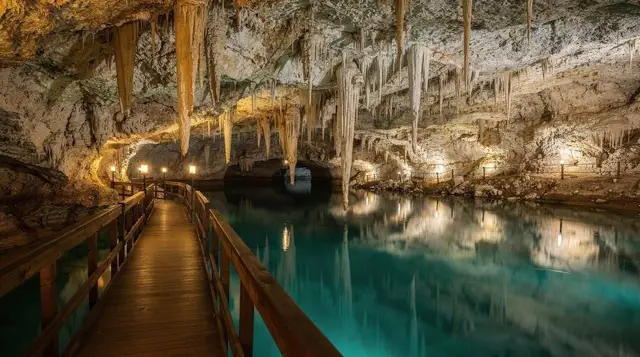
Is Zuddas cave in the Sulcis, famous for its crystal formations
Where is Is Zuddas cave and how do you get there?
Is Zuddas sits near Santadi in the Sulcis-Iglesiente, southwest Sardinia, roughly an hour's drive from Cagliari. It's most easily reached by hire car, though it's also sold as a shore excursion from Cagliari's cruise port for visitors without their own transport that day.
Is Zuddas cave, near Santadi in the Sulcis-Iglesiente region of southwest Sardinia, is the island’s least visited of the well-known show caves, and also one of the geologically rarest — its aragonite formations include the delicate, gravity-defying “excentriche” crystals that grow at odd angles rather than straight down, a formation type found in only a handful of caves worldwide. It sits far enough from the main coastal resorts that most visitors reach it deliberately rather than in passing, which keeps the experience noticeably quieter than Neptune’s Grotto or Bue Marino at the height of summer.
| Where | Near Santadi, Sulcis-Iglesiente, roughly an hour’s drive from Cagliari |
| Main feature | Rare aragonite “excentriche” crystal formations |
| Access | By hire car, or as a shore excursion from Cagliari’s cruise port |
| Ticket | Around €10-12 adult, guided tour included |
| Time needed | About 50 minutes for the guided walk |
What makes the crystals unusual
Most cave formations grow in predictable directions, governed by gravity pulling mineral-laden water straight down to form stalactites and stalagmites. Is Zuddas’s aragonite “excentriche” formations break that pattern, branching and curling in seemingly random directions as capillary action rather than gravity drives their growth — a rarer process that produces genuinely strange, coral-like shapes rather than the classic pointed columns most visitors expect from a cave. Guides typically single these out early in the tour, since they’re the reason the cave has any wider reputation at all despite its remote location.
How the excentriche formations form, in more detail
Where a typical stalactite grows straight down under gravity’s pull, following the path of least resistance for a falling drop of water, aragonite excentriche formations grow through capillary action — water seeping slowly through microscopic pores in the crystal structure itself, depositing mineral in whatever direction that seepage happens to travel, largely independent of gravity. The result is formations that branch, curl and twist at angles that look almost deliberately sculpted, some resembling coral, others closer to frost patterns frozen in stone.
Aragonite itself is a calcium carbonate mineral, chemically similar to the calcite that forms most standard stalactites, but it crystallises in a different structure that makes this eccentric growth pattern possible under the right humidity and mineral conditions — conditions that Is Zuddas happens to preserve unusually well, which is precisely why the cave has the reputation it does among specialists despite its modest visitor numbers compared to the coastal caves.
Reaching it from Cagliari
For visitors without their own car, or those arriving by cruise ship into Cagliari, a shore excursion covering the drive out to Santadi and the guided cave tour is the simplest way to see it without arranging independent transport:
Is Zuddas caves shore excursion from CagliariThe drive from Cagliari takes roughly an hour each way through the Sulcis countryside — vineyards, cork oak forest, and the occasional abandoned mining structure that marks this whole region’s industrial past — so budget close to half a day for the round trip plus the visit itself if you’re arranging it independently.
The wider Sulcis-Iglesiente context
The Sulcis-Iglesiente region, tucked into Sardinia’s southwest corner, carries a distinct identity from the rest of the island, shaped over more than a century by intensive lead, zinc and coal mining that only wound down definitively toward the end of the twentieth century.
Abandoned mining infrastructure — pitheads, worker housing, narrow-gauge railway lines — still marks much of the landscape between Is Zuddas and the coast, giving the whole area a slightly melancholic, post-industrial character that contrasts sharply with the resort towns of the Costa Smeralda or the beach-focused south around Chia and Villasimius. It’s a region that rewards visitors with a genuine interest in Sardinia’s economic and social history rather than those purely chasing beaches, and Is Zuddas fits naturally into that slower, more exploratory kind of day.
Pairing Is Zuddas with the Sulcis mining coast
The Sulcis-Iglesiente region’s other headline attraction is its abandoned mining heritage along the coast near Masua and Nebida, where the Porto Flavia complex — a mineral-loading tunnel cut straight through a cliff, opening dramatically onto the sea — makes a natural pairing with a cave visit given the shared geological and industrial history of the area. A guided canyoning-style descent through the old mine shafts is the more adventurous version of a Porto Flavia visit, worth considering if you want to add some adrenaline to an otherwise sightseeing-focused day:
Canyoning descent at the old Porto Flavia mine, MasuaIglesias, the regional hub town, and Carbonia both make sensible overnight bases if you want to explore the Sulcis-Iglesiente properly rather than treating Is Zuddas as a rushed day trip from Cagliari, and Buggerru adds a beach stop with its own mining-era backdrop to the same itinerary.
How it compares to Sardinia’s other caves
If you’ve already seen Neptune’s Grotto or Bue Marino and are wondering whether Is Zuddas adds anything new, the honest answer is yes, geologically — the excentriche formations genuinely aren’t replicated at the island’s other show caves — but the overall visitor experience is smaller in scale, without a boat crossing or dramatic cliff setting to pad out the day. For a broader tour comparing all of the island’s caves side by side, including which suits which kind of traveller, see the best caves in Sardinia:
Bue Marino cave guided tour with entry ticket, from Cala GononeSantadi and the local wine
The nearby village of Santadi, the closest settlement to Is Zuddas, sits in a small but well-regarded wine district known particularly for Carignano del Sulcis, a robust red made from old, low-yielding bush vines that thrive in the area’s sandy coastal soils — a different grape and style from the Cannonau more commonly associated with Sardinia’s interior.
The local cooperative winery runs tastings and cellar visits that pair naturally with a cave visit, offering a practical way to fill out a day that would otherwise be a single, relatively short stop. Sardinian food and wine and wine tours in Sardinia both cover this side of the island in more depth if the Sulcis wine district turns out to be more interesting to you than the cave itself.
Shore excursion versus independent car hire
For cruise visitors calling at Cagliari, the calculation between a shore excursion and independent car hire mostly comes down to time and risk tolerance. A shore excursion guarantees you’ll be back at the port before the ship departs, handles the drive and language logistics, and requires no independent planning — genuinely valuable given how far Is Zuddas sits from Cagliari relative to a typical port stay.
Independent car hire is cheaper if you’re travelling in a larger group able to split the cost, and gives more flexibility to add the Sulcis mining coast or a Santadi wine stop to the same day, but carries real risk if traffic or a wrong turn eats into your return margin — cruise ships don’t wait for late passengers. For a first visit to this part of Sardinia on a constrained port day, the shore excursion is the lower-stress choice; independent hire suits travellers with more time margin or those staying in Sardinia overnight rather than on a cruise itinerary.
What to expect if you’re not a cave specialist
If you’re visiting Is Zuddas as a general traveller rather than someone with a specific interest in cave geology, it’s worth setting expectations honestly: the guided walk is informative and the crystal formations are genuinely striking once pointed out, but the overall visitor experience — a fixed 50-minute walkway tour with a guide narrating in a mix of Italian and English — is less immediately dramatic than the scale of Neptune’s Grotto or the boat approach to Bue Marino.
Most visitors who make the trip do so either because they’re already exploring the Sulcis-Iglesiente for its mining history and wine, or because they specifically sought out a quieter, less touristy alternative to the coastal caves. Coming in with that context tends to produce a more satisfying visit than expecting a headline attraction on the scale of the island’s better-known caves.
Getting there
By car, Is Zuddas is reached via the SS130 toward Iglesias then local roads to Santadi, roughly an hour from Cagliari — see driving in Sardinia and renting a car in Sardinia for general planning. Day trips from Cagliari covers other options for the same base if the cave alone doesn’t fill a full day for you.
Family and group ticket prices in 2026
Adult admission sits around €10-12, with a reduced children’s rate typically €6-8 for roughly ages 6-12 and free entry for younger children with a paying adult, broadly in line with pricing at Sardinia’s other show caves. Because Is Zuddas sees meaningfully fewer visitors than the coastal caves, group bookings for ten or more people can sometimes negotiate a modest per-person reduction directly with the site rather than through a platform — worth a phone call ahead if travelling as a larger family or friend group planning to combine the cave with a Santadi wine stop on the same day.
The shore excursion price bundles the cave ticket into the overall tour cost rather than charging separately, generally working out similar to or slightly above the combined cost of independent car hire and admission for a solo traveller, but cheaper per person once split across a fuller cruise excursion group. There’s no meaningful price difference between visiting in July or in a quieter shoulder month — admission stays flat year-round, and the only real seasonal variable is how far in advance a shore excursion slot needs booking during the busiest cruise weeks.
Frequently asked questions about Is Zuddas cave
What is the “excentriche” crystal formation?
A rare type of aragonite mineral growth that branches in unpredictable directions rather than following gravity straight down, found in only a small number of caves worldwide and one of Is Zuddas’s main draws for cave specialists.
How long does a visit take?
The guided walk itself takes around 50 minutes; including the drive from Cagliari, budget close to half a day for the full round trip.
Is Is Zuddas suitable for children?
Yes, generally — the walk is not physically demanding, though as with any cave, temperatures are cooler than outside and the ground can be uneven and slippery in places.
Can you visit Is Zuddas without a car?
Independently, it’s difficult without a car since there’s no direct public transport link; the Cagliari shore excursion is the practical option for visitors without their own transport.
Is Is Zuddas worth visiting if I’ve already seen Neptune’s Grotto?
If cave geology specifically interests you, yes — the crystal formations are genuinely different. If you’re after another dramatic boat-and-cliff day out, the experience is smaller in scale and may feel like a lesser repeat.
Are there facilities at the site?
A small visitor centre and toilets are available at the entrance; food options are limited, so most visitors eat in Santadi or wait until returning to Cagliari or Iglesias.
What is aragonite and why is it rare in this form?
Aragonite is a calcium carbonate mineral, chemically similar to the calcite in typical stalactites, but its different crystal structure allows capillary action rather than gravity to shape its growth, producing the branching “excentriche” formations found at only a small number of caves worldwide.
Is Is Zuddas connected to Sardinia’s mining history?
Not directly — it’s a natural limestone cave rather than a mine — but it sits within the same Sulcis-Iglesiente region whose landscape and identity were shaped by over a century of mineral mining, and many visitors combine the two themes on the same trip.
Is photography allowed inside the cave?
Standard handheld photography is generally permitted on the guided walk; check with the guide at the start of the tour for any specific restrictions around the more delicate crystal formations.
How does Is Zuddas compare to Ispinigoli, given both are road-accessible?
Both skip the boat crossing that Neptune’s Grotto and Bue Marino require, but the sites differ in focus — Ispinigoli centres on a single dramatic stalagmite column, while Is Zuddas is defined by its unusual crystal variety spread across several chambers. Ispinigoli sits in the east near Dorgali; Is Zuddas is in the far southwest, so combining both on one trip isn’t realistic unless you’re covering the whole island.
Is the drive from Cagliari worth it for a family with young children?
It can be, if paired with the Sulcis mining coast or a wine stop to make a fuller day of it, but for families with very young children and limited patience for a long drive, a closer attraction nearer Cagliari — such as the Molentargius flamingo park or Poetto beach — may make for a less demanding day.
Are guided tours available in languages other than Italian and English?
Language availability varies by season and staffing; Italian and English are the most consistently available, and it’s worth asking directly when booking a shore excursion if another language is needed.
Cave & canyon tours on GetYourGuide
Verified deep-linked GetYourGuide tours. Book through these links and we earn a small commission at no cost to you.
These are our own photographs of Sardinia, not the operator's pictures of this tour — open the tour page to see those.