Best beaches in the Gulf of Orosei
How do you get to the beaches in the Gulf of Orosei?
By boat from Cala Gonone or Santa Maria Navarrese, or on foot via demanding hiking trails. There is no coast road along this stretch, so every beach here — Cala Luna, Cala Sisine, Cala Mariolu and Cala Goloritzé — requires either a boat trip or a genuine hike to reach.
The one stretch of coast with no road at all
The Gulf of Orosei runs roughly 40km down Sardinia’s east coast between Cala Gonone and Santa Maria Navarrese, and unlike anywhere else on the island, there is no coast road along it. Limestone cliffs drop straight into the sea, which means every beach in this guide is reached by boat, by demanding hiking trail, or occasionally both — and it’s exactly that isolation that keeps the water clear and the crowds thinner than the numbers you’ll see quoted for the south coast in August. This guide runs through the four best-known beaches, how each is actually reached, and which permits you need before you set out.
| Beach | Boat access | Hiking access | Permit needed |
|---|---|---|---|
| Cala Luna | Yes, from Cala Gonone (20 min) | Yes, moderate trail from Cala Fuili | No |
| Cala Sisine | Yes, from Cala Gonone | Yes, long trail via Selvaggio Blu route | No |
| Cala Mariolu | Yes, from Cala Gonone or Arbatax | Yes, difficult, via Su Porto | Access-managed, book ahead |
| Cala Goloritzé | Yes, from Santa Maria Navarrese or Arbatax | Yes, steep descent from the Golgo plateau | Yes, paid, capped daily |
Cala Luna: the easiest of the four, and still spectacular
Cala Luna is the most accessible beach in the gulf — a 20-minute boat ride from Cala Gonone, or a two-hour walk each way from Cala Fuili on a marked but genuinely warm, exposed trail. Karst caves punctuate the cliff behind the beach, and the sand runs into a small freshwater stream at one end that’s worth the short detour. Unlike Cala Goloritzé and Cala Mariolu it has no formal quota, which makes it the sensible first stop for anyone new to the gulf. Full detail on the trail, boat schedules and how busy it gets by midday is in our Cala Luna guide.
The boat ride to Cala Luna from Cala Gonone is the quickest way in if hiking isn’t the plan, and it typically allows two to three hours on the beach before the return crossing. For a longer day that covers more of the gulf, the Cala Luna and Cala Sisine boat tour adds a second, quieter beach to the same outing.
Cala Sisine: quieter, and part of the Selvaggio Blu route
Cala Sisine sits between Cala Luna and Cala Mariolu and sees noticeably fewer day-trippers, partly because most boat tours prioritise the two better-known beaches either side of it. It’s also one of the checkpoints on the Selvaggio Blu, Italy’s toughest long-distance coastal trail — see our Selvaggio Blu trek guide if a multi-day hike rather than a boat day is the plan. For a straightforward boat visit, it’s usually combined with Cala Luna on the same tour rather than booked as a standalone trip.
Cala Mariolu: pebbles, not sand, and some of the clearest water on the island
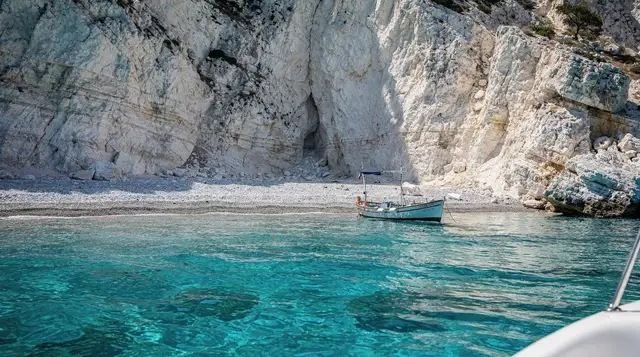
Cala Mariolu trades sand for smooth white pebbles, and the water above them reads an almost unnatural turquoise-to-deep-blue gradient that’s become one of the most photographed views in Sardinia. It sits between Cala Sisine and Cala Goloritzé and is reachable by boat from either Cala Gonone or Arbatax, or by a genuinely difficult hiking trail that isn’t recommended without good fitness and proper footwear. Numbers are managed here too, though less strictly than at Cala Goloritzé — see our Cala Mariolu guide for the current access situation.
The boat tour to Cala Goloritzé and Cala Mariolu from Arbatax is the efficient way to see both of the gulf’s most dramatic beaches in one day if you’re based on the southern side, and it avoids the steep hike into either one.
Cala Goloritzé: the gulf’s most famous beach, and its strictest permit
Cala Goloritzé is a UNESCO natural monument, framed by a 143m limestone spire (the Monte Caroddi pinnacle, known locally as the Aguglia) that rises straight from the pebble beach. It’s also the most tightly managed beach in this guide: hiking in from the Golgo plateau above Baunei requires a paid, capped daily permit purchased in advance, and even arriving by boat doesn’t exempt you from the landing limits during peak hours. Our full Cala Goloritzé guide covers the permit system, the descent trail, and what the boat alternative looks like if the hike isn’t for you.
By boat, the Baunei coast cruise with swim stops from Santa Maria Navarrese reaches Cala Goloritzé without the 300m descent, and by trail, the guided trekking tour to Cala Goloritzé handles the permit and route-finding for you, which matters on a trail that gets genuinely hot and exposed by mid-morning in summer.
Inland detours worth combining with a boat day
If a full beach day feels like too much sitting in a boat, the Gulf of Orosei’s hinterland has two strong half-day detours. The Tiscali nuragic village hike, reached from Oliena or Orosei, climbs into a limestone doline hiding Bronze Age stone huts — see the Tiscali mountain and nuragic village hike from Orosei for a guided version. The Gola Su Gorropu canyon, one of Europe’s deepest gorges, sits inland from Dorgali and pairs well with a Cala Luna morning if you split the day between the two.
Choosing a base: Cala Gonone versus Baunei
Cala Gonone, on the northern edge of the gulf, is the more developed base — a proper small town with a working harbour, plenty of restaurants, and the most frequent boat departures to Cala Luna and Cala Sisine. Baunei and nearby Santa Maria Navarrese, on the southern side, sit closer to Cala Goloritzé and Cala Mariolu and are the better choice if those two beaches are the priority.
There’s no wrong answer for a single-region trip, but if you’re trying to see all four beaches without excessive backtracking, splitting a stay between the two — a few nights at each — works better than commuting the length of the gulf daily. Our day trips from Cala Gonone guide has a base-specific itinerary if Cala Gonone is the plan.
Diving and snorkelling in the gulf
The Gulf of Orosei’s clarity, particularly around Cala Mariolu, makes it one of the better snorkelling stretches on the island even without a wetsuit or tank — bring a mask on any boat trip here, since several operators build in unstructured swim time specifically for this. For anyone who dives, the underwater topography along this coast includes dramatic drop-offs close to shore that aren’t accessible from most other parts of the island; see diving in Sardinia for operators who run trips out of Cala Gonone and Arbatax specifically for this stretch of coast.
What to bring for a Gulf of Orosei boat day
Water shoes are worth packing for Cala Mariolu specifically, since the pebble beach is uncomfortable barefoot for most people. A dry bag protects phones and cameras from spray on the crossings, which can be choppier than the calm-looking bay photographs suggest, particularly on the longer routes from Arbatax. Bring more water than feels necessary — none of these beaches has a shop, and boats don’t always carry enough for a full day in August heat — along with reef-safe sunscreen, since several of these coves sit within areas where runoff affects a genuinely sensitive marine environment.
Weather, wind and when boats don’t run
The mistral wind can cancel or reroute Gulf of Orosei boat trips with relatively little notice, most commonly in April-May and October when the shoulder-season weather is more changeable than the settled conditions of July and August. Operators generally offer a refund or reschedule rather than sailing in unsafe conditions, but it’s worth building a spare day into your itinerary if this stretch of coast is a genuine priority rather than a nice-to-have. Sea temperatures follow the rest of the island’s pattern — around 20-22°C in June, peaking near 25-26°C in August, and still swimmable into early October in a normal year. See best time to visit Sardinia for the fuller month-by-month picture.
What a Gulf of Orosei boat trip actually costs
Full-day boat trips from Cala Gonone or Arbatax typically run €50-80 per person depending on the operator, boat size and how many beaches the itinerary covers, with private charters costing considerably more but allowing a custom stop list rather than a fixed group schedule. Guided hikes to Cala Goloritzé, which bundle the permit into the price, generally cost €35-55 per person on top of the mandatory access fee itself. Neither is a cheap day out by Sardinian standards, but the gulf’s isolation — no roads, no free alternative to seeing these beaches — makes the cost a fairer reflection of what’s involved than it might first appear.
The Selvaggio Blu, in brief
Cala Sisine’s place on the Selvaggio Blu is worth understanding even for visitors with no plan to attempt the full trek — Italy’s toughest long-distance coastal trail runs roughly 45km over several days between Pedra Longa near Santa Maria Navarrese and Cala Gonone, involving via ferrata sections, ropes in places, and camping wild along largely waterless terrain.
It’s a serious undertaking that requires a guide for most visitors and proper multi-day planning, not something to attach casually to a beach-focused trip. For anyone drawn to the idea without the full commitment, several operators run shorter one- or two-day sections that take in some of the same dramatic cliff scenery without the full trek’s logistics. See our Selvaggio Blu trek guide for the full route and what it actually involves.
Photography and the best time of day
Midday light flattens the Gulf of Orosei’s cliffs and washes out the water’s colour gradient in photographs, so the first and last boat departures of the day — where operators offer them — generally produce noticeably better results than a midday charter. Cala Mariolu’s turquoise-to-blue gradient photographs best in the hour or two after sunrise, when the light angles into the bay rather than sitting directly overhead, and Cala Goloritzé’s limestone spire catches dramatic side-lighting in late afternoon for anyone hiking in rather than arriving by boat. A polarising filter, if bringing a proper camera rather than a phone, makes a genuine difference to the water’s colour in photographs taken from a moving boat.
Frequently asked questions about the Gulf of Orosei’s beaches
Do I need a permit for every beach in the Gulf of Orosei?
No — only Cala Goloritzé requires a mandatory paid permit for the hiking route, and Cala Mariolu has managed but less strict numbers. Cala Luna and Cala Sisine have no permit requirement.
Can I drive to any of the Gulf of Orosei beaches?
No. There is no coast road along this stretch; every beach here is reached by boat or on foot.
Which is easier, Cala Luna or Cala Goloritzé?
Cala Luna, by a wide margin — it has boat access with no permit and a moderate hiking option, while Cala Goloritzé requires either a permit-controlled hike with a steep descent or a boat that still has landing limits.
What’s the best base for exploring the Gulf of Orosei?
Cala Gonone for the northern beaches (Cala Luna, Cala Sisine), or Baunei and Santa Maria Navarrese for the southern ones (Cala Goloritzé, Cala Mariolu). See day trips from Cala Gonone for a base-specific itinerary.
How long does a Gulf of Orosei boat trip take?
Most full-day tours run 6-7 hours including two or three swim stops; half-day options exist but typically only reach Cala Luna.
Is the water genuinely clearer here than the rest of Sardinia?
Yes, generally — the lack of a coast road means less runoff and boat traffic than the south or Costa Smeralda, and the limestone seabed gives the water its distinctive turquoise-to-blue gradient, especially at Cala Mariolu.
Can beginners hike to Cala Goloritzé?
The trail is manageable for a reasonably fit adult but involves a genuine 300m descent and re-ascent on loose, exposed ground; it isn’t suitable for young children or anyone with knee problems. A guided tour or the boat alternative are safer choices for less experienced hikers.
How much does a Gulf of Orosei boat trip cost?
Full-day trips from Cala Gonone or Arbatax typically run €50-80 per person; guided hikes to Cala Goloritzé cost €35-55 on top of the mandatory permit fee.
What is the Selvaggio Blu and do I need to attempt it to see these beaches?
No — it’s Italy’s toughest coastal trek, roughly 45km over several days with via ferrata sections, and a serious undertaking in its own right. Cala Luna, Cala Sisine, Cala Mariolu and Cala Goloritzé are all reachable by boat or shorter day hikes without attempting the full route.
Beach & coastal tours on GetYourGuide
Verified deep-linked GetYourGuide tours. Book through these links and we earn a small commission at no cost to you.
These are our own photographs of Sardinia, not the operator's pictures of this tour — open the tour page to see those.