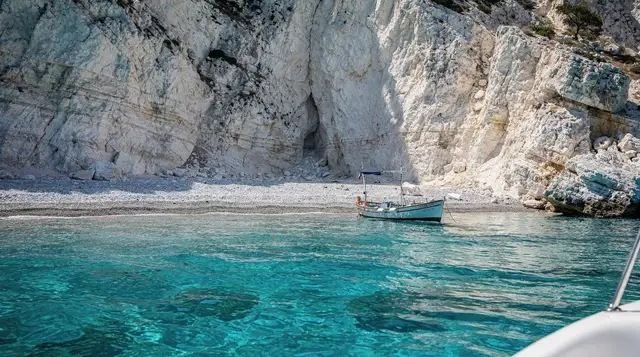
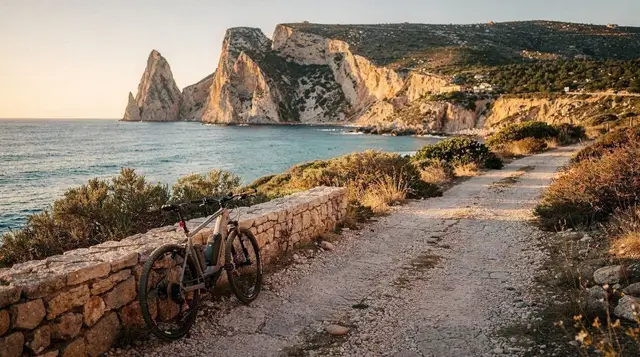
Baunei sits at around 480 metres above sea level, perched on the edge of a limestone plateau in the Ogliastra region of eastern Sardinia, with the Gulf of Orosei’s cliffs dropping away to the sea below. The town itself is small and workmanlike rather than picturesque — a scatter of stone houses, a couple of bars, and views out over the Supramonte massif — but it matters because almost everything worth doing on this stretch of coast is reached from here. That includes the Golgo plateau, the Su Sterru sinkhole, the start of the Selvaggio Blu trek, and the road-end car park that most people use to hike down to Cala Goloritze.
Understanding the geography before you arrive saves a wasted morning: Baunei is not on the sea, and there is no beach in the town. The coastline below — Cala Goloritze, Cala Sisine, Cala Mariolu — belongs to a different, much wilder world of cliffs and coves that you either hike down into or reach by boat from Santa Maria Navarrese or Arbatax. Baunei’s role is as the gateway and the last stop for supplies, water and fuel before you head up onto the plateau or down to the water.
The Golgo plateau and Su Sterru
From Baunei’s centre, a narrow paved road climbs onto the Golgo plateau (Altopiano del Golgo), a stretch of karst scrubland dotted with wild donkeys, holm oaks and drystone walls that feels closer to a highland pasture than the Mediterranean coast twenty minutes below. The drive from town to the Golgo road-end, where the marked trail to Cala Goloritze begins, takes about 20 to 25 minutes and covers roughly 8km of narrow, winding tarmac — allow extra time in July and August when oncoming traffic and parked cars slow things down.
Just off the plateau road sits Su Sterru, one of the deepest sinkholes in Europe, dropping close to 300 metres into the earth in a single vertical shaft. It’s fenced but genuinely dramatic to look into, and free to visit if you’re passing on the way to the trailhead. Near the sinkhole, the small chapel of San Pietro hosts a rustic country festival each August, with communal meals cooked in the open and a genuinely local atmosphere that has nothing to do with the coastal tourist season below.
Parking at the Golgo road-end costs around €5–8 per day in summer, collected informally by attendants; a handful of agriturismi and a small bar near the trailhead sell water and simple food, which is worth stocking up on since there’s nothing beyond this point until the beach.
Hiking down to Cala Goloritze
The classic route to Cala Goloritze starts at the Golgo road-end and drops roughly 300 metres over about 4.5km, a walk of 1.5 to 2 hours down through holm oak woodland and open limestone scree, with the final stretch descending steeply toward the sea. The path is well marked and doesn’t require technical skill, but the loose rock and heat make proper hiking shoes and at least 1.5 litres of water per person essential — this is not a beach walk in sandals. The return climb typically takes 2 to 2.5 hours and is the harder half of the day by a clear margin.
a guided trek down to Cala Goloritze from the Golgo plateau is worth considering even for confident hikers, since local guides know the quota booking system, the best pace for the heat, and can point out the Aguglia — the 143-metre limestone pinnacle that rises straight out of the beach and is the cove’s signature landmark. Our guide to hiking to Cala Goloritze covers the full route in more detail, including where the shade runs out.
Cala Goloritze is one of six quota-controlled beaches in Sardinia, alongside La Pelosa, Cala Mariolu, Cala Brandinchi, Lu Impostu and Tuerredda — see Sardinia’s beach access quotas for how the wider system works. Access must be booked online in advance through the Baunei municipality’s system, with a daily cap on visitor numbers and a small entry fee (typically around €5–7 per person in 2026, on top of Golgo plateau parking). Booking even a day ahead is safer in July and August, when the daily quota routinely sells out by mid-morning.
Reaching Cala Goloritze by boat instead
The alternative to the hike is arriving by sea, which avoids the climb back up entirely but trades it for a different kind of commitment — you’re on a boat’s schedule rather than your own. a full-day boat tour along the Baunei coast typically covers Cala Goloritze alongside other coves such as Cala Sisine or Cala Mariolu, with swimming stops built in, departing from Santa Maria Navarrese or Arbatax.
a coast cruise from Santa Maria Navarrese with swim stops along the Baunei coastline is a shorter version of the same idea if a full day feels like too much.
Boats generally anchor offshore and ferry passengers to the beach by tender, or in some cases the beach is a short swim from the mooring — check the specific tour details, since not every boat trip includes stepping onto the sand itself given the quota system. For the wider choice of boat operators along this coast, see boat trips on the Gulf of Orosei.
| Route | Time | Effort | Best for |
|---|---|---|---|
| Hike from Golgo plateau | 1.5–2h down, 2–2.5h back up | High — steep, exposed, hot | Hikers wanting the classic approach and the Aguglia views from above |
| Boat from Santa Maria Navarrese/Arbatax | 20–40 min crossing | Low — no climbing | Families, limited mobility, combining with other coves in one day |
| Guided trek | 4–5h round trip | Moderate, paced by guide | First-timers wanting local knowledge of quotas and heat management |
Cala Goloritze itself is small — a wedge of white pebbles and pale sand backed by the Aguglia pinnacle and a natural rock arch at one end. The sand-removal ban applies here as everywhere in Sardinia, with fines of €500 to €3,000 for anyone caught taking sand, shells or pebbles home; customs checks at Sardinia’s airports and ferry ports do happen, so leave the beach exactly as you found it.
Su Golgo, Su Sterru and Selvaggio Blu
Baunei is also the recognised starting point for the Selvaggio Blu, widely considered Sardinia’s toughest long-distance trek — a multi-day route along the wild Ogliastra and Supramonte coastline that mixes hiking with via ferrata sections and requires a certified guide, ropes and an overnight camping permit. It is not a casual outing: parts of the route involve exposed scrambling above the sea, and attempting it without a guide has led to rescues in past seasons. Our Selvaggio Blu trek guide covers logistics, guide costs and what a realistic itinerary looks like.
For visitors who want a taste of the plateau scenery without committing to a multi-day trek, walking even the first section of the Golgo plateau on foot, away from the road, gives a sense of the same limestone and scrub landscape that makes the Selvaggio Blu route so distinctive. Wild Sardinian donkeys often graze along this stretch and are used to walkers, though feeding them is discouraged by local guides.
Where Baunei fits on a wider trip
Baunei works best paired with a stay in Santa Maria Navarrese or Arbatax, both on the coast a short drive below, since Baunei town itself has limited accommodation and no beach of its own. Tortoli, the nearest larger town with the regional airport, is about 25 minutes further south and a practical base if you need more restaurant and shopping options. The wider Ogliastra region ties all of these together, and renting a car is close to essential here — the coastal buses don’t reach the Golgo plateau road-end at all.
For a structured trip that includes Baunei alongside the rest of this coastline, see our seven-day east coast Sardinia itinerary, and if hiking is the priority rather than beaches, the seven-day Sardinia hiking itinerary builds in the Golgo plateau and a Selvaggio Blu stage properly.
Frequently asked questions about Baunei and Cala Goloritze
Do I need to book Cala Goloritze in advance even if I’m hiking, not taking a boat?
Yes. The daily access quota applies to every visitor arriving on foot or by boat, and it’s booked online through the Baunei municipality’s system before you go; walking to the trailhead without a booking risks being turned away at busy times.
How difficult is the hike to Cala Goloritze really?
The descent is manageable for anyone with reasonable fitness and proper shoes, but the climb back up in summer heat, with no shade for most of the route, catches out visitors who underestimate it — carry more water than feels necessary.
Is there anywhere to stay in Baunei itself, or should I base elsewhere?
Baunei has a handful of B&Bs and agriturismi, but the choice of restaurants and hotels is much wider in Santa Maria Navarrese or Arbatax, both under 15 minutes away by car.
Can I drive all the way to Cala Goloritze?
No. The road only reaches the Golgo plateau car park; from there it’s a hike or nothing, since no vehicle track continues down to the beach.
What’s the difference between Cala Goloritze and Cala Mariolu?
Cala Goloritze is reached from Baunei via the Golgo plateau hike or by boat and is known for the Aguglia pinnacle; Cala Mariolu, further south, is boat-access only or a much longer hike, and known for its pale, rounded pebbles.
Is Su Sterru safe to visit with children?
The sinkhole is fenced at the viewing point and safe to look into with supervision, though the drop is real and not a place for children to run around unsupervised.
Does the Selvaggio Blu trek pass through Cala Goloritze?
Yes, most itineraries include a stage that reaches or passes near Cala Goloritze, but hiking to the beach on a day trip from the Golgo plateau doesn’t require any Selvaggio Blu experience or permits.