Hiking to the Tiscali nuragic village
What is Tiscali and how hard is the hike?
Tiscali is a Bronze Age Nuragic settlement built inside a collapsed limestone cave (doline), hidden in the Supramonte above Oliena. The hike is moderate — around 4-5 hours round trip with a steep, rocky final ascent into the doline itself — and doesn't require technical skill, but route-finding on unmarked sections makes a guide worthwhile.
A village hidden inside a mountain
Tiscali is unlike any other archaeological site in Sardinia, and arguably in the Mediterranean. Around 3,000 years ago, Nuragic-era Sardinians built a cluster of stone huts inside a doline — a cave whose roof had partially collapsed, leaving a hidden, roughly circular opening high in the Supramonte massif, invisible from below and reachable only by a narrow scramble path.
Nobody fully agrees on why the site was built this way; the leading theory is defensive, since the same concealment that makes it hard to find today made it hard for Bronze Age raiders or later Roman forces to locate at all. Some structures inside are remarkably intact, with drystone walls and rounded doorways still standing among the rubble and vegetation.
Getting there is the point almost as much as the site itself: the hike climbs through classic Supramonte terrain — pine and holm oak woodland giving way to bare limestone — before a final steep scramble up into the doline mouth. It’s genuinely worth the effort, but it is effort, not a casual stroll.
| Detail | What to expect |
|---|---|
| Round trip | 4-5 hours, moderate difficulty |
| Elevation gain | ~450-500m over roughly 3-4km each way |
| Starting points | Su Gologone (Oliena side) or the Orosei-side approach |
| Terrain | Woodland path, then steep bare limestone scramble |
| Guide needed? | Not legally, but strongly recommended for route-finding |
The route from Oliena and Su Gologone
The standard approach starts near the Su Gologone spring, a short drive from Oliena, following the Lanaitto valley — itself worth lingering in, since it holds several other archaeological remains including a domus de janas rock-cut tomb — before the path climbs into pine woodland and then onto exposed karst. The final stretch into the doline is the hardest part: a steep, sometimes hand-assisted scramble over loose limestone that gains the last 100m or so in a short, sharp push. Inside, the hut remains are scattered across an uneven cave floor, so allow real time to explore rather than treating the climb as the whole experience.
The guided hike to Tiscali mount covers this full route with a local guide, useful given how easy it is to miss the correct branch at a couple of unmarked junctions in the Lanaitto valley. For a shorter version that pairs the hike with a traditional meal afterwards, the Tiscali trekking with tasting bundles a Barbagia-style lunch into the day, a good option if the archaeology matters more to you than a punishing pace.
The route from Orosei
A separate approach runs from the coastal side near Orosei, covered by the Tiscali mountain and nuragic village hike from Orosei. This suits visitors based on the coast rather than inland at Oliena, and converges on broadly the same doline from a different direction, with its own stretch of Supramonte scenery along the way. Either approach delivers the same site; choose based on where you’re staying rather than any meaningful difference in what you’ll see.
What you’ll actually find inside
Once inside the doline, expect a genuinely atmospheric rather than immaculately preserved site — this isn’t a reconstructed museum piece like Su Nuraxi di Barumini, it’s ruins largely as archaeologists found them, with information limited to what a guide can tell you on-site (signage is minimal). Bring a headtorch if you want to peer into the darker corners of the cave, and be prepared for uneven, rocky footing throughout — this isn’t a site you wander casually in sandals.
For context on how Tiscali fits into Sardinia’s wider Nuragic story, our nuraghi of Sardinia guide covers the roughly 7,000 nuraghi across the island, and domus de janas of Sardinia covers the rock-cut tombs of the same era, several of which sit in the same Lanaitto valley you’ll pass through en route.
Combining Tiscali with the rest of the Supramonte
Tiscali pairs naturally with other Supramonte routes on a multi-day visit — see our full Supramonte hiking guide for how the region’s trailheads connect, and Gola su Gorropu if you want a second serious hike within the same base. Oliena itself is worth a night for its Cannonau wine — see wine tours in Sardinia — and sits close enough to the coast that a Gulf of Orosei boat trip the following day is realistic without excessive driving.
Why Tiscali was built where it was: the leading theories
Archaeologists broadly agree Tiscali was occupied from the Nuragic Bronze Age through into the era of Roman contact, but exactly why a community chose to build inside a hidden doline rather than a more conventional hilltop or valley site remains genuinely debated. The defensive theory holds that concealment from raiders — whether rival Nuragic communities or, in later centuries, Roman forces known to have struggled to fully subdue Sardinia’s interior — was the primary motive, and the site’s near-total invisibility from surrounding valleys supports this reading.
An alternative view points to the doline’s natural advantages independent of any threat: a reliable water source, natural shelter from wind and extreme heat, and a defensible perimeter that required minimal additional fortification compared with an open hilltop nuraghe. Whichever explanation is correct, the site’s survival largely undisturbed until 19th-century rediscovery is itself remarkable, and it’s part of why walking in still feels genuinely like finding something hidden rather than visiting a signposted monument.
The wider Lanaitto valley: more than a route to Tiscali
The Lanaitto valley, which the standard approach from Su Gologone follows for much of its length, holds more archaeological interest than most hikers realise while focused on reaching Tiscali itself. Rock-cut tombs (domus de janas, literally “houses of the fairies” in Sardinian folklore) dot the valley’s limestone outcrops, some visible a short detour from the main path, dating from the pre-Nuragic Ozieri culture centuries before Tiscali’s Bronze Age occupation.
The Su Gologone spring itself, near the valley’s start, is one of Italy’s largest karst springs, historically significant enough that a small hotel and restaurant complex has grown around it — a useful stop for a meal either before setting out or after returning, well positioned given the general scarcity of facilities directly at Supramonte trailheads. Our domus de janas of Sardinia guide covers the wider phenomenon of these rock-cut tombs across the island in more depth.
Choosing between operators for the guided hike
Both the Oliena-side guided options covered above and the Orosei-side alternative are run by local guide cooperatives with genuine expertise in the site’s archaeology as well as the terrain — worth asking about specifically when comparing listings, since the quality of on-site interpretation varies more between operators than the physical route does. Group sizes tend to run small (6-12 people is typical), which suits a site this atmospheric better than a large tour group would. If you’re combining Tiscali with other Supramonte hiking in the same trip, ask whether a multi-day package with the same guide is available — several operators offer discounted combined bookings covering Tiscali and Gorropu across consecutive days.
What was found at Tiscali and where it went
Excavations at Tiscali since the early 20th century recovered pottery, tools and other everyday artefacts consistent with a working settlement rather than a purely ceremonial or defensive outpost, supporting the theory that families genuinely lived inside the doline rather than using it only as a refuge in times of threat.
Much of what was recovered sits today in archaeological museums in Nuoro and Cagliari rather than on-site, which is worth knowing before you visit — there’s no visitor centre or museum at Tiscali itself, just the stone hut foundations as excavated, with minimal signage explaining what you’re looking at beyond what a guide provides. This is part of what makes booking a guided option genuinely worthwhile here rather than at some other sites: the physical remains alone tell you relatively little without someone who can explain construction techniques, likely hut functions and how the settlement related to the wider Nuragic world outside.
How Tiscali compares to a typical nuraghe visit
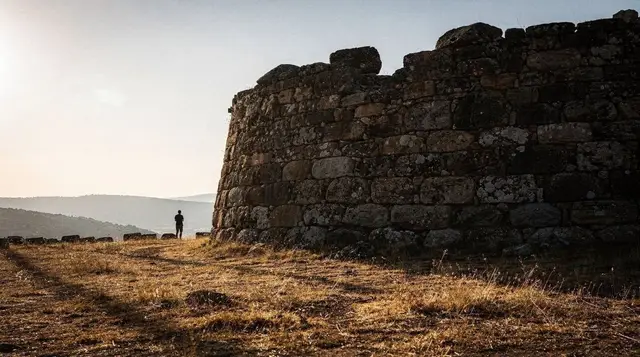
Most visitors picture a nuraghe as a standalone stone tower — the archetypal Nuragic structure, exemplified by Su Nuraxi di Barumini with its central tower and surrounding bastion. Tiscali is a genuinely different category of site: a cluster of circular stone huts rather than a tower complex, built inside a natural cave rather than freestanding, and reachable only on foot rather than by a car park and paved path.
If Su Nuraxi gives the clearest single introduction to how Nuragic architecture worked at scale, Tiscali gives a far more atmospheric sense of how ordinary Nuragic-era life might have looked, away from the monumental structures that dominate most of the island’s roughly 7,000 surviving nuraghi. Visiting both across a trip — one for scale and clarity, one for atmosphere — gives a more complete picture than either alone, and our nuraghi of Sardinia overview and a nuragic route across Sardinia both help plan that combination.
Seasonal considerations specific to Tiscali
Unlike coastal hikes, Tiscali’s woodland-shaded lower stretch through the Lanaitto valley offers genuine relief from direct sun for much of the approach, making this one of the more forgiving Supramonte hikes in shoulder-season heat — though the final limestone scramble into the doline is unshaded regardless of season. Spring brings the valley’s wildflowers into bloom and keeps the Su Gologone spring at its most visually impressive with higher water flow; by late summer the same spring can run noticeably lower. Winter access is possible on dry days but genuinely riskier given how the final scramble’s already-loose limestone behaves when wet, and short daylight hours make an early start even more important than in summer.
Practical tips for a comfortable visit
Bring more water than a “moderate” grading suggests — there’s no refill point along the route, and the final scramble into the doline is more physically demanding than the distance alone implies. A light picnic works well eaten inside the doline itself, in the shade the cave roof provides, rather than rushing back down before eating.
Photography inside the doline benefits from arriving reasonably early, both for softer light filtering through the collapsed roof opening and to have the site to yourself before larger guided groups arrive later in the morning. If you’re combining the hike with the Su Gologone spring, allow a genuine hour there separately rather than treating it as a five-minute photo stop — the spring and its surrounding gardens are a pleasant, low-effort complement to the harder walk.
Guided tour prices in 2026
A standard half-day guided hike to Tiscali from the Oliena side runs roughly €40-60 per person, generally including a local guide’s commentary on both the route and the site itself; the version bundling a Barbagia-style lunch afterwards costs somewhat more, typically €65-85 per person, reflecting the meal on top of the guiding fee.
The Orosei-side guided option prices similarly, generally within a few euros of the Oliena equivalent, since both routes involve a comparable amount of guide time regardless of starting point. Independent hikers save the guiding fee entirely but should budget for parking near the trailhead, generally a few euros for the day, and should factor in that going without a guide means accepting the real risk of a wrong turn at one of the Lanaitto valley’s less obvious junctions.
Group discounts are uncommon for a hike this specialised, since operators run small fixed groups rather than scaling per-person pricing down the way a bus tour might. Water and a picnic lunch are worth budgeting for separately too — nothing is sold along the route itself, and the nearest realistic food stop is back in Oliena or at Su Gologone once the hike is done.
Frequently asked questions about hiking to Tiscali
How long does the hike to Tiscali take?
Around 4-5 hours round trip from the Su Gologone side, including time to explore the site itself, not just the climb.
Do I need a guide to hike to Tiscali?
Not legally, but the Lanaitto valley has a few unmarked junctions that catch out independent hikers, so a guide or a reliable GPS track is genuinely useful.
Is the Tiscali hike suitable for children?
Older children in good general fitness can manage it; the final scramble into the doline involves some hand-assisted climbing that’s harder for young children.
What footwear do I need for the Tiscali hike?
Proper trail shoes with solid grip — the final approach into the doline is steep, loose limestone, and trainers are genuinely inadequate.
Can I visit Tiscali from the coast rather than Oliena?
Yes — the Orosei-side approach covers the same site from the coastal direction, useful if you’re not staying inland near Oliena.
What’s the difference between Tiscali and Su Nuraxi di Barumini?
Su Nuraxi is a restored, easily accessible UNESCO nuraghe complex on flat ground; Tiscali is an unreconstructed hilltop settlement reachable only on foot, with a much more remote, ruin-in-situ feel. See Su Nuraxi di Barumini for the comparison.
Nuraghi & archaeology tours on GetYourGuide
Verified deep-linked GetYourGuide tours. Book through these links and we earn a small commission at no cost to you.
These are our own photographs of Sardinia, not the operator's pictures of this tour — open the tour page to see those.