Sardinia's nuraghi, an island-wide guide
What exactly is a nuraghe, and which ones are worth visiting?
A nuraghe is a Bronze Age drystone tower, unique to Sardinia, built roughly 1900-730 BC — Sardinia has around 7,000 of them. Su Nuraxi at Barumini is the only UNESCO-listed one and the best all-round visit; Santu Antine near Torralba and Nuraghe Losa near Abbasanta are close runners-up, and Palmavera near Alghero is the easiest to combine with a coastal trip.
No other Mediterranean island has anything quite like Sardinia’s nuraghi. Somewhere between 7,000 and 8,000 of these drystone towers still stand across the island — nobody has an exact count, since new ones keep turning up under farmland and scrub — and they were built without mortar, using corbelled stonework that’s held up for well over three thousand years. They’re the physical evidence of the Nuragic civilisation, a Bronze Age culture that left no written record of its own, which is exactly why the towers themselves, and the bronze figurines and tombs that go with them, are the main way anyone understands who lived here before Phoenicians, Romans or anyone else arrived.
This guide is the starting point for the island’s nuragic archaeology: what a nuraghe actually is, which of the roughly 7,000 are worth the drive, and how the site fits together with the tombs, ancient towns and museums covered in more depth elsewhere on this site. If you already know you want to focus on one site, jump straight to our guides on Su Nuraxi at Barumini, Nuraghe Palmavera near Alghero, the tombs of the giants or domus de janas rock-cut tombs.
| Number on the island | Roughly 7,000–8,000, of which a few dozen are properly set up for visitors |
| Date range | c. 1900–730 BC, with some sites reused into the Iron Age |
| Best single visit | Su Nuraxi, Barumini — Sardinia’s only UNESCO World Heritage Site |
| Runners-up | Santu Antine (Torralba), Nuraghe Losa (Abbasanta), Palmavera (Alghero) |
| Typical entry cost | €6–15 depending on site, often guided-only |
| Best season | April–June and September–October; most sites are exposed with little shade |
What a nuraghe actually is
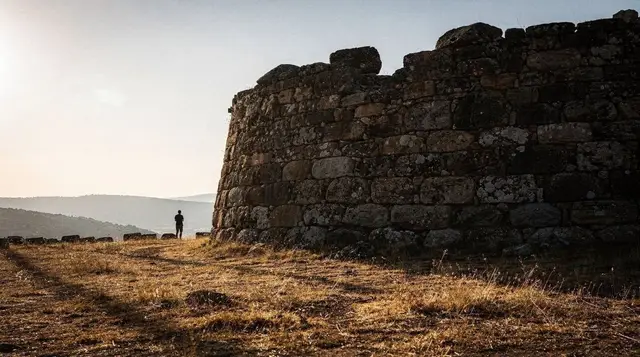
A nuraghe is a tower built from roughly cut, unmortared stone blocks, corbelled inward course by course until the walls close into a false dome, or tholos, at the top — the same building technique used in Mycenaean beehive tombs, though there’s no evidence the two traditions influenced each other directly.
The simplest nuraghi are a single tower, maybe 10 to 15 metres tall originally, with one or two internal chambers stacked on top of each other and a spiral staircase built into the thickness of the wall. The more impressive ones, like Su Nuraxi or Santu Antine, are “complex” or polylobate nuraghi: a taller central tower ringed by two, three or four smaller corner towers, connected by curtain walls, sometimes with an entire village of circular stone huts built up against the outer walls later on.
Construction ran from around 1900 BC through to roughly 1200 BC in its main phase, with many towers reused, extended or resettled well into the Iron Age and even, in a handful of cases, into the Punic and Roman periods that followed. What nuraghi were actually for is still debated among archaeologists — defensive strongholds, chieftains’ residences, grain stores, religious and meeting sites, or some mix of all four depending on the settlement — and that open question is part of what makes visiting a good one worthwhile: you’re looking at hard physical evidence for a society whose own explanation of itself never survived.
The nuragic civilisation, in outline
The people who built these towers left no deciphered writing, so most of what’s known comes from the towers, the tombs and thousands of small bronze figurines — the bronzetti — depicting warriors, boats, animals, priests and chieftains, many of them now in the Museo Archeologico Nazionale in Cagliari.
The civilisation is generally split into phases: an early nuragic period of tower-building through the mid-Bronze Age, a middle phase when the biggest complex nuraghi and surrounding villages were built and fortified, and a later phase, after roughly 1200 BC, when many settlements shifted toward open villages, sanctuary sites and the distinctive collective tombs known as tombs of the giants. Sacred wells and spring sanctuaries, built with the same precise drystone technique as the towers, appear in this later period too, suggesting an organised religious practice with its own architecture, separate from the defensive towers.
By the time Phoenician traders started setting up coastal outposts in the 9th and 8th centuries BC — leading eventually to sites like Tharros and Nora — nuragic society was already deeply established inland, and the two cultures overlapped and traded for centuries before Carthage and then Rome absorbed the island outright. Some nuraghi, including parts of Su Nuraxi, kept being used as shelters and even churches well into the medieval period, which is one reason a site can hold Bronze Age stonework, Iron Age hut floors and later burials all stacked within a few metres of each other.
The must-see nuraghi, region by region
Su Nuraxi, Barumini — the one to see if you only see one
Su Nuraxi, on the edge of the village of Barumini in the Marmilla region, is Sardinia’s only UNESCO World Heritage Site and, by scale and preservation, the strongest single argument for what nuragic builders were capable of. A central tower, originally around 18.6 metres tall, is ringed by four corner bastions and a surrounding village of hut foundations that once housed several hundred people.
Visits are guided-only, run in small groups through narrow, low passages, and last about 45 minutes. See our dedicated Su Nuraxi guide for the excavation history and what the tour actually covers, or book directly: a guided tour of the Su Nuraxi UNESCO site from Cagliari.
Santu Antine, Torralba — the biggest tholos on the island
Inland from Sassari, near the town of Torralba, Nuraghe Santu Antine is sometimes called Sa Domo de su Re — “the king’s house” — and its central tower has one of the largest tholos chambers of any nuraghe, with a base diameter wide enough that early archaeologists assumed it must have collapsed and been rebuilt to be structurally sound. Three corner towers connect to the keep via curtain walls, and the site sits in the Valle dei Nuraghi, a stretch of countryside dense enough with towers that you can see several more from the access road alone. It’s less visited than Barumini, largely because it’s further from any single coastal base, but it rewards the detour with none of the summer coach-tour crowding.
Nuraghe Losa, Abbasanta — a well-preserved trilobate tower
Near Abbasanta, roughly halfway between Oristano and Nuoro, Nuraghe Losa is a trilobate complex — a central tower with three corner bastions rather than four — built from black basalt rather than the paler limestone of many southern sites, giving it a noticeably different look. It’s one of the better-preserved complex nuraghi outside the headline sites, with an intact vaulted chamber you can still climb inside, and it’s a natural stop if you’re driving the SS131 between Cagliari and the north.
Nuraghe Arrubiu, Orroli — the only known pentalobate nuraghe
East of Barumini, near Orroli in the interior, Nuraghe Arrubiu — “the red nuraghe,” named for the lichen colouring its stone — is the only known nuraghe with five corner towers rather than the usual two to four, giving it an unusually sprawling footprint for a single fortress. It sits well off the main tourist routes, which means genuinely quiet visits even in August, and its scale rewards the extra driving time for anyone building a dedicated archaeology trip through the interior.
Nuraghe Palmavera, Alghero — the easiest to combine with the coast
Just outside Alghero on the road toward Porto Conte, Nuraghe Palmavera is a complex nuraghe with an unusual feature: the Capanna delle Riunioni, a large circular meeting hut with a stone bench running around its interior wall, thought to have served as a communal or ceremonial gathering space distinct from the ordinary domestic huts around it.
Because it’s a short drive from a proper resort town, it’s the nuraghe most visitors combine with a beach-and-history day rather than a dedicated archaeology trip. Full detail is in our Nuraghe Palmavera guide; book ahead with a guided city centre tour combined with a visit to the Palmavera nuraghe.
Nuraghe Albucciu and the Arzachena cluster
Around Arzachena in Gallura, a dense cluster of nuragic sites — the smaller Nuraghe Albucciu, the more elaborate Nuraghe La Prisgiona, and the Coddu Vecchiu and Li Lolghi tombs of the giants — sit within a short drive of each other and share a combined ticketing system. It’s a good half-day loop for anyone based near the Costa Smeralda who wants archaeology without giving up a whole day of the coast. See our Arzachena archaeological park guide for the full route.
| Site | Region | Type | What makes it distinct |
|---|---|---|---|
| Su Nuraxi | Barumini, west-central | Complex, 4-tower + village | UNESCO status; largest excavated village |
| Santu Antine | Torralba, northwest | Complex, 3-tower | One of the largest tholos chambers on the island |
| Nuraghe Losa | Abbasanta, west-central | Complex, trilobate | Black basalt construction; intact vaulted chamber |
| Nuraghe Arrubiu | Orroli, interior | Complex, 5-tower | Only known pentalobate nuraghe |
| Palmavera | Alghero, northwest | Complex, village | Meeting hut with stone bench; coastal proximity |
| Albucciu / La Prisgiona | Arzachena, Gallura | Simple / complex | Built partly into natural granite outcrops |
What isn’t a nuraghe: the rest of the nuragic landscape
Nuraghi are the most visible remains, but the same civilisation left several other monument types worth knowing before you plan a trip. Tombs of the giants (tombe dei giganti) are collective burial monuments with a distinctive stele-fronted entrance, covered in depth in our tombs of the giants guide. Domus de janas, or “fairy houses,” are rock-cut chamber tombs that actually predate the nuragic period, carved by the earlier Ozieri culture — see our domus de janas guide for where to see them.
Sacred wells, like the well temple at Santa Cristina near Paulilatino, are another category entirely, built with precise drystone stairwells leading down to a spring chamber aligned to lunar cycles according to some researchers. And the Giants of Mont’e Prama — monumental stone statues found near Cabras — are the most significant nuragic-era art find of the last century; see our guide to the Giants for the full story.
Nearby but not nuragic at all are the Phoenician-Punic-Roman cities that grew up on the coast once trade routes opened, particularly Tharros on the Sinis peninsula and Nora near Pula — both worth understanding as the layer of history that came after, not instead of, the nuragic period.
Planning a nuraghi-focused trip
Most nuraghi sit inland, off the coastal routes that dominate a typical beach-focused Sardinian holiday, and the roads to reach them are rarely fast — Sardinia’s real average driving speed away from the SS131 dual carriageway is closer to 60km/h than a straight-line map distance suggests. A car is close to essential; public buses reach some site-adjacent towns but rarely on a schedule that suits a half-day visit. See our renting a car in Sardinia and driving in Sardinia guides for what to expect.
If archaeology is the whole point of the trip rather than a single day’s detour, our seven-day Sardinia archaeology itinerary strings together Barumini, the Arzachena cluster, Tharros and Nora without excessive backtracking, and our nuragic route across Sardinia guide covers the same ground in more geographic detail if you’re building a custom route.
For a shorter add-on to a Cagliari-based trip, a private day tour to the Nora archaeological site or a tour of the Giants by e-scooter from Cabras both bundle transport with entry, useful if you’d rather not navigate rural parking yourself.
Most of the major nuraghi charge €6–15 for entry, with visits at the larger sites often guided-only and run on a fixed schedule rather than free wandering, largely for conservation reasons — the stonework at Su Nuraxi in particular is more fragile underfoot than it looks. Shade is minimal at almost every site, so a morning visit beats the midday sun between June and August, and proper closed shoes matter more here than at almost any beach or town stop on the island, since interior passages are uneven, narrow and occasionally require ducking.
Frequently asked questions about Sardinia’s nuraghi
How many nuraghi are actually open to visitors?
Only a few dozen of the roughly 7,000 on the island have ticket offices, marked paths and regular opening hours; the rest are either on private land, unexcavated, or accessible only with local knowledge. The sites in this guide are the ones set up for a proper visit.
Do I need a guide to visit a nuraghe?
At the larger, better-known sites like Su Nuraxi, yes — access to the central tower is guided-only for safety and conservation reasons. Smaller sites like Palmavera or Nuraghe Losa often allow more independent exploration with information panels rather than a fixed tour group.
Are nuraghi suitable for children?
Older children who can manage uneven steps and low doorways generally find them exciting rather than dull; strollers and very young children struggle with the narrow, dark interior passages at the larger sites. See our Sardinia with kids guide for wider family-trip planning.
What’s the difference between a nuraghe and a tomb of the giants?
A nuraghe is a tower — defensive, residential or ceremonial — while a tomb of the giants is a collective burial monument with a distinctive fan-shaped forecourt and stele entrance. Both come from the same nuragic culture but serve entirely different purposes.
Which nuraghe is closest to Cagliari?
Su Nuraxi at Barumini, around 50 minutes by car, is the closest major site and the most straightforward day trip from the capital. See our day trips from Cagliari guide for how to combine it with other stops.
Is it true nobody knows what nuraghi were for?
Broadly, yes — there’s no surviving nuragic writing to confirm their purpose, so archaeologists rely on excavated layouts, artefacts and comparative evidence. Most current thinking treats the larger complex nuraghi as combining defensive, residential and status functions, but the debate isn’t settled.
Can you climb inside every nuraghe?
No. Interior access varies by site and by conservation status; some, like Su Nuraxi’s central tower, allow a guided climb through internal passages, while others restrict visitors to the exterior and ground-floor chamber only.
Nuraghi & archaeology tours on GetYourGuide
Verified deep-linked GetYourGuide tours. Book through these links and we earn a small commission at no cost to you.
These are our own photographs of Sardinia, not the operator's pictures of this tour — open the tour page to see those.