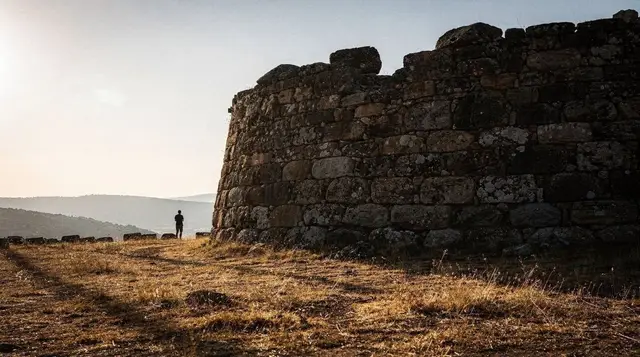
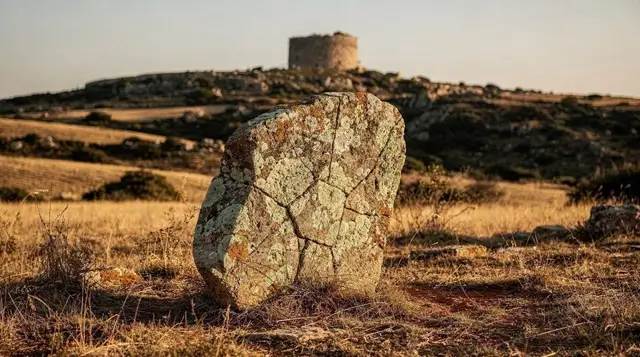
Tombs of the giants, Sardinia's nuragic burial monuments
What are Sardinia's tombs of the giants, and why are they called that?
Tombs of the giants (tombe dei giganti) are collective burial monuments unique to nuragic Sardinia, built from around 1800 BC with a distinctive stele-fronted entrance to a long stone gallery. The Italian name comes from later observers who assumed only giants could be buried under stones that size. Coddu Vecchiu near Arzachena is the best-preserved example.
Scattered across the Sardinian countryside, usually not far from a nuraghe or nuragic settlement, are collective burial monuments found nowhere else in the world in quite this form: the tombe dei giganti, tombs of the giants. Each one centres on a long, narrow gallery — sometimes running 10 metres or more — fronted by a striking stele wall, a curved arrangement of standing stones that later observers, centuries after the nuragic builders had gone, assumed could only have been raised to bury giants.
The reality is more interesting: these were collective family or clan burial sites, used and reused across generations, holding the remains of dozens of individuals rather than any single outsized body. This guide covers what tombs of the giants actually are and where to see the best examples; for the wider nuragic picture, see our guide to the nuraghi of Sardinia, and for the older rock-cut tombs that came before them, see domus de janas of Sardinia.
| Date range | c. 1800–1200 BC, with some examples reused later |
| What they are | Collective burial galleries fronted by a curved stele wall |
| Best example | Coddu Vecchiu, near Arzachena, Gallura |
| Other major sites | Li Lolghi (Arzachena), S’Ena e Thomes (Dorgali), Iloi (Sedilo) |
| Entry cost | €5–8, often bundled with a nearby nuraghe |
| Best time | Morning or late afternoon; almost no shade at most sites |
What a tomb of the giants actually is
A tomb of the giants has two clearly distinct parts. The stele wall, or esedra, is a curved, fan-shaped arrangement of standing stones fronting the entrance, usually centred on a single larger stele — sometimes over three metres tall — carved with a small doorway-shaped opening near its base, too narrow for an adult to pass through and generally interpreted as a symbolic threshold to the world of the dead rather than a practical entrance.
Behind the stele wall runs the burial gallery itself, a long, narrow, roofed corridor built from upright slabs or, in some later examples, corbelled drystone construction similar to nuraghi, where remains were placed over successive burials across generations rather than in a single interment event.
Construction began in the nuragic period’s middle phase, roughly 1800 to 1600 BC, and continued in various forms through to around 1200 BC, broadly overlapping with the construction of the larger complex nuraghi covered in our nuraghi guide — many tombs of the giants sit within a short walk of a nuragic settlement, which most archaeologists read as evidence that the two monument types served the same communities. Rituals involving libations or offerings poured through the small opening in the central stele are widely inferred from surviving evidence, suggesting the tombs functioned as ongoing sites of ancestor veneration rather than simple burial ground, sealed and forgotten after use.
Coddu Vecchiu, near Arzachena: the best-preserved example
Just outside Arzachena in Gallura, Coddu Vecchiu is widely regarded as the best-preserved tomb of the giants on the island: a central fissured stele over three metres tall, flanked by curved wings of standing stones, fronting a long burial gallery that would originally have held dozens of individuals across generations of use. It sits within the same archaeological cluster as the nearby Li Lolghi tomb and Nuraghe Albucciu, all covered together in our Arzachena archaeological park guide, and the granite countryside around this part of Gallura holds one of Sardinia’s densest concentrations of nuragic monuments of any kind.
Entry to Coddu Vecchiu runs around €6 to €8, often bundled with the nearby Li Lolghi site on a combined ticket, and there’s minimal shade on the approach, so an early morning or late afternoon visit beats the midday sun between June and August. The approach path crosses uneven pasture rather than a paved walkway, so proper shoes matter more here than at most of Sardinia’s coastal attractions.
Li Lolghi: Coddu Vecchiu’s near neighbour
A short drive from Coddu Vecchiu, still within the Arzachena archaeological cluster, Li Lolghi is a second, similarly impressive tomb of the giants with its own distinctive stele wall and gallery, generally visited on the same combined ticket and half-day loop as Coddu Vecchiu and Nuraghe Albucciu. Having two major examples this close together is unusual even by Gallura’s dense standards, and comparing the two side by side — subtle differences in stele carving, gallery length and construction technique — is one of the more genuinely educational things a casual visitor can do at any Sardinian archaeological cluster without needing a specialist guide to explain it.
S’Ena e Thomes, near Dorgali: a quieter example on the east coast
On the east coast near Dorgali, close to the trailheads for the Gorropu gorge, S’Ena e Thomes is a well-preserved tomb of the giants set in a quieter, less-visited corner of the island than the Arzachena cluster. Its stele wall, though smaller than Coddu Vecchiu’s, is intact enough to give a clear sense of the construction technique, and the site’s relative remoteness — it sees a fraction of the visitors the Gallura sites do — makes for a genuinely peaceful stop for anyone already in the Dorgali area for hiking or the Gulf of Orosei’s boat trips.
a trek to Gorropu with panoramic views from Dorgali doesn’t include S’Ena e Thomes directly, but it’s a natural half-day pairing for anyone based in Dorgali for hiking who wants to add a nuragic site without much extra driving.
| Site | Location | Distinct feature |
|---|---|---|
| Coddu Vecchiu | Near Arzachena | Best-preserved stele wall on the island |
| Li Lolghi | Near Arzachena | Second major tomb within the same cluster |
| S’Ena e Thomes | Near Dorgali | Quieter east-coast example, near Gorropu |
| Iloi | Near Sedilo, interior | Less-visited example in the island’s centre |
Regional variation across the island
Tombs of the giants aren’t perfectly uniform across Sardinia — construction technique and stele design vary meaningfully between regions, reflecting local stone availability and, likely, some degree of independent regional tradition within the broader nuragic culture. Gallura’s examples, including Coddu Vecchiu and Li Lolghi, tend toward large single-slab granite steles, taking advantage of the region’s abundant granite outcrops, while some interior and eastern examples, including parts of the Iloi complex, show more composite construction using multiple smaller stones fitted together rather than a single monolithic stele.
This regional variation is a genuinely useful thing to notice if you visit more than one site on a trip — it’s easy to assume all tombs of the giants look essentially identical from photographs, but the construction differences are visible enough in person to reward comparing sites in different parts of the island rather than treating one visit as representative of the whole monument type.
Visiting: what to expect and how to book
None of Sardinia’s tombs of the giants operate on the kind of guided-only, timed-entry system used at Su Nuraxi — these are generally open sites with a ticket office and information panels rather than mandatory small-group tours, which makes them more flexible to visit on your own schedule but also means you’re relying more on your own reading of the panels or a guidebook for context.
There isn’t a dedicated GetYourGuide product built specifically around the tombs of the giants as their own attraction; the closest match is the nuraghe and giant’s grave day trip from Cagliari, which combines a tomb visit with a nearby nuraghe in a single guided day. For a self-driven or independently ticketed visit to the Arzachena cluster specifically, see our Arzachena archaeological park guide for the practical ticketing details.
If you’re staying near the Costa Smeralda and want to pair a morning at Coddu Vecchiu and Li Lolghi with an afternoon on the water, a boat trip to the La Maddalena archipelago departing from nearby Cannigione is a genuinely popular combination, since Cannigione’s harbour is only about 15 minutes from Arzachena. For a broader archaeological day that also takes in Sardinia’s most famous nuragic site, a guided tour of the Su Nuraxi UNESCO site covers the Bronze Age fortress side of the same civilisation that built these burial monuments.
What excavations have found inside the galleries
Excavated burial galleries at several tombs of the giants have yielded fragmentary human remains from multiple individuals, consistent with the collective, ongoing-use interpretation rather than a single burial event — bones from different periods, sometimes deliberately pushed aside or bundled to make room for later interments, a practice documented at similar collective tomb traditions elsewhere in prehistoric Europe.
Grave goods are generally modest compared with the richer burials known from some other Bronze Age cultures: pottery fragments, occasional bronze tools or ornaments, and little of the elaborate metalwork associated with elite burials in, say, contemporary Mycenaean Greece. This relative modesty has led most archaeologists to read tombs of the giants as genuinely communal burial sites for ordinary extended families or clan groups, rather than monuments built to showcase individual wealth or status — a meaningful contrast with how burial practice worked in several neighbouring Bronze Age Mediterranean cultures during the same centuries.
Iloi, near Sedilo: an interior example
In the island’s interior, near the town of Sedilo not far from Lake Omodeo, the Iloi necropolis includes tomb of the giants examples alongside earlier domus de janas tombs on the same site — a useful single stop for seeing how burial architecture changed across Sardinia’s prehistoric periods within one location, similar in concept to the layered site at Tuvixeddu in Cagliari but with nuragic-period tombs rather than later Punic ones sitting alongside the earlier rock-cut chambers.
It receives a fraction of the visitors that the Gallura cluster or S’Ena e Thomes attract, largely due to its more remote interior location away from the main coastal routes, which makes for a genuinely quiet visit for anyone already exploring central Sardinia’s lake district or the Barbagia region.
How tombs of the giants relate to Sardinia’s wider prehistory
Tombs of the giants sit chronologically after the domus de janas rock-cut tombs of the earlier Ozieri culture, and broadly alongside the construction of the larger complex nuraghi covered island-wide in our main archaeology guide. The shift from individual or family rock-cut chamber tombs toward these larger collective galleries is generally read by archaeologists as evidence of changing social organisation in nuragic society — larger kin groups, clearer territorial identity, and a burial practice built for ongoing communal use rather than one-off interment.
For the monumental sculpture that emerged from the same broader nuragic art tradition, see our Giants of Mont’e Prama guide — a different kind of “giants” entirely, referring to stone statues rather than burial monuments, but a useful companion piece for understanding nuragic-era symbolism more broadly.
Frequently asked questions about the tombs of the giants
Were giants actually buried in these tombs?
No — the name comes from later folk explanations, since observers centuries after the nuragic period assumed only giants could have moved stones that size. Excavated remains show ordinary human burials, likely from extended family or clan groups, interred collectively over generations.
How is a tomb of the giants different from a domus de janas?
A domus de janas is a rock-cut chamber carved into existing stone, from an earlier period (roughly 4000–2700 BC); a tomb of the giants is a free-standing built monument from the nuragic period (roughly 1800–1200 BC), with a distinctive stele-fronted gallery. See our domus de janas guide for the earlier tradition.
Can you go inside the burial gallery?
At most sites, yes, though the interiors are dark, low and narrow — a torch or phone light helps, and taller visitors will need to stoop through parts of the gallery.
Is Coddu Vecchiu the same as Nuraghe Albucciu?
No — they’re different monument types within the same archaeological cluster near Arzachena. Coddu Vecchiu is a tomb; Albucciu is a nuraghe, a residential and defensive tower. See our Arzachena archaeological park guide for how the two combine on a single visit.
Are there tombs of the giants outside Gallura and Dorgali?
Yes — examples exist across the island, including Iloi near Sedilo in the interior, though Coddu Vecchiu and S’Ena e Thomes are generally considered among the best-preserved and most worthwhile to visit.
Do the tombs require a guide to appreciate?
Not strictly, since most sites have on-site information panels, but a guide adds real value in explaining the ritual function of the stele’s small opening and how burial practices evolved across the nuragic period — something the panels alone often only touch on briefly.
What kind of grave goods have been found inside?
Generally modest finds — pottery fragments, occasional bronze tools or ornaments — rather than the richer elite burials known from some contemporary Bronze Age cultures elsewhere in the Mediterranean, supporting the interpretation of these as communal family or clan tombs rather than monuments built for individual status.
Is Iloi near Sedilo worth visiting if I’ve already seen the Gallura sites?
Yes, if you’re already exploring central Sardinia — it’s a genuinely different, much quieter setting, and its combination of tombs of the giants alongside earlier domus de janas tombs on the same site offers a useful side-by-side comparison of two burial traditions from different periods.
Nuraghi & archaeology tours on GetYourGuide
Verified deep-linked GetYourGuide tours. Book through these links and we earn a small commission at no cost to you.
These are our own photographs of Sardinia, not the operator's pictures of this tour — open the tour page to see those.