Su Nuraxi di Barumini, a guide to Sardinia's only UNESCO site
What makes Su Nuraxi different from Sardinia's other nuraghi?
Scale, preservation and excavation history. Su Nuraxi is a central tower originally around 18.6 metres tall, ringed by four corner bastions and a fully excavated village of several hundred huts — the most complete nuragic complex on the island, and the only Sardinian site on UNESCO's World Heritage list, inscribed in 1997.
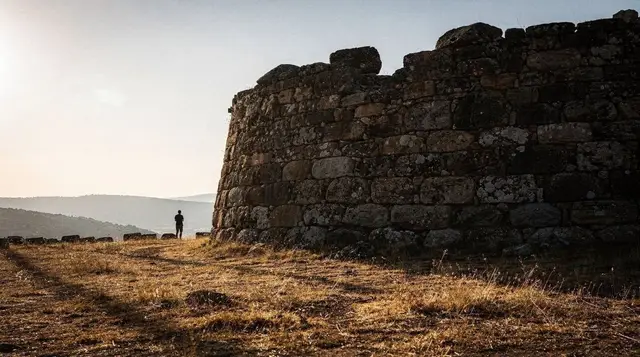
Su Nuraxi sits on the edge of Barumini, a small farming town in the Marmilla region, half-buried in what looks from a distance like an ordinary low hill. It isn’t one. Underneath the grass and scrub is the most complete nuragic complex ever excavated on the island — a central tower, four surrounding bastions, and a full village of circular stone huts, all built without mortar using a corbelled drystone technique that has kept much of it standing for roughly 3,500 years.
UNESCO inscribed it as a World Heritage Site in 1997, the only entry from Sardinia on the entire list, and it remains the single strongest argument for what nuragic builders were capable of. This guide covers the site’s construction, its excavation history, and what an actual visit involves; for the wider island-wide picture of nuraghi, see our guide to the nuraghi of Sardinia.
| Where | Edge of Barumini village, Marmilla, 50km north of Cagliari |
| Built | Central tower c. 1600–1500 BC; bastions and village added through the Bronze and Iron Ages |
| UNESCO status | Inscribed 1997 — Sardinia’s only World Heritage Site |
| Visit format | Guided-only, roughly every 30–45 minutes, about 45 minutes long |
| Entry cost | Around €13–15 self-arranged; €30–70 on an organised tour with transport |
| Best time | Morning, year-round; the site is exposed and shadeless at midday in summer |
How Su Nuraxi was built, in phases
The earliest structure on the site is the central keep, a tholos tower originally around 18.6 metres tall (now closer to 14 metres after millennia of erosion, quarrying for building stone, and centuries of soil accumulation before excavation), built around 1600–1500 BC from roughly cut basalt blocks corbelled inward until the walls closed into a false dome. A few centuries later, likely around 1400–1300 BC, a second building phase added four corner bastions connected by curtain walls, turning a single tower into a proper fortress with a quatrefoil footprint when seen from above — one of the clearest examples anywhere of a “complex” nuraghe, as opposed to the simpler single-tower type found at smaller sites.
The village came later still. From roughly 1000 BC through the Iron Age and into the period of Phoenician and Carthaginian contact, a settlement of circular stone huts grew up around the fortress, eventually housing what excavators estimate was several hundred people — bakeries, storage rooms, a meeting hut and ordinary domestic huts have all been identified within the excavated area. Some parts of the complex were still in occasional use well into the Roman period and beyond, which is part of what makes reading the site’s chronology from the ground itself genuinely difficult; layers from three thousand years of activity sit stacked within a few metres of soil.
The excavation and the man behind it
Su Nuraxi was excavated between 1949 and the 1950s by Giovanni Lilliu, the Sardinian archaeologist most responsible for establishing nuragic studies as a serious academic field, after a storm in the late 1940s exposed part of the buried structure.
Lilliu’s excavation was unusually thorough for its era, clearing the full village around the central tower rather than stopping at the fortress itself, which is precisely why Su Nuraxi’s site plan — tower, bastions, and hundreds of surrounding hut foundations — reads so much more completely today than smaller, partially excavated nuraghi elsewhere on the island. Lilliu went on to become one of the most influential figures in Sardinian archaeology generally, and Cagliari’s Museo Archeologico Nazionale, home to the bronzetti figurines central to understanding nuragic culture, now carries his name.
What the guided visit actually covers
Access to the central tower’s interior is guided-only, in small groups, because the internal passages are narrow, low, and involve worn stone steps without handrails in several places — genuine conservation and safety reasons rather than an arbitrary restriction. Tours run roughly every 30 to 45 minutes through the day and last about 45 minutes themselves, taking in the keep’s internal chambers, the well room at the base of the tower, and a walk through the excavated village foundations outside. Expect to duck through low doorways and climb in near-darkness for parts of the interior route — it’s a genuinely physical visit, not a passive walk-through.
a guided tour of the Su Nuraxi UNESCO site from Cagliari bundles transport, entry and a licensed guide into a single booking, which removes the trouble of timing your own arrival against tour-group slots — worth it if you don’t have your own transport, since public buses to Barumini run on a thin schedule that doesn’t suit a half-day visit. If you’re driving yourself, self-arranged tickets are sold at the site office, though summer weekends can mean a genuine wait for the next available guided slot; a guided day tour to Barumini from Cagliari is the practical alternative if you’d rather not self-drive but still want more flexibility than a large coach group.
Casa Zapata: the second nuraghe underneath a Spanish palace
A five-minute walk from the main site, in the centre of Barumini village, Casa Zapata is a 16th-century Spanish-Aragonese palace that turned out to be sitting directly on top of a second nuragic settlement. Renovation work in the 1990s uncovered ruins beneath the palace floor, and rather than reburying them, the building was converted into a museum with glass floor panels over the excavated remains — a genuinely unusual way to view a nuraghe, from above and indoors rather than from ground level outside.
a combined tour of Su Nuraxi and the Casa Zapata Museum pairs the outdoor site with this indoor context, and the museum’s collection of bronzetti figurines, pottery and tools found during excavations at Su Nuraxi and nearby sites fills in daily-life detail the ruins alone can’t convey.
| Site | Format | Time needed | Best paired with |
|---|---|---|---|
| Su Nuraxi (main site) | Guided-only, small groups | 45 min tour, 1.5–2 hrs total | Casa Zapata museum |
| Casa Zapata | Self-guided museum, glass floor panels | 30–45 minutes | Su Nuraxi ticket |
| Giara di Gesturi plateau | Self-drive or guided | Half day | Wine tasting, wild horses |
The Giara plateau, a natural add-on
Barumini sits at the foot of the Giara di Gesturi, a flat-topped volcanic plateau roughly 600 metres above sea level and one of the few places in Italy with a genuinely wild horse population — the small, sturdy cavallini della Giara, found nowhere else in their pure form. Seasonal ponds called paulis form on the basalt surface after autumn and winter rain, drawing both the horses and a good range of birdlife.
a combined Su Nuraxi and Giara Park tour with wine tasting extends a morning at the nuraghe into a full day with a stop at a local winery, and a shorter 4-hour Su Nuraxi and Giara horses tour keeps things tighter while still covering both.
For visitors who want to see the plateau and Su Nuraxi in one loop without self-driving between stops, a tour combining Su Nuraxi and the Giara di Gesturi is the straightforward all-in-one option. Our Marmilla and the Giara destination page covers the plateau and the villages around it in more depth, and the wild horses of the Giara guide is worth reading first if wildlife-spotting is the priority.
Getting there and getting around
Cagliari-Elmas airport (CAG) is roughly 50 minutes by car on the SS131 and then local roads through the Marmilla countryside, with no motorway shortcut once you leave the SS131 itself. From Oristano it’s a similar 45 to 50 minutes heading south-east. Public transport exists via ARST buses from Cagliari, but the schedule — typically a couple of departures a day — makes it impractical for anything but a very deliberately planned trip; most independent travellers either hire a car or book an organised tour.
See our renting a car in Sardinia and driving in Sardinia guides for what to expect on Marmilla’s secondary roads, which are well-maintained but narrower and slower than they look on a map. Parking at Barumini itself is free and easy to find, a genuine contrast with the summer parking scramble at Alghero’s old town or the coastal hotspots.
Why Lilliu’s excavation approach matters for what you see today
The decision to clear the entire surrounding village rather than stop at the fortress itself wasn’t the obvious or standard approach for its era — many earlier nuragic excavations across Sardinia focused narrowly on the more visually impressive tower structures, leaving surrounding settlement remains unexplored or only partially uncovered.
Lilliu’s more comprehensive method at Su Nuraxi set a precedent that later excavations at sites like Nuraghe Palmavera near Alghero and Nuraghe La Prisgiona near Arzachena would follow, gradually building a fuller understanding of nuragic settlements as complete communities rather than isolated defensive towers. It’s a useful thing to keep in mind walking through the site today: what looks like a natural, obvious way to present a nuragic complex — tower plus surrounding village, both fully excavated and open to visitors — was, at Su Nuraxi, a genuinely influential archaeological choice rather than simply how nuraghi are always studied.
Where Su Nuraxi fits on a longer trip
For a south-coast archaeology day, Su Nuraxi pairs naturally with Nora near Pula, roughly an hour and a half further south, though the two are different eras entirely — nuragic Bronze Age at Barumini, Punic-Roman at Nora — and are best treated as separate half-day trips on a longer stay rather than crammed into one day.
Our nuragic route across Sardinia guide sketches out how to combine Su Nuraxi with the Arzachena archaeological park and other nuragic sites further north without excessive driving, and if archaeology is the entire point of the trip, our seven-day archaeology itinerary uses Barumini as its central-Sardinia leg. Compare it against Santu Antine and the other nuraghi covered island-wide if you’re deciding whether one site is enough or whether a dedicated nuragic trip is worth the extra days.
Barumini itself is a working agricultural town rather than a tourist restaurant strip, with a handful of solid trattorie serving Marmilla staples — malloreddus with a rich tomato-and-sausage sauce, roast lamb, the local take on pane carasau — at prices well below the coastal resorts. See our what to eat in Sardinia guide for the wider culinary picture, and our hotel versus agriturismo comparison if you’re weighing where to stay for a Marmilla-based night.
What to pack for the visit
Beyond the closed shoes already mentioned, a torch or phone light is genuinely useful for the darker sections of the interior passages, even though the guide typically carries one — having your own means you’re not relying entirely on a shared light source in a small group. Water matters more than it might seem for a 45-minute visit, since the exposed approach and waiting areas offer little shade between June and August, and a hat is worth having for the same reason. Photography is generally permitted without flash, though check with your guide at the start of the tour, since rules can vary slightly depending on current conservation guidance for the more fragile interior surfaces.
Frequently asked questions about Su Nuraxi di Barumini
How long does a full visit take?
The guided tour itself runs about 45 minutes. Budget 1.5 to 2 hours total once you factor in arrival, waiting for your tour slot, and a look through the visitor centre and small on-site exhibition.
Can I visit the interior without a guide?
No — access to the central tower and excavated village interior is guided-only, for both safety and conservation reasons. You can book your own slot independently at the ticket office rather than joining a pre-arranged group, if you’d rather not commit to an organised tour.
Why is Su Nuraxi the only UNESCO site in Sardinia?
UNESCO’s 1997 inscription recognised it as an outstanding, largely intact example of nuragic civilisation’s architectural and social organisation — the combination of a fully excavated fortress and surrounding village, at this scale and preservation, doesn’t exist anywhere else on the island.
Is it suitable for young children or anyone with mobility issues?
The interior passages are narrow, uneven, and involve ducking through low doorways and climbing worn steps without handrails, so it isn’t well suited to strollers or limited mobility. Older children who can manage stairs generally find it genuinely exciting rather than dull.
How does Su Nuraxi compare to Santu Antine or Nuraghe Losa?
Su Nuraxi has the most completely excavated surrounding village of any nuraghe on the island, which is its real distinction; Santu Antine has one of the largest single tholos chambers, and Losa is notable for its black basalt construction and quieter visitor numbers. See our island-wide nuraghi guide for the full comparison.
Is Su Nuraxi worth visiting if I’ve already seen other nuraghi?
Yes, generally — the scale of the excavated village sets it apart from smaller, single-tower sites, and it’s genuinely worth the visit even for travellers who’ve already seen Palmavera or a smaller local nuraghe elsewhere on the island.
Nuraghi & archaeology tours on GetYourGuide
Verified deep-linked GetYourGuide tours. Book through these links and we earn a small commission at no cost to you.
These are our own photographs of Sardinia, not the operator's pictures of this tour — open the tour page to see those.