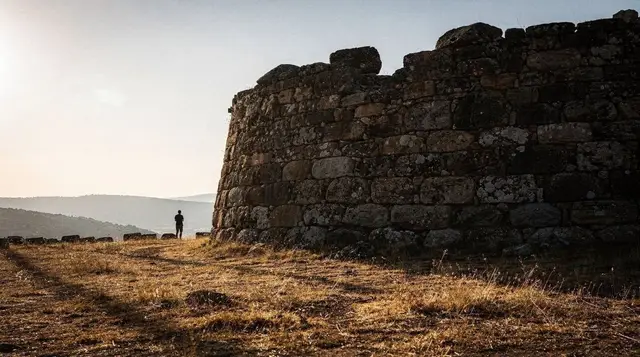
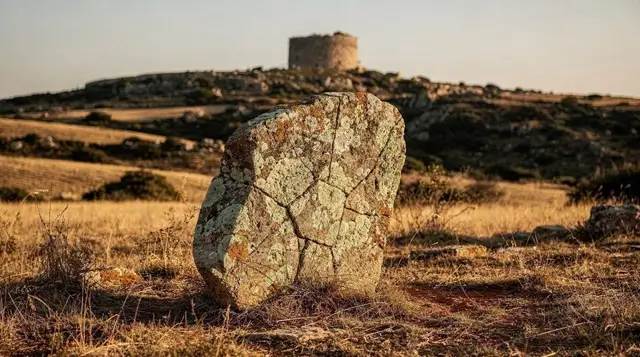
Nora, the Punic-Roman city near Pula
What makes Nora different from Sardinia's other archaeological sites?
Preservation and completeness. Nora has an intact Roman theatre still used for summer performances, in-situ mosaic floors in its bath complexes, and a temple platform on a headland — a more complete Roman-period picture than Tharros, which is older and more Punic in character, or Barumini's nuragic Su Nuraxi, which is a different civilisation entirely.
Three kilometres south of the market town of Pula, on a peninsula where the sea has been quietly reclaiming part of the ancient street grid for centuries, Nora is one of the best-preserved Punic-Roman cities anywhere in the western Mediterranean.
Where Tharros leaves visitors piecing together fallen columns and foundation walls, Nora gives you a Roman theatre still complete enough to host performances, bath complexes with mosaic floors intact underfoot, and a temple platform on a headland where a 16th-century Spanish watchtower now stands guard over the whole site. This guide covers Nora’s history, what’s actually standing today, and how to visit it properly — for the town of Pula itself and practical trip logistics, see our Pula and Nora destination guide.
| Where | 3km south of Pula, 35–40 minutes from Cagliari |
| Founded | c. 8th–7th century BC, Phoenician trading post |
| Peak period | Punic city, then Roman colonia and, briefly, provincial capital |
| Best-preserved structure | Roman theatre, still used for the summer Nora Festival |
| Entry cost | Around €7–10, self-arranged |
| Best time | Morning, April–June or September–October |
From Phoenician outpost to Roman provincial capital
Nora was founded, most likely in the 8th or 7th century BC, as a Phoenician trading post on a peninsula that offered ships shelter whichever way the wind was blowing — the same logic that shaped Tharros further up the west coast. It grew into a major Punic city under Carthaginian influence and, after Rome absorbed the island following the First Punic War, into a substantial Roman colonia.
For a period, Nora even served as the administrative centre of the province, before Cagliari — ancient Caralis — eclipsed it in importance, a shift that shaped the balance of what survives at each site today: Cagliari kept building over its Roman core for two thousand years, while Nora was largely abandoned by the early Middle Ages.
That abandonment, driven by Saracen raids that made the exposed coastline too dangerous to inhabit safely, is precisely why so much of Nora survived intact: nobody built over it afterward. Rising sea levels and slow coastal subsidence have since put part of the ancient city underwater, but what remains on dry land is unusually legible — a genuine Roman-period city plan rather than isolated fragments.
The Roman theatre: the site’s centrepiece
The best-preserved structure at Nora is its Roman theatre, a small but essentially complete semicircular auditorium cut into the hillside, still used today for the summer Nora Festival of open-air plays and concerts — a rare case of an ancient performance space still doing the job it was built for, roughly two thousand years after construction. Unlike most Roman theatres, which typically face away from the sea toward a hillside backdrop, Nora’s faces the water, a deliberate choice archaeologists read as a display of civic pride toward arriving ships rather than a purely practical decision.
The baths, forum and residential quarter
Close to the theatre, the Terme a Mare (“sea baths”) complex retains black-and-white geometric mosaic floors still in place underfoot, along with the remains of a forum and residential quarter scattered with further mosaic fragments. A second, smaller bath complex closer to the town’s Punic core shows an earlier layout later adapted by Roman engineers, similar to the Punic-to-Roman rebuild pattern seen at Tharros’s own baths. Walking between the two gives a genuine sense of how the city’s infrastructure evolved across five or six centuries of continuous habitation, rather than the single-period snapshot most ruins offer.
The temple platform and the watchtower above it
At the tip of the peninsula, Punta ‘e su Coltellazzo, the base of a temple platform — likely dedicated to the Punic goddess Tanit — sits beneath a squat 16th-century Spanish watchtower, built to watch for Barbary corsair raids along a coastline that stayed dangerous for a thousand years after Rome’s own authority collapsed. The two structures, over two thousand years apart in construction, standing on the same few square metres of headland, are as good a single image as Sardinia offers for how many layers of history can stack up on one strategically useful point of land.
| Structure | Period | What to look for |
|---|---|---|
| Roman theatre | Roman | Intact auditorium, sea-facing orientation, still used for performances |
| Terme a Mare | Roman | In-situ geometric mosaic floors |
| Punic-era baths | Punic, Roman-adapted | Earlier layout beneath later Roman engineering |
| Temple platform | Punic (Tanit) | Foundations beneath the later Spanish tower |
| Watchtower | 16th century Spanish | Best overview point over the whole peninsula |
Submerged Nora and the site museum
Part of ancient Nora now sits underwater as a result of gradual coastal subsidence, and snorkellers who bring their own mask can make out submerged wall foundations a short swim from the beach — though there’s no official underwater trail, marked route or equipment hire on site, so this is an informal extra rather than a structured part of a visit. A modest site museum in Pula town centre, the Museo Archeologico “Giovanni Patroni”, holds the finds too fragile or valuable for outdoor display — mosaic fragments, pottery, a Punic funerary stele — and the twenty-minute stop is genuinely worth building into the day before or after the ruins themselves, since it fills in context the open-air site alone can’t provide.
Touring Nora: guided or independent
Nora is straightforward to visit independently: buy a ticket at the entrance, follow the marked path, and read the bilingual Italian-English information boards along the way. Where a good guide earns its cost is context — explaining which mosaic is second-century Roman and which floor beneath it is Punic, why the theatre faces the sea against the usual convention, and how the submerged sections fit into the wider story of the coastline’s slow sinking.
a guided half-day tour of Nora and Pula from Cagliari covers transport, entry and a walk-through with an archaeologist-trained guide, and suits anyone who’d rather not deal with parking and ticket queues themselves. For a private version with more flexibility on pace, a private day tour to the Nora archaeological site is worth the extra cost for families or small groups who don’t want to match a coach’s schedule.
If arriving by cruise ship into Cagliari, the Nora shore excursion or the longer five-hour archaeological shore excursion are built around the ship’s return time, which matters more than it sounds — Pula is close enough to Cagliari that this is genuinely one of the better shore excursions on the island, unlike some that spend half the day on a coach.
Simpler group options such as the standard Nora tour from Cagliari or a Nora tour with tickets included skip the extras and get you there, guided, without the private-tour price tag.
Getting to Nora and the parking situation
From Cagliari, Pula is a straightforward 35 to 40-minute drive on the SS195 Sulcitana, passing Sarroch’s oil refinery before opening onto pine woods and the first sea views near Santa Margherita di Pula — allow closer to 45 minutes if starting from Cagliari-Elmas airport rather than the city centre itself, since there’s no motorway shortcut once you’re off the dual-carriageway stretch near Cagliari. See our renting a car in Sardinia guide if you haven’t arranged one, and note that Sardinia’s real average driving speed away from the SS131 is closer to 60km/h than a map distance suggests.
There’s no useful public transport link directly to the ruins; ARST buses stop in Pula town, leaving a further 3km walk or taxi to the site entrance. The car park at Nora fills by mid-morning in July and August, so arrive before 10am or after 4pm for an easier space and softer light for photos.
The beach beside the ruins
Spiaggia di Nora runs along the eastern side of the peninsula, looking back at the theatre and temple platform — one of the more atmospheric places to swim in southern Sardinia, since the ruins remain visible from the water. It’s shallow and gently shelving, reasonable for children, though it fills up fast given the double draw of ruins and beach on the same afternoon.
A short walk further south, Su Guventeddu is a smaller, quieter cove with less shade and fewer facilities, favoured by locals over the busier main beach. Neither carries a booking quota like La Pelosa, but the island-wide rule against removing sand still applies — fines run €500 to €3,000, genuinely enforced in high season. See our guide to Sardinia’s beach access quotas for which beaches actually need advance booking.
Excavation history: from antiquarian curiosity to modern archaeology
Nora has attracted archaeological interest since at least the 19th century, but the systematic excavations that revealed most of what’s visible today — the theatre, the bath complexes, the residential quarter — largely date from the 20th century onward, with Italian and, more recently, international teams continuing seasonal excavation campaigns well into the 21st century.
Unlike Su Nuraxi at Barumini, which was substantially cleared in a concentrated mid-20th-century campaign, Nora’s excavation has been a more gradual, ongoing process, partly because the site is larger and more complex, spanning Phoenician, Punic and Roman phases that each need separate, careful stratigraphic work to distinguish. Active excavation seasons still occasionally close small sections of the site to visitors, generally in spring or early summer — worth checking locally if a specific area matters to your visit, though it rarely affects the main theatre, baths and temple platform that most visitors come to see.
What to pack for the visit
Sun protection matters more at Nora than at most Sardinian attractions, given the exposed peninsula setting and minimal shade across most of the site — a hat, sunscreen and water are worth having even for a morning visit between April and October. Closed shoes handle the uneven, worn Roman paving better than sandals, particularly around the theatre steps and the temple platform’s rougher ground near the watchtower. If you’re planning to snorkel near the submerged sections, bring your own mask, since there’s no equipment hire at the site itself, only the option of buying or renting gear in Pula town beforehand.
Where Nora fits on a longer trip
Nora pairs naturally with a day around Cagliari’s old town, or with a longer loop that also takes in Barumini’s Su Nuraxi — our nuragic route across Sardinia sketches how to combine several sites without excessive driving, even though Nora itself isn’t nuragic.
If archaeology is the whole point of the trip, our seven-day archaeology itinerary uses Pula and Nora as its opening leg out of Cagliari, and the broader seven-day south Sardinia itinerary fits Nora alongside Chia and Villasimius for a fuller south-coast trip.
Frequently asked questions about visiting Nora
How long does it take to see Nora properly?
Most visitors need 90 minutes to two hours to walk the site at a reasonable pace, longer with a guide who stops to explain each layer of the city’s history, or if you also want to swim at the adjoining beach afterwards.
Is Nora suitable for children?
Yes, though there’s limited shade on the peninsula and the paths are uneven in places — bring hats, water and good shoes, and treat the beach afterwards as the reward for getting through the ruins first.
Can you swim near the ruins themselves?
Yes — Spiaggia di Nora sits right beside the site, and part of the ancient city lies just offshore underwater, visible to snorkellers with their own mask, though there’s no official underwater trail.
Is the site museum in Pula worth the extra stop?
It’s small but worthwhile if you want context for the mosaics and Punic finds too fragile to leave outdoors — twenty to thirty minutes in Pula town centre covers it comfortably.
Does Nora get busy in summer?
Yes, particularly late morning in July and August, when the archaeology crowd and the beach crowd overlap. An early start before 10am avoids the worst of both the heat and the car park queue.
Is Nora better than Tharros or Barumini?
They’re different eras and not really comparable — Nora is Punic-Roman and coastal, Barumini’s Su Nuraxi is Bronze Age nuragic and inland, and Tharros sits on its own exposed peninsula between the two in character. A serious archaeology trip through Sardinia takes in all three rather than choosing one; see our island-wide nuraghi guide for how they relate.
What’s the difference between the various Nora tours on offer?
The Pula-branded tours generally combine the ruins with a walk through Pula town itself, while the plain Nora tours focus on the archaeological site alone — check the itinerary description before booking if the town stop matters to you.
Is excavation still ongoing at Nora?
Yes — Italian and international archaeological teams continue seasonal excavation campaigns at Nora, generally in spring or early summer, which occasionally closes small sections of the site but rarely affects the main theatre, baths or temple platform that most visitors come to see.
Where are the finds from Nora’s excavations displayed?
Most movable artefacts — mosaics too fragile to leave exposed, pottery, jewellery, inscriptions — are held in the Museo Archeologico “Giovanni Patroni” in Pula town centre, a short drive from the ruins themselves, rather than displayed on site.
Nuraghi & archaeology tours on GetYourGuide
Verified deep-linked GetYourGuide tours. Book through these links and we earn a small commission at no cost to you.
These are our own photographs of Sardinia, not the operator's pictures of this tour — open the tour page to see those.