Oristano is the town most west-coast itineraries drive straight through on the way to somewhere else, which is a mistake if you never stop long enough to see why it’s different from the rest of Sardinia’s coastline. It’s not a beach resort — it sits a few kilometres inland on the Stagno di Cabras lagoon system — but a working provincial capital with its own university faculty, a produce market, and a historic centre that has never been rebuilt for tourism. That makes it one of the few places on this coast where you can get a genuinely local evening: an aperitivo in a piazza full of Oristanesi rather than other travellers.
The town’s real value on an itinerary is its position. Within a 20 to 40-minute drive you can reach the quartz sands of Is Arutas, the Roman-Phoenician ruins at Tharros, the dune systems of Costa Verde, and the flamingos on the Stagno di Cabras itself. Base yourself in Oristano for two or three nights and you cover more of unspoilt west Sardinia than almost any other single stop on the island.
| What | Where | How long from Oristano | Best time |
|---|---|---|---|
| Old town and Piazza Eleonora d’Arborea | Oristano centre | Half a day | Any time; evenings for the piazza |
| Is Arutas and the Sinis beaches | Sinis Peninsula | 20–25 minutes by car | May to September |
| Tharros archaeological site | San Giovanni di Sinis | 30–35 minutes by car | Morning, before midday heat |
| Costa Verde dunes | Arbus/Piscinas coast | 55–65 minutes by car | Spring or autumn for the walk in |
| Su Nuraxi, Barumini | Marmilla | 45–50 minutes by car | Morning, book ahead in summer |
Piazza Eleonora d’Arborea and the old town
The old town’s centrepiece is Piazza Eleonora d’Arborea, a long, arcaded square named after the medieval giudicessa (judge-ruler) who governed the Giudicato of Arborea from 1383 and issued the Carta de Logu, a written legal code that stayed in force in parts of Sardinia until 1827. She’s a genuine local hero rather than a tourist-board invention — statues, street names and the annual Sartiglia all trace back to the same period of Arborean independence, and Oristanesi still talk about her with real pride. The square itself is lined with cafés and porticoed buildings, and it’s where the evening passeggiata actually happens, not a version staged for visitors.
A few streets away, the Torre di Mariano II — usually called the Torre di San Cristoforo — is what survives of Oristano’s 13th-century fortifications, a stone gate-tower you can still walk beneath on Via Duomo. The Duomo (Cattedrale dell’Assunta) has a Baroque interior behind a much older base, worth ten minutes if you’re passing, and the Antiquarium Arborense nearby holds finds from Tharros, including material that helps make sense of the ruins before you drive out to see them in situ. None of this is a full day of sightseeing, but it’s enough to make Oristano worth an overnight rather than a drive-through.
The Sartiglia: Sardinia’s carnival joust
If your dates land in late February or early March, the Sartiglia is one of the most spectacular events in Sardinia and reason enough to route through Oristano deliberately. It’s an equestrian tournament dating to the 16th century in which masked riders — led by su Componidori, whose face is covered by an androgynous white mask before he’s ritually lifted onto his horse — attempt to spear a hanging star at full gallop. Two runs happen, on the last Sunday of carnival and on Shrove Tuesday, both starting from Via Duomo near the tower. See the Sartiglia of Oristano for the exact dates, where to stand, and how it compares to Sardinia’s other big festivals.
Outside carnival season, the same streets are just an ordinary provincial town’s, which is part of what makes the Sartiglia worth planning around if the dates work for your trip.
The Sinis Peninsula: quartz sand and Phoenician ruins
The single best reason to base in Oristano is the Sinis Peninsula, 20 to 30 minutes northwest by car. Is Arutas is the standout beach: instead of regular sand it’s made of small rounded quartz grains, pale pink to white, that squeak underfoot and stay cool even in August heat. It’s protected — removing even a handful is illegal and enforced with fines, the same rule as at other quota beaches around the island. Mari Ermi and Maimoni, a few kilometres either side, are quieter alternatives with the same quartz sand and considerably smaller crowds.
Further into the peninsula, the archaeological site of Tharros sits on a narrow spit at San Giovanni di Sinis, founded by Phoenician settlers around the 8th century BC and later expanded by Carthage and Rome. Column bases, a tophet, thermal baths and stretches of Roman road survive on a headland with the sea on both sides, and the early Christian church of San Giovanni next to the car park is one of the oldest still standing in Sardinia.
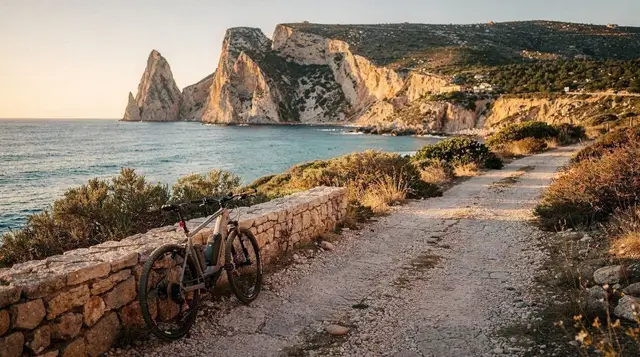
a mountain bike tour of the Sinis Peninsula is a good way to cover the peninsula’s beaches, salt flats and viewpoints in a single half-day if you’d rather not plan the driving yourself. Read Tharros archaeological site in full before you go — opening hours and ticket prices change seasonally.
Cabras, the lagoon and bottarga
Between Oristano and the Sinis coast lies Cabras, a lagoon town whose economy still runs on fishing the Stagno di Cabras — a shallow brackish lagoon that separates the town from the peninsula and regularly attracts flamingos, herons and other waterbirds close enough to see from the causeway road. Cabras is the source of Sardinia’s best bottarga, cured grey mullet roe, produced by local fishing cooperatives using techniques barely changed in generations. See the bottarga of Cabras for where to buy it and how it’s actually eaten (grated over pasta, or thin-sliced with olive oil, not as a garnish).
Cabras is also the base for the Museo Civico Giovanni Marongiu, which holds the Giants of Mont’e Prama — a set of monumental Nuragic stone statues, among the oldest large-scale sculpture found anywhere in the western Mediterranean, discovered in a field nearby in 1974 and only fully excavated decades later. See the Giants of Mont’e Prama for the full story of the find and where the statues are displayed today.
Costa Verde: the dunes south of Oristano
An hour south of Oristano, Costa Verde is a different landscape again — a stretch of wild, largely undeveloped coast dominated by Europe’s tallest coastal dune system at Piscinas, where sand rises in places to over 60 metres and shifts visibly year to year. an off-road trip to the Costa Verde dunes is the practical way to see the area properly, since the tracks in are unsealed, easy to misjudge in a normal rental car, and genuinely rough after rain. If you’d rather drive yourself, read Piscinas first for road conditions and where the marked parking actually is.
For a wider comparison of west-coast sand beyond Sinis and Costa Verde, best beaches in west Sardinia ranks the options by crowd levels and how easy each one is to reach without a 4x4.
Barumini and the interior
Oristano also works as a base for Barumini and the Su Nuraxi nuraghe, Sardinia’s only UNESCO World Heritage Site and the best-preserved Bronze Age nuraghic complex on the island, roughly 50 minutes east through the Marmilla hills. It’s an easy half-day round trip, ideally timed for a morning slot before the site gets hot and busy. Full detail, including how to book ahead in summer, is in the Su Nuraxi Barumini guide.
Combine an inland day like this with a coastal one and Oristano starts to look less like a stopover and more like the most efficient single base on the whole west coast — see day trips from Oristano for a fuller list, and the west coast Sardinia 7-day itinerary for how it fits into a longer trip.
Oristano as a base: three ways to split your time
Not every traveller wants to sleep in the same place every night. This is roughly how the three obvious bases on this stretch of coast compare.
| Base | Best for | Trade-off |
|---|---|---|
| Oristano town | Restaurants, a real evening out, easy day trips in every direction | Not beachfront — 20+ minutes to the sea every day |
| Sinis coast (San Giovanni di Sinis / Marina di Torregrande) | Waking up near Is Arutas and Tharros | Thin on restaurants and nightlife outside July–August |
| Costa Verde (Torre dei Corsari / Marina di Arbus) | Wild dunes, quiet beaches, off-road scenery | Furthest from everything else, roads slower than they look on a map |
Most visitors get the best result splitting a week roughly two-thirds in Oristano and a night or two on the coast, rather than committing fully to either.
Getting to and around Oristano
Oristano sits directly on the SS131, Sardinia’s only genuine dual-carriageway, which makes it unusually well connected for a town of its size: Cagliari is about 95km and 1 hour 10 minutes south, and Sassari is around 100km and just over an hour north. There’s no airport in Oristano itself — Cagliari-Elmas (CAG) is the nearest, and most visitors either fly into Cagliari and drive north or add Oristano onto a longer west-coast route from Alghero-Fertilia. A car is close to essential: renting a car in Sardinia covers what to expect on price and road conditions, and without one the Sinis beaches and Costa Verde in particular become very difficult to reach on any kind of schedule.
Within the old town itself, everything is walkable — Piazza Eleonora d’Arborea, the Duomo and the tower are all within a five-minute radius of each other, and parking is easiest at the free lots just outside the historic centre rather than trying to find a space on the narrow central streets.
Frequently asked questions about visiting Oristano
How many days do you need in Oristano?
Two to three days covers the old town plus day trips to Sinis and either Costa Verde or Barumini without rushing. If you only have one night, prioritise a Sinis beach in the morning and the old town in the evening, and accept you’ll leave Costa Verde and Barumini for a return trip.
Is Oristano on the sea?
Not directly — the town sits on the edge of the Stagno di Cabras lagoon system, a few kilometres inland from the open coast. The nearest sea beaches are around Marina di Torregrande, 8km west, though the better sand at Is Arutas and Mari Ermi is another 15 minutes beyond that on the Sinis Peninsula.
What’s the best month to visit Oristano and the Sinis coast?
May, June and September give warm sea temperatures without the July–August crowds and price spikes that hit the Sinis beaches hardest. If the Sartiglia carnival dates line up with a February or March trip, it’s worth prioritising over beach weather entirely — it doesn’t repeat outside its fixed carnival dates.
Can you see Is Arutas and Tharros in the same day?
Yes — they’re about 10 minutes apart by car on the Sinis Peninsula, and both are within 30–35 minutes of Oristano. A sensible order is Tharros first thing in the morning before the site gets hot, then Is Arutas or Mari Ermi for the rest of the day.
Do you need a car to visit Oristano and the Sinis Peninsula?
Effectively yes. Local ARST buses run to some Sinis villages but the schedule is thin outside summer and doesn’t reach beaches like Is Arutas conveniently. If you’re not driving, renting a car in Sardinia explains what to expect on price, and picking up in Cagliari or Oristano itself is usually the simplest option.
Is Oristano safe and easy for a first-time visitor to Sardinia?
Yes — it’s a low-key, low-crime provincial town with no particular tourist-scam issues, and English is spoken at hotels and the main restaurants even though it’s less common on the street than in Cagliari or Alghero. The main practical thing to plan around is that most shops and some restaurants close for a long midday break, typically 1pm to 4:30pm.
How does Oristano compare to Cagliari as a base for west Sardinia?
Cagliari is bigger, has an airport, and works better if you also want a city break with nightlife and a wider restaurant scene. Oristano is smaller and quieter but sits far closer to the Sinis Peninsula and Costa Verde — Cagliari to Is Arutas is over an hour, against 20–25 minutes from Oristano — so it’s the more efficient base specifically for west-coast beaches and archaeology.
Ready to see the west coast from Oristano rather than just drive past it — book a full-day tour from Oristano covering the Sinis Peninsula’s highlights and let someone else handle the driving and the unsealed tracks.