Freediving in Sardinia
Where is the best freediving in Sardinia?
Capo Caccia and the Alghero coastline are the most established freediving destinations, thanks to deep water close to shore, strong underwater visibility and a cluster of schools running AIDA-certified courses. The Gulf of Orosei and La Maddalena archipelago are also popular with experienced freedivers for their clarity and dramatic underwater topography.
Freediving — descending on a single breath, without tanks — has quietly built a following in Sardinia over the past decade, drawn by the same water clarity that makes the island’s scuba diving and snorkelling so good, plus a coastline that drops off quickly enough in places to give serious depth close to shore. It’s a much smaller scene than scuba diving here, with fewer dedicated schools, but the ones that exist are competent, and the natural conditions are genuinely among the best in the western Mediterranean for the sport.
Part of what draws serious freedivers here specifically, rather than to better-known apnea destinations further afield, is the combination of depth and accessibility: unlike tropical blue holes or fjords that require significant travel and logistics to reach, Capo Caccia’s wall and the Gulf of Orosei’s cliffs are a short walk or boat ride from ordinary tourist infrastructure, meaning a dedicated freediving trip here doesn’t demand the same isolation or specialist travel planning that the sport’s most famous locations do.
| Best areas | Capo Caccia and Alghero, Gulf of Orosei, La Maddalena archipelago |
| Cost | €90-150 for an introductory apnea course or guided session |
| Visibility | Typically 15-25m+ in calm summer conditions, among the best in the Mediterranean |
| Best time | June to September for warm water; experienced freedivers also go in shoulder months with a thicker suit |
Why Sardinia suits freediving
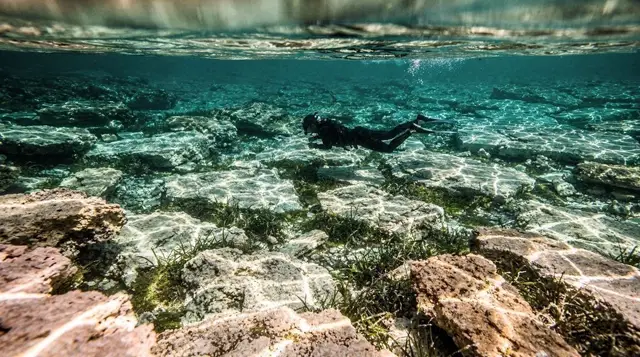
Freediving rewards two things above all: water clarity, so a diver can see and orient themselves at depth without artificial light, and a coastline that reaches meaningful depth without a long swim out. Sardinia has both in places most beach destinations don’t. The limestone cliffs of Capo Caccia drop almost vertically into water that regularly exceeds 20m visibility in summer, and the Gulf of Orosei’s sheer coastline does something similar further east, giving freedivers rapid access to depth without the long surface swims that make freediving tiring and less enjoyable elsewhere.
Capo Caccia and Alghero
This is the established centre of the sport on the island. The same headland that draws cave divers and scuba schools to Alghero offers freedivers a dramatic wall that drops well past recreational scuba depths, giving experienced apnea divers a genuine sense of open water rather than a shallow bay. Local dive operations that run scuba trips here also cater to freedivers on request, and a guided session with instructors familiar with the site’s currents and depth changes is the sensible way to explore it rather than going independently:
Guided diving with local professionals at Capo Caccia, suitable for apnea sessionsFor anyone starting from scratch, an introductory diving experience with instructors who can accommodate a freediving-curious beginner is a reasonable first step before committing to a dedicated apnea course:
Introductory diving experience in AlgheroThe Gulf of Orosei
The Golfo di Orosei’s roadless limestone coastline, covered in detail in the Gulf of Orosei boat trips guide, is one of the most photogenic stretches of water in Sardinia and a serious draw for experienced freedivers who bring their own gear and local knowledge, since there are fewer dedicated schools operating out here than in Alghero. The coves around Cala Gonone and Baunei offer both shallow, sheltered practice water close to shore and rapid access to real depth just beyond it, though anyone unfamiliar with the coastline should treat this as a place to freedive with a local guide or an experienced group rather than solo.
La Maddalena archipelago
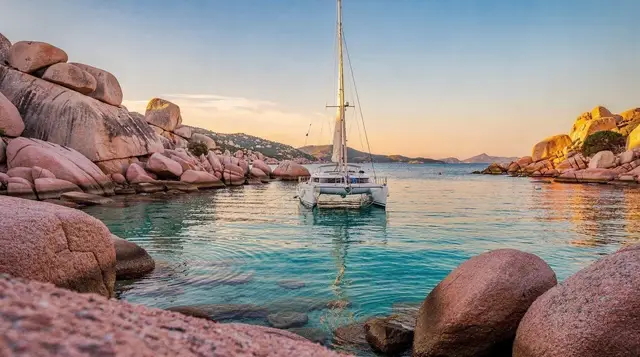
The granite islands and channels around La Maddalena offer a different kind of freediving to the sheer walls of Capo Caccia — shallower on average, with boulder fields, eelgrass beds and a maze of channels between islands that reward slow, exploratory apnea over deep vertical descents. It’s a good complement to a Capo Caccia trip if you’re spending time in the north of the island, and the marine park’s protected status means the fish life here is noticeably richer than in less regulated waters.
The physiology of a first breath-hold
Freediving courses spend a surprising amount of time on dry land before anyone gets in the water, and for good reason: breath-hold ability has far more to do with relaxation and technique than with lung capacity or fitness, which is why unfit beginners often outperform triathletes on their first static breath-hold attempt. Instructors teach specific breathing patterns to relax the body before a dive, techniques for equalising ears that differ from scuba equalisation because there’s no tank pressure assisting the process, and — critically — how to recognise the body’s own warning signs long before a genuine emergency develops.
Understanding the mammalian dive reflex, the body’s automatic response to submersion that slows the heart rate and redirects blood flow, is typically covered in the theory portion of any proper introductory course, and it explains why breath-holds that feel impossible on land become manageable once you’re actually in the water.
The competitive and community scene
Freediving in Sardinia isn’t purely a tourist activity; the island has a modest but genuine competitive freediving community, with informal training groups based mainly around Alghero and occasional depth competitions held in the deep water off Capo Caccia when conditions allow.
Visiting freedivers with some experience often find it worth reaching out to local clubs directly, since informal training sessions and shared boat trips to deeper water are sometimes more accessible through word of mouth than through a standard tourist-facing school. This community is small compared to established freediving hubs like Dahab in Egypt or Kalamata in Greece, but the quality of the water and the willingness of local freedivers to share knowledge more than compensates for the smaller scale.
Safety equipment and protocols
Serious freediving groups use a weighted safety line with depth markers, a buoy on the surface, and a dedicated safety diver whose only job is watching the freediver rather than diving themselves, protocols that any proper introductory course will introduce even at modest depths.
A dive computer designed for freediving, distinct from a scuba computer, is standard equipment for anyone progressing beyond casual apnea, tracking depth, dive time and surface intervals to avoid the cumulative fatigue that contributes to blackout risk on repeated dives. None of this equipment is expensive relative to scuba gear, but skipping it in favour of “just going for it” with a beach towel and a rough idea of technique is exactly the kind of shortcut that turns freediving’s excellent underlying safety record into a personal statistic.
Courses for beginners
An introductory apnea course, typically following AIDA or a comparable federation’s beginner syllabus, covers breathing technique, equalisation, safety protocols and a first supervised series of dives to modest depth, usually over a half-day or full-day session. Expect to pay roughly €90-150 for a group introductory session, more for private one-on-one instruction. Unlike scuba, freediving courses put heavy emphasis on relaxation and breath-hold technique on the surface before any real depth work happens, so a first session often involves more time practising breathing patterns than actually swimming.
Freediving versus scuba and snorkelling
Freediving sits between snorkelling and scuba in terms of commitment: it needs more technique and breath-hold training than snorkelling, but far less equipment and none of scuba’s decompression constraints, which is part of its appeal to experienced water people. If you’re not sure which suits you, a guided snorkelling trip around a site like Capo Caccia is a reasonable low-commitment way to see whether you’re drawn to going deeper on a single breath:
Guided snorkelling tour of the Capo Caccia cliffsFor divers who’d rather use tanks, the full diving guide and trying scuba diving for the first time cover the equivalent scuba-based routes into the same waters.
Respecting the marine environment while freediving
Freedivers spend more time in close proximity to marine life than almost any other water sport participant, simply because the absence of bubbles and tank noise lets fish and other creatures behave naturally rather than fleeing on approach.
That proximity comes with a responsibility to avoid touching coral, sea fans or resting marine animals, and to maintain distance from any protected species encountered, particularly within the marine reserves around Capo Caccia and La Maddalena where disturbance rules are actively enforced. Reputable schools build this etiquette into their briefings as a matter of course, treating respectful observation as part of good technique rather than a separate environmental lecture tacked onto the end of a lesson.
When to go
June to September brings the warmest water (22-26°C at the surface, cooler at depth even in summer) and the calmest conditions for both training and open-water sessions. Experienced freedivers do dive the shoulder months and even winter with a thicker wetsuit, since the sport doesn’t rely on boat charters the way scuba often does, but course availability drops sharply outside the main season as schools scale back. If flexibility matters more to you than crowd levels, September offers close to peak-season water temperature with noticeably fewer people in the water.
Combining freediving with photography
Freediving’s silent, bubble-free approach makes it a favourite technique among underwater photographers documenting marine life that would otherwise scatter at the sound of scuba bubbles, and Sardinia’s clear water and healthy fish populations around its marine protected areas make it a genuinely good location for this kind of photography.
Groupers, moray eels and schools of barracuda are all considerably easier to approach on a breath-hold dive than with a tank, and several photography-focused freediving workshops run periodically around Capo Caccia and La Maddalena for visitors specifically interested in this combination. Even without formal photography training, a waterproof camera and patience go a long way toward capturing the kind of close encounters that make freediving so appealing to experienced water photographers.
What a typical training day looks like
A structured freediving day, whether on a course or with an experienced training group, typically starts with dry breathing exercises on land, moves to static breath-hold practice floating at the surface, and only then progresses to actual depth work with a buddy and safety line.
This gradual build-up isn’t just for beginners; even experienced freedivers warm up this way before a serious depth attempt, since jumping straight into deep breath-holds without preparation increases both discomfort and risk. A full session, including the land-based warm-up, commonly runs two to three hours, considerably less time actually submerged than the overall session length might suggest, which surprises some first-time participants expecting a more continuous, active experience.
Packing for a freediving trip
Beyond the core kit of fins, mask and wetsuit, a few smaller items make a real difference to a freediving trip in Sardinia specifically. Neoprene socks or reef shoes are worth bringing for entries and exits over rocky ledges around Capo Caccia and the Gulf of Orosei, where a smooth sandy beach entry isn’t always available.
A nose clip is unnecessary for most freediving technique, which relies on manual equalisation rather than a sealed nose, but some divers find nose plugs useful for comfort during long surface intervals in choppy water. Lastly, a nutrition and hydration plan for the day matters more than it might for a casual swim — a full day of repeated breath-holds is genuinely more physically demanding than it looks from the surface, and arriving under-hydrated or under-fed noticeably shortens both comfort and safe performance.
Frequently asked questions about freediving in Sardinia
Do I need a certification to freedive in Sardinia?
Not legally for casual, shallow apnea with a buddy, but a proper introductory course is strongly recommended before attempting any real depth, both for technique and for safety training around blackout risk.
Is Capo Caccia safe for beginner freedivers?
The site itself is excellent, but its depth and occasional current make it better suited to guided sessions than independent beginner practice; start with a local instructor.
How deep can a beginner freedive safely?
Introductory courses typically work in the 5-10m range initially, building depth gradually under supervision rather than pushing for maximum depth in a first session.
Can I freedive and scuba dive on the same trip?
Yes, but not on the same day without a significant gap — freediving soon after a scuba dive increases decompression sickness risk due to residual nitrogen.
Is the Gulf of Orosei good for beginners?
It’s better suited to intermediate or experienced freedivers given the more remote, boat-dependent access; Alghero has more structured beginner-friendly options.
What equipment do I need?
A long freediving fin, a low-volume mask, a wetsuit appropriate to the season, and a weight belt sized correctly for buoyancy — most schools rent all of this for course participants.
Is freediving cheaper than scuba diving?
Generally yes for equipment and ongoing costs, since there’s no tank, compressor or regulator servicing involved, though introductory course prices are broadly similar to a scuba try-dive.
What is shallow-water blackout and how common is it?
It’s a loss of consciousness caused by falling oxygen levels near the surface at the end of a breath-hold, made more likely by hyperventilating beforehand. It’s rare among trained freedivers using a buddy system correctly, which is precisely why proper training and never diving alone are emphasised so heavily.
Can I combine freediving lessons with spearfishing?
Some schools offer combined courses, though spearfishing in Sardinia’s marine protected areas is restricted or banned entirely in core zones, so check local rules for the specific area before planning a trip around it.
Is there a minimum age for freediving courses?
Most schools set a minimum age around 12-14 for structured introductory courses, with full open-water certification typically starting from 16 in line with most training agencies’ policies.
Diving & snorkelling tours on GetYourGuide
Verified deep-linked GetYourGuide tours. Book through these links and we earn a small commission at no cost to you.
These are our own photographs of Sardinia, not the operator's pictures of this tour — open the tour page to see those.