Spiaggia del Principe, the Costa Smeralda's most private-feeling beach
Why is Spiaggia del Principe called that?
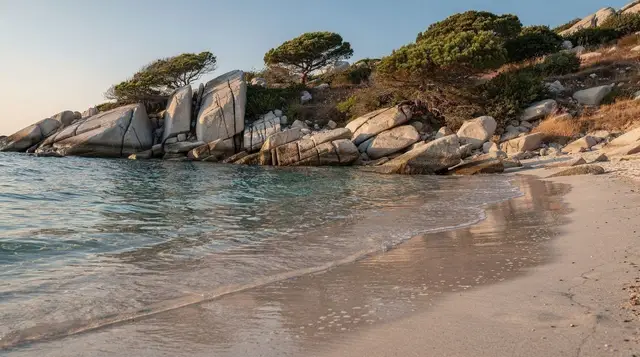
It was reportedly the Aga Khan's own favourite beach when he began developing the Costa Smeralda in the 1960s, hence 'the prince's beach'. It's a public beach today, reached by two unpaved access roads north of Porto Cervo, with granite outcrops sheltering a bay of pale sand and turquoise water.
Spiaggia del Principe sits a few kilometres north of Porto Cervo on the Costa Smeralda, a broad bay of pale granite-sand hemmed in by pink-tinged rock formations that give the whole area its trademark colour palette. The name — “the prince’s beach” — refers to the Aga Khan, whose development consortium transformed this stretch of coast from scrubby, undeveloped shoreline into Sardinia’s most exclusive resort area starting in the 1960s; this was reportedly the beach he was drawn to first, before any of the villas and marinas existed.
| Where | Costa Smeralda, north of Porto Cervo |
| Cost | Free beach access; parking a few euros, sunbed hire optional and pricier than elsewhere |
| Time needed | Half a day |
| Getting there | Car via unpaved access roads from the Porto Cervo-Liscia di Vacca road, or by boat |
| Best time | Weekday mornings in July-August; June and September for a genuinely quiet visit |
A beach that still looks the way the Aga Khan found it
What distinguishes Spiaggia del Principe from a lot of the Costa Smeralda’s more manicured coastline is how little has been built around it. There’s no promenade, no row of beach clubs, and no marina in sight — just granite boulders, low juniper scrub, and a bay that curves gently enough to feel sheltered without losing the open sea view. The relative lack of development isn’t an accident; much of the immediate hinterland remains protected, which has kept the beach closer to its 1960s condition than almost anywhere else on this coast.
Getting there
Two unpaved access roads reach the beach from the main road connecting Porto Cervo to Liscia di Vacca, both signposted but narrow enough that traffic can back up on peak August days. Parking is informal and limited, priced at a few euros where attendants operate a paid area; arriving before mid-morning is the reliable way to find space close to the beach rather than facing a longer walk in from an overflow area. There’s no public bus service to Spiaggia del Principe specifically, so a car — or a boat — is effectively required; see renting a car in Sardinia for the practicalities of self-driving this stretch of coast.
Both access roads are unsurfaced for their final stretch, fine for an ordinary hire car in dry conditions but worth navigating slowly given the loose gravel and occasional pothole. The walk from the car park to the sand itself is short, a few minutes at most, over a mix of sandy track and low scrub rather than anything technical.
Seeing it by boat instead
Given the parking constraints, a lot of visitors reach Spiaggia del Principe — and the string of similarly striking coves further along the Costa Smeralda — by boat instead. A private boat tour with snorkelling stops covers this stretch of coastline at a more relaxed pace than a car-based visit allows, anchoring offshore rather than competing for a parking space:
Private boat tour of the Costa Smeralda with snorkellingA shared dinghy tour from Olbia is the lower-cost version of the same idea, taking in several of the coast’s best-known beaches in a single half-day or full-day outing:
Dinghy tour of the Costa Smeralda’s best beaches from OlbiaFor visitors who’d rather stay on dry land but still want a guided overview of the coastline’s history and viewpoints, a half-day guided tour from Olbia covers Porto Cervo, Porto Rotondo and the beaches between them by road:
Half-day guided tour of the Costa Smeralda from OlbiaFacilities at the beach itself
Spiaggia del Principe has no permanent buildings on the sand — no fixed toilets, no bar directly on the beach — so anyone planning a full day should bring water and snacks rather than expecting to buy them on-site. A seasonal snack van sometimes operates near the main car park in July and August, but it isn’t guaranteed, and the nearest proper toilets and restaurants are back in Porto Cervo or along the access road itself.
Wind and the best conditions to visit
Spiaggia del Principe’s bay faces a direction that offers reasonable shelter from the prevailing mistral, but like most of the Costa Smeralda’s coastline it can still turn choppier than expected on a windy afternoon, particularly from midday onward as thermal winds tend to build through the northeast in summer. Morning visits are the more reliable choice for calm water as a result, a pattern that holds across most of this stretch of coast rather than being specific to this one beach. Sardinia’s mistral wind guide has more on how wind timing affects beach conditions across the island generally.
What it costs to spend a day here
Spiaggia del Principe itself is free to access, but the Costa Smeralda’s general price level shows up in everything around the beach: sunbed and umbrella hire, where available, tends to run noticeably higher than the equivalent in Chia or Villasimius further south, and the handful of beach bars nearby price accordingly. Bringing your own umbrella and lunch is the straightforward way to avoid the area’s premium, a strategy that applies across most of the Costa Smeralda rather than this beach specifically.
The Aga Khan’s development and how it shaped this coast
The Costa Smeralda’s transformation began in 1962, when Karim Aga Khan IV and a consortium of investors bought up a substantial stretch of then-undeveloped Gallura coastline and began building what became one of the Mediterranean’s most exclusive resort areas.
The development imposed strict architectural rules from the outset — low-rise buildings in muted, locally sourced stone, generous green space between structures, no visible advertising — that still govern construction today and are a big part of why the coast reads as considerably less built-up than its reputation for wealth might suggest. Spiaggia del Principe sat outside the immediate footprint of the earliest villas and marinas, which is part of why it retains more of its original character than beaches directly adjacent to Porto Cervo’s centre.
The granite formations and why they turn pink
The distinctive rock formations framing Spiaggia del Principe and much of the Costa Smeralda’s coastline are granite, weathered over millions of years into smooth, rounded boulders rather than sharp outcrops — a process driven by a combination of chemical weathering and the wind erosion common across this exposed northeastern corner of the island.
The pink tinge that gives the coast its recognisable colour comes from feldspar minerals within the granite, most visible at sunrise and sunset when low-angle light catches the rock directly; photographers specifically time visits around those windows for that reason. The same granite formations continue along much of Sardinia’s northeast and appear again, in a different context, around La Maddalena archipelago further north.
A realistic day plan
Arrive early, ideally before 10am, both for parking and to see the beach before the day’s boat traffic and car arrivals build up. Spend the morning swimming and exploring the granite formations at either end of the bay, then either continue by boat further along the coast toward Porto Cervo and Liscia di Vacca, or head back into Porto Cervo itself for lunch — pricier than most of the island, but a reasonable one-off for the marina views and people-watching that are as much a part of the Costa Smeralda experience as the beaches themselves.
Afternoon light is generally considered less flattering for photography here than morning, given the bay’s orientation, so visitors prioritising photographs are better served by an early start than a late one.
Nearby beaches worth comparing
The Costa Smeralda has several beaches within a short drive of Spiaggia del Principe, each with a slightly different character — from the more sheltered coves around Porto Cervo to the broader sands near Porto Rotondo and Baja Sardinia. The Costa Smeralda boat tours guide covers how operators typically string several of these beaches together for visitors who want to sample more than one in a day rather than committing to just this one.
What a day here realistically costs
Beyond the free beach access and modest parking fee, most costs at Spiaggia del Principe come down to choices rather than necessities: skipping sunbed hire and bringing your own umbrella and lunch keeps a visit close to the cost of parking alone, while a full day with rented sunbeds, drinks at a beach bar and lunch at a Porto Cervo restaurant can easily run well over €100 per person, reflecting the area’s overall price level rather than anything specific to this beach. Travellers keeping a tighter Costa Smeralda budget generally do best treating this as a self-catered beach day and saving restaurant spending for a single, deliberately chosen meal in Porto Cervo rather than every stop along the coast.
Getting around the wider Costa Smeralda
A car remains the most flexible way to move between the Costa Smeralda’s scattered beaches and villages, though the roads here are narrow, winding and often busier than their width suggests in peak season — average driving speeds well below the island’s already-modest 60km/h norm are common on the coastal lanes north of Porto Cervo. See driving in Sardinia for the wider context, and is the Costa Smeralda worth it for an honest look at whether the area’s reputation and prices match the actual experience.
Snorkelling around the granite outcrops
The rocky edges of Spiaggia del Principe’s bay offer better snorkelling than the open, sandy centre — small fish shelter in the crevices between granite boulders, and the water stays clear even when the middle of the bay picks up some churn from swimmers and passing boats. It’s not a marine reserve in the way Capo Carbonara near Villasimius is, so don’t expect the same density of marine life, but it’s a reasonable way to spend an hour beyond simply swimming and sunbathing. Best snorkelling spots in Sardinia has the wider island comparison for anyone planning snorkelling stops as a specific priority.
Combining a beach day with Porto Cervo’s marina
Porto Cervo’s marina, a short drive south of Spiaggia del Principe, is worth a visit in its own right even for travellers with no interest in the yachts moored there — the piazzetta at its centre has a genuinely pleasant, low-key atmosphere outside the height of the evening see-and-be-seen hours, and several of the area’s better restaurants and shops cluster around it. Pairing a morning at Spiaggia del Principe with an afternoon wander around the marina and a late lunch is one of the more efficient ways to see two sides of the Costa Smeralda’s reputation — the natural coastline and the built resort — in a single day without excessive driving.
When to go
Late June and September offer the most favourable balance on the Costa Smeralda generally: warm enough water, considerably lower prices than peak August, and far less parking pressure at beaches like this one. July and especially August bring the coast’s famous nightlife and social scene into full swing, but also its highest prices and busiest beaches. See Sardinia in June and best time to visit Sardinia for the fuller seasonal picture.
Frequently asked questions about Spiaggia del Principe
Is Spiaggia del Principe a private beach?
No, it’s a public beach, despite the exclusive reputation of the surrounding area — anyone can access it via the two unpaved roads or by boat, though facilities and sunbed hire are priced at Costa Smeralda levels.
Is there an entry fee?
No entry fee applies to the beach itself; the only cost is informal parking, typically a few euros, or optional sunbed hire.
How do I get there without a car?
The most practical car-free option is a boat tour or dinghy rental from Olbia, Porto Cervo or Palau, since no public bus reaches the beach directly.
Is Spiaggia del Principe good for swimming?
Yes, the bay is sheltered and the water shallows gradually near the shore, making it comfortable for swimming in typical Costa Smeralda summer conditions.
What’s the best time of day to visit?
Early morning, both for parking availability and for softer light on the pink-granite rock formations that frame the bay.
How does it compare to other Costa Smeralda beaches?
It’s generally considered one of the more naturally scenic and least developed beaches on this stretch of coast, with fewer facilities than beaches closer to Porto Cervo’s marina but a correspondingly quieter, more open feel outside peak hours.
Why does the rock look pink?
The granite that frames the bay contains feldspar minerals that catch a pink tone in low-angle light, most visible at sunrise and sunset — the same effect seen at several points along the Costa Smeralda and further north toward La Maddalena.
Is Spiaggia del Principe expensive to visit?
The beach itself is free; the expense, if any, comes from sunbed hire or food and drink at nearby bars, both priced at typical Costa Smeralda levels, noticeably higher than the island average.
Beach & coastal tours on GetYourGuide
Verified deep-linked GetYourGuide tours. Book through these links and we earn a small commission at no cost to you.
These are our own photographs of Sardinia, not the operator's pictures of this tour — open the tour page to see those.