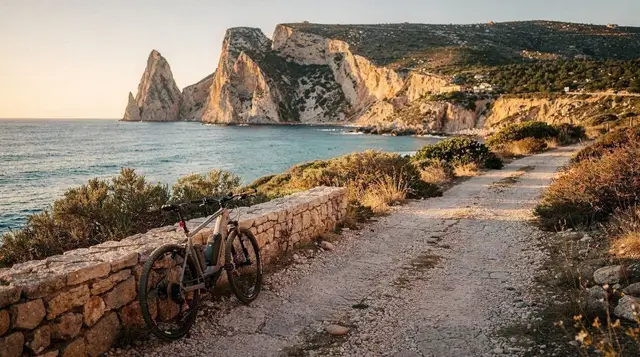
eSIM and mobile data in Sardinia
Do I need an eSIM or physical SIM for Sardinia?
EU citizens with an EU mobile plan don't need anything extra — roam-like-home rules mean your normal data allowance works across Sardinia. Non-EU visitors, or EU visitors who want a dedicated data-only plan, are usually better off with an eSIM bought before arrival than queuing at an airport phone shop.
Why connectivity matters more here than on a typical city break
Sardinia’s trips lean heavily on driving between towns, beaches and trailheads rather than staying within a single walkable centre, which makes reliable maps and navigation more central to the day than on a typical European city break.
Beach-quota bookings for places like La Pelosa and Cala Goloritzé are also managed digitally, sometimes checked on-site by staff scanning a phone screen, so a dead phone or no signal at the wrong moment is a bigger practical problem here than it would be at, say, a museum with a printed ticket. Sorting connectivity properly before you land removes one of the more common sources of low-level friction on an island where a car is doing most of the work of getting you around.
Start with whether you actually need anything
If you’re travelling from another EU country on an EU mobile contract, “roam like home” rules mean your existing data allowance simply works in Sardinia at no extra charge, up to your plan’s fair-use cap — most visitors from France, Germany, Spain and elsewhere in the EU need to do nothing at all. Everyone else — UK visitors post-Brexit roaming changes, US, Canadian, Australian and other non-EU travellers, or EU visitors who’ve hit their roaming cap — needs either a physical Italian SIM or an eSIM. This guide covers both, plus the coverage gaps worth planning around regardless of which you choose.
| Option | Cost (2026) | Setup | Best for |
|---|---|---|---|
| EU roaming (existing plan) | Included, within fair-use cap | None | EU residents with an EU contract |
| eSIM (data-only) | €4-15 for 5-20GB, 7-30 days | Install before you fly | Non-EU visitors, short trips, dual-SIM phones |
| Physical Italian SIM | €10-25 + credit | Buy in-store, needs passport | Longer stays, need a local number |
| Airport wifi / hotel wifi | Free-low cost | None | Backup only, not a primary plan |
How to set up an eSIM before you fly
The process is simpler than it sounds, but it’s worth doing before you leave rather than at the airport with patchy wifi. First, confirm your phone is eSIM-compatible and unlocked for additional profiles — check your device settings or your home carrier’s site if you’re unsure, since a small number of carrier-locked phones, particularly some US models, block extra eSIM profiles even on otherwise compatible hardware. Second, buy a plan sized to your trip length and expected data use, choosing a provider that covers Italy specifically (some plans are Europe-wide, others Italy-only — either works for Sardinia, but region-wide plans cost more for the same data).
Third, install the eSIM profile while you still have wifi — it downloads and activates in a few minutes — and most providers let you activate the actual data plan only once you land, so you’re not burning days of a fixed-length plan while still at home. Keep your existing home SIM in place for calls and texts if you need to stay reachable on your usual number; the eSIM runs as a second, data-only profile alongside it.
eSIM is the simplest option for most non-EU visitors
An eSIM installs digitally before you travel, activates the moment you land, and avoids both the airport-kiosk queue and the hassle of swapping a physical SIM out of your home number. Coverage on Italian eSIM providers runs on the same underlying networks — TIM, Vodafone, WindTre — as physical SIMs, so there’s no practical downside in signal quality. The main things to check before buying: confirm your phone supports eSIM (most phones from the last five years do, but not all US carrier-locked models), and buy a plan sized to your trip length rather than over-buying data you won’t use in a week.
Physical SIMs: still an option, with more friction
TIM, Vodafone, WindTre and Iliad all have shops in Cagliari, Olbia and Sassari, and kiosks at Cagliari-Elmas and Olbia Costa Smeralda airports, though Alghero-Fertilia’s options are more limited. A prepaid SIM with a reasonable data allowance runs roughly €10-25 including a starter data bundle, but requires your passport for registration by Italian law, and airport queues in July and August can run 20-30 minutes. This route makes more sense than an eSIM mainly if you need a genuine Italian phone number for the trip, rather than data only.
Where coverage actually drops out
Sardinia’s coverage is solid in and around every town and along the main roads, but it thins out in three predictable places: deep in the Gulf of Orosei where cliffs block signal from inland towers, the interior mountains around the Supramonte and Gennargentu, and at sea more than a few kilometres offshore.
If a boat trip is part of your plan — anything from an Oristano day trip along the coast to the half-day guided tour of Costa Smeralda from Olbia — assume you’ll lose signal for stretches and download offline maps and any booking confirmations before you leave port. The same applies for hiking routes like the descent to Cala Goloritzé, where a missed turn without offline maps is a genuine inconvenience rather than a minor one.
Combining Sardinia with a multi-country trip
If Sardinia is one stop on a wider Mediterranean trip — paired with a ferry crossing to Corsica, covered in Sardinia versus Corsica, or onward travel to mainland Italy — a regional eSIM plan covering multiple countries can work out cheaper and simpler than buying separate country-specific plans for each leg. The trade-off is usually a slightly higher per-GB cost than an Italy-only plan, so it’s worth doing the maths on your specific itinerary: for a trip spending the bulk of its time in Sardinia with only a short Corsica day trip, an Italy-only eSIM topped up if needed usually beats a full regional plan on price.
Wifi as a backup, not a plan
Hotels, agriturismi and most restaurants in towns offer free wifi, generally reliable in Cagliari, Alghero and Olbia and more variable in rural stays — some agriturismi in the interior have genuinely weak connections given their remote settings. Treat hotel wifi as a backup for uploading photos or a video call rather than your only connectivity option, since it won’t help while you’re out for the day, which is where most of a Sardinia trip actually happens.
Data needs for a typical trip
For most travellers, 1-2GB per day covers maps, messaging, some photo uploads and occasional browsing without heavy streaming — a week-long trip comfortably fits an 8-15GB eSIM plan. If you plan to stream music or video regularly, or work remotely for part of the trip, size up accordingly; data top-ups are usually available within the same eSIM app if you underestimate.
Working remotely from Sardinia
Sardinia has become a genuine option for short remote-work stints, particularly in and around Cagliari and Alghero, where cafés and co-working-friendly spots have reasonably fast wifi. For anything call-dependent or requiring guaranteed uptime, a higher-tier eSIM plan as a mobile hotspot backup is worth the extra cost over relying on a single wifi connection, especially in smaller towns where a single provider outage can take out a café’s whole connection for hours. Avoid scheduling video calls during a planned boat trip or hiking day in the interior — those are exactly the windows where connectivity is least reliable, covered above.
Comparing Sardinia’s coverage to mainland Italy
Visitors arriving from mainland Italy sometimes assume coverage will match what they’re used to in Rome or Milan, and in the main towns it broadly does — Cagliari, Olbia, Sassari and Alghero all have coverage comparable to a mid-sized mainland Italian city. The gap appears specifically in Sardinia’s more remote interior and along undeveloped stretches of coast, which are considerably more extensive relative to the island’s size than equivalent rural gaps on the mainland. This isn’t a reason to avoid an eSIM or SIM purchase — it’s a reason to plan around the specific gaps covered above rather than assuming blanket coverage.
Popular eSIM providers and what they actually cost
A handful of eSIM providers dominate the Italy market, and it’s worth knowing roughly what to expect from each rather than picking blind at the app store. Airalo and Holafly are the two most commonly used by visitors to Sardinia: Airalo sells pay-as-you-go data bundles, typically €15-20 for around 10GB valid for two weeks, while Holafly leans toward unlimited-data plans at a flatter rate, often €25-35 for a week, which suits heavy streamers more than the typical maps-and-messaging use most Sardinia trips actually need.
Ubigi and Nomad are two further options worth comparing on price for longer stays, since the per-GB cost usually drops noticeably on plans above 20GB. None of these differ meaningfully on underlying network quality in Sardinia — they all resell capacity from the same three Italian carriers — so the real decision is data allowance and price rather than coverage.
Read the small print on hotspot and tethering permissions, and on any automatic renewal terms, before buying. Some providers default to auto-renewing a plan at full price once the initial period ends, which isn’t always obvious at checkout, and a handful restrict tethering entirely on their cheapest tiers. Comparing two or three providers against your actual trip length and expected data use takes five minutes and usually saves a few euros over just picking whichever app ranks first in search results.
Frequently asked questions about mobile data in Sardinia
Does my UK phone plan work in Sardinia without extra charges?
Not automatically — since Brexit, UK operators can and sometimes do apply roaming charges in the EU. Check your specific provider’s current policy before you travel, since several major UK networks have reintroduced fees.
Is an eSIM better than a physical SIM for a short trip?
Generally yes for trips under two weeks — it’s faster to set up, avoids an in-store queue and passport registration, and costs about the same or less for data-only use.
Does my phone need to be unlocked to use an eSIM in Sardinia?
Not unlocked in the traditional sense, but it does need to be eSIM-compatible and not carrier-locked in a way that blocks additional eSIM profiles — check with your home carrier if you’re unsure, particularly for US phones.
Is there wifi on Sardinia’s ferries and boat tours?
Rarely, and unreliably where it exists — most boat tours and inter-island ferries have patchy or no signal once away from the coast, so treat any connectivity at sea as a bonus rather than a plan.
Will I have signal while hiking in the Gennargentu or Supramonte?
Not reliably — mountainous interior terrain blocks signal in valleys and gorges even where nearby towns have good coverage. Download offline maps before setting out on any interior trail.
How much data do I actually need for a week in Sardinia?
For typical use — maps, messaging, some photos and browsing — 8-15GB comfortably covers a week. Heavy streaming or remote work needs more.
Can I buy a SIM card at Alghero-Fertilia airport?
Options are more limited than at Cagliari-Elmas or Olbia — it’s safer to sort an eSIM before you fly or buy a physical SIM once in Alghero town rather than counting on the airport.
Do I need data at all if I’m staying at one resort the whole trip?
Less than a touring trip, but even resort-based stays benefit from data for maps to nearby restaurants, translation and checking beach-quota bookings if you leave the property at all.
Can I use my eSIM data plan as a hotspot for a laptop?
Most eSIM plans support hotspot/tethering, but check the specific provider’s terms before buying if this matters — a small number of budget plans restrict or throttle hotspot use even when the underlying data allowance is generous.
Is it cheaper to buy a physical Italian SIM in-store than an eSIM online?
Prices are broadly comparable for equivalent data amounts; the eSIM’s real advantage is convenience and time saved rather than being meaningfully cheaper, since both draw on the same underlying Italian networks.
Does Sardinia have 5G coverage?
Yes, in and around the main towns — Cagliari, Olbia, Sassari and Alghero all have reasonable 5G coverage from the major Italian carriers. Rural and interior areas remain largely on 4G, which is more than adequate for maps and messaging.
What happens if I run out of data mid-trip?
Most eSIM providers let you buy a top-up or a fresh plan instantly through their app, without needing a store visit — worth checking your specific provider supports this before you rely on it, particularly if you’re travelling somewhere with unreliable wifi to complete the purchase.
Do I need a VPN while using an eSIM in Sardinia?
Not for normal browsing, but it’s a reasonable precaution for anyone banking or logging into sensitive accounts over unfamiliar wifi networks — an eSIM’s mobile data connection is generally safer than open cafe or hotel wifi for that kind of use anyway.
Does switching to an eSIM affect my phone’s battery life?
Marginally, if at all — running two active profiles, a home SIM plus a data eSIM, uses slightly more power for network searching, but the difference is small enough that it isn’t a practical reason to avoid one on a week-long trip.
Trip-planning essentials on GetYourGuide
Verified deep-linked GetYourGuide tours. Book through these links and we earn a small commission at no cost to you.
These are our own photographs of Sardinia, not the operator's pictures of this tour — open the tour page to see those.